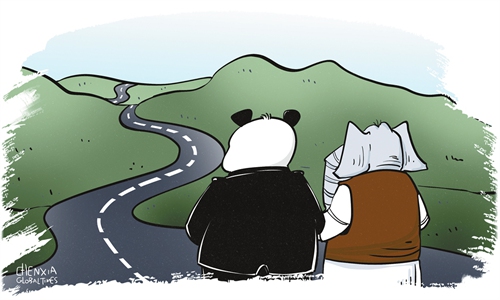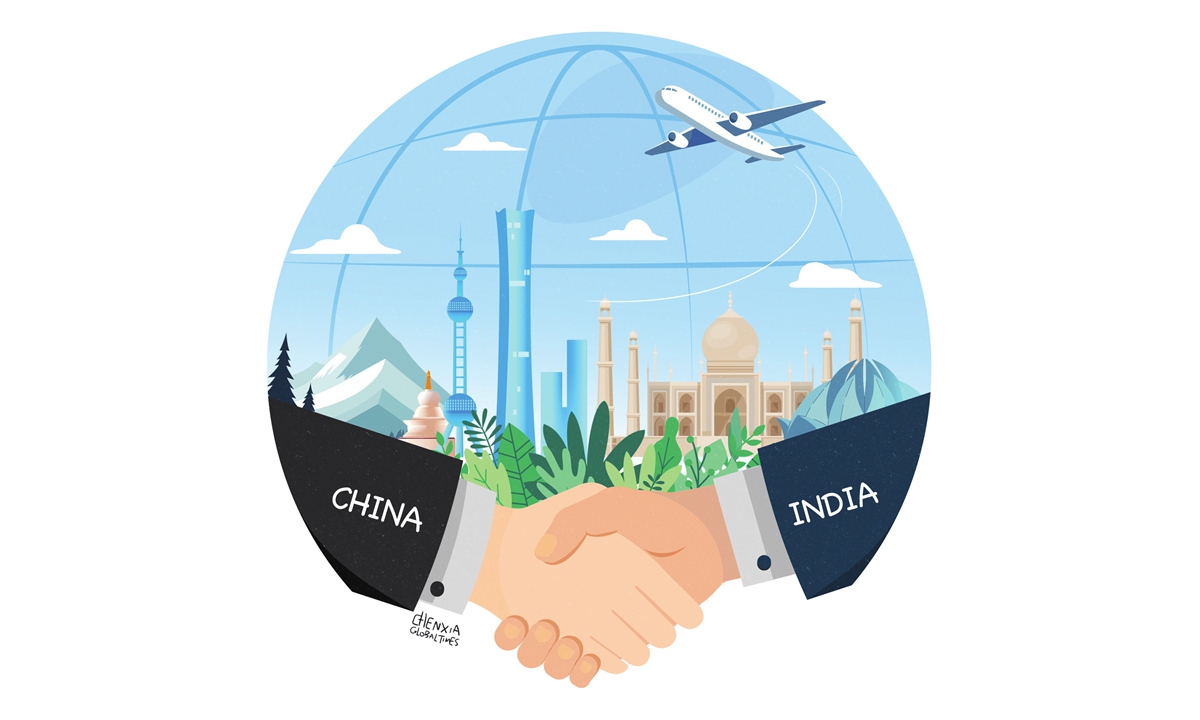
Illustration: Chen Xia/GT
"Hard-won progress should be cherished." This remark in President Xi Jinping's meeting with Prime Minister Narendra Modi in New Delhi instantly caught my attention.For anyone who has closely watched India-China relations over the past several years, the significance of those words is difficult to overstate. As an Indian, I couldn't be happier.
During a two-week visit to China in June and July, I witnessed a small part of this change myself. As an Indian journalist, I experienced the warmth with which Indians are received in China. Ordinary interactions with journalists, officials, academics, and people encountered along the way conveyed a sense that relations between the two countries are entering a different phase.
That is why President Xi's four observations on promoting the steady and sustained development of China-India relations deserve to be seen not merely as diplomatic language, but as a practical roadmap. The first and most important point is that China and India are partners rather than rivals, and development opportunities rather than threats to each other.
This is a proposition that India should embrace with confidence. The two countries are not competitors in every field, nor do their interests always coincide.
However, neither country's development is diminished by the success of the other. China and India have an enormous stake in Asian stability and global economic growth.
As I said during my interactions with my Chinese counterparts, "We are half the world. And half the world cannot remain distant from each other."
The second point - win-win cooperation - is already visible in the economic relationship.
The economic relationship offers the clearest evidence of why deeper engagement makes sense.
India-China merchandise trade has reached a substantial scale, touching $118 billion in 2023-24, according to data from India's Department of Commerce's Annual Report 2024-25. China also remained India's largest source of imports in 2024-25. According to Indian media reports in April, China has become India's largest trading partner in the 2025-26 fiscal year.
This is not to suggest that the economic relationship is without its imbalances or concerns. But the scale of this interdependence and the recent growth in Indian exports to China make a compelling case for engagement rather than disengagement.
The objective should not be to pretend that differences do not exist, but to ensure that they do not prevent two of Asia's largest economies from expanding mutually beneficial cooperation.
Trade is not merely a number on a spreadsheet. It means factories, supply chains, employment, consumers and opportunities for millions of people in both countries.
The third point: stay committed to advancing bilateral relations and resolving the boundary question.
India and China will not resolve every disagreement overnight. But the experience of the past few years has demonstrated the enormous cost of allowing differences to overwhelm the larger relationship. Both sides now emphasize maintaining peace and tranquility along the border while pursuing a fair, reasonable and mutually acceptable settlement. This in itself is important progress.
Differences need not become disputes, and disputes need not define an entire relationship.
The fourth point is perhaps where the two countries can make the greatest contribution beyond their bilateral relationship: contribute to a better world with open and inclusive multilateral coordination.
China and India are two of the most consequential voices of the Global South. They have shared interests in a more representative international order, stronger multilateral institutions and greater space for developing countries in global decision-making. Their cooperation in BRICS, the Shanghai Cooperation Organization, the G20 and the UN can therefore produce benefits far beyond their own borders.
There is another area where India can respond positively and immediately to the spirit of Xi's remarks: people-to-people exchanges.
As a journalist, I believe one of the first practical steps India can take to strengthen the present bonhomie is to facilitate the return of Chinese journalists to India.
Journalists are not merely observers of relations between countries; they help shape how societies understand one another. If India and China genuinely want to improve mutual understanding, the presence of Chinese journalists in India, just as Indian journalists should be able to work and travel in China, should be welcomed as part of that process.
The same principle applies to students, researchers, businesspeople, tourists and artists.
Besides summit meetings, the relationship between India and China has to be rebuilt in classrooms, newsrooms, factories, airports, universities and ordinary conversations between people.
There was a time when the distance between India and China seemed to be growing faster than the opportunities for engagement. Today, the direction has changed. Leaders are meeting. Flights are returning. Trade is expanding. People are travelling again.
None of this means that every problem has disappeared. It means something more important: The two countries have demonstrated that difficult relationships can move forward when both sides choose strategic patience, mutual respect and engagement. The task now is not to take this progress for granted. It is to cherish it and build on it.
The author is the executive editor at EastMojo.com, a digital, independent multimedia news platform focusing on the Northeast of India. opinion@globaltimes.com.cn
RELATED ARTICLES