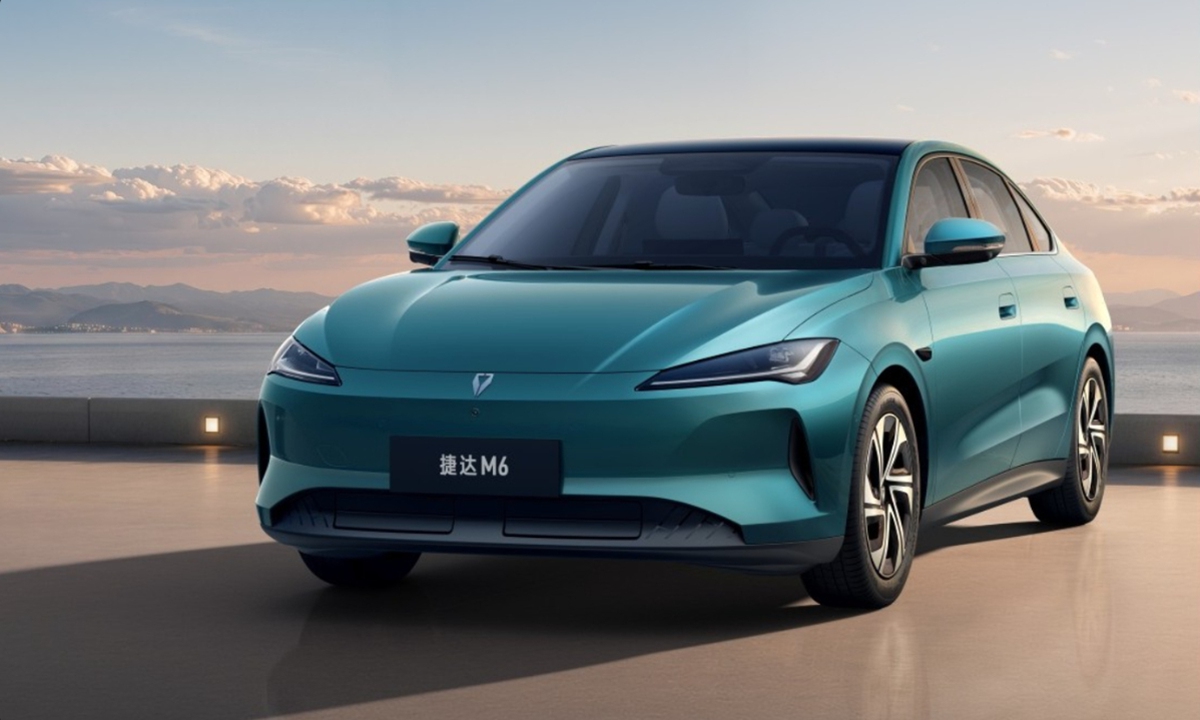
Screenshot of the Jetta M6 Photo: Jetta official website
Once synonymous with rugged reliability and the brand that gave millions of Chinese families their "first car," Jetta has recently returned to the spotlight. On October 22, FAW-Volkswagen's Jetta brand unveiled its battery electric vehicle, the M6, in China. Priced at under 100,000 yuan (about $15,000) even in its top trim, the model comes equipped with advanced urban navigation on autopilot driver-assistance features. It surpassed 10,000 locked orders within just 19 hours of launch.
This figure may not be staggering in China's fiercely competitive new-energy vehicle sector, yet the market response merits close attention - especially for a legacy automaker racing to embrace electrification. More than just sales performance for a single new model, it points to broader potential for China-Germany automotive industrial cooperation.
Earlier, FAW and the Volkswagen Group signed a strategic cooperation agreement in Wolfsburg, Germany. Under the deal, the two sides will jointly roll out 11 China-customized models starting in 2026, spanning battery electric, plug-in hybrid and range-extender electric powertrains. Jetta's electric transformation forms an integral part of this roadmap.
More than 30 years ago, the Jetta served as a bridge between German engineering quality and China's mass market. Unlike the old "German technology, assembled in China" model, the new agreement elevates the Chinese side beyond manufacturing and market execution to deep involvement in product definition and research and development, with the Chinese partner taking the lead in selected areas. German manufacturing expertise and engineering standards, paired with China's mature battery, smart-cabin and autonomous-driving solutions as well as local supply chains, create distinctive synergy. This revives the iconic national car with German roots for a new era. The Jetta M6's market reception serves as a real-world test of this collaborative framework.
Beneath China-Germany automotive cooperation lies four decades of integration and mutual trust. Since the establishment of SAIC Volkswagen Automotive Co Ltd in the 1980s, which marked the beginning of joint ventures in China's passenger car industry, the partnership has continued to evolve, with successive contract renewals in recent years and increased investment in local R&D. The rationale behind the cooperation has long since moved beyond its original model. Volkswagen has built in Hefei, East China's Anhui Province its first R&D center outside Germany, with the capacity to fully develop and validate products, cutting the overall vehicle development cycle by 30 percent. A growing body of practice shows that aligned technologies, talent pools, supply chains and market demands from both countries can generate a competitive edge greater than the sum of its parts.
Against various external speculations, China has demonstrated its commitment to high-standard opening-up through verifiable institutional arrangements. It rejects closed, exclusive blocs. Foreign automakers receive full national treatment on permits, standards and subsidies. Foreign brands account for one-third of sales under China renews auto trade-in subsidy program. China's Ministry of Commerce has held repeated exchanges with the German Association of the Automotive Industry, welcoming and encouraging German enterprises to deepen their footprint in China and expand local R&D and investment. It also advocates managing frictions and differences through dialogue and consultation to keep the global automotive supply chain stable and unimpeded. Jetta's electric "comeback" in China is a tangible industrial manifestation of this openness.
"Volkswagen Jetta, a rational choice" remains Jetta's most classic and widely recognized tagline. Today, "Jetta electrifies, born anew" adds a solid footnote to win-win collaboration between Chinese and foreign automakers in the new-energy age. It is, truly, "a rational choice." Jetta's "comeback" in China proves this was the right move.
RELATED ARTICLES