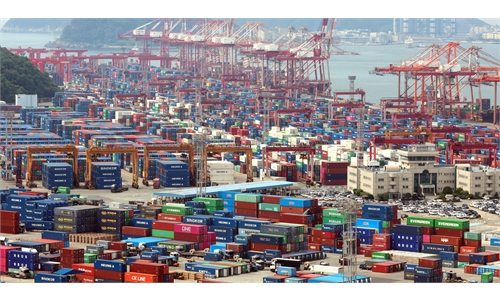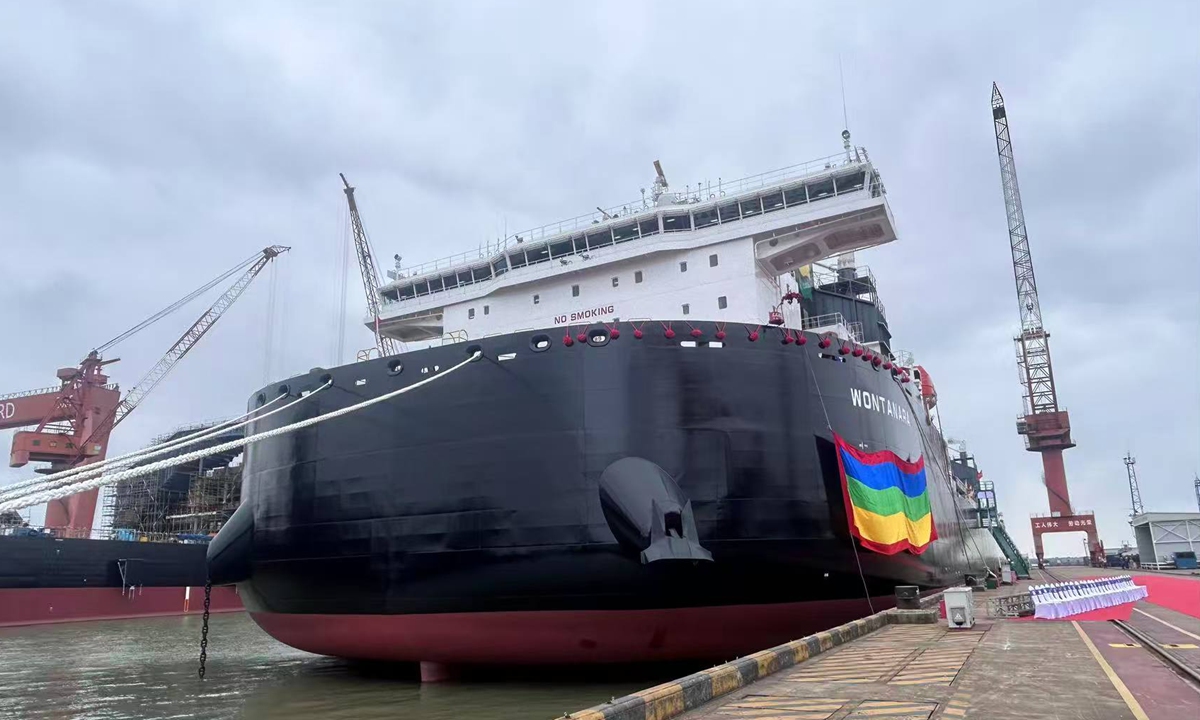
The world's first 41,800-ton bidirectional sailing self-discharging ship delivers in East China's Jiangsu Province on July 21. Photo: Guo Yuandanz/GT
New data from China's shipbuilding industry has drawn widespread media attention. China continues to lead the world in three key indicators, the Ministry of Industry and Information Technology (MIIT) reported.
In the first nine months of this year, Chinese shipyards completed 58.05 million deadweight tons (DWT) of shipbuilding output, a year on year rise of 50.7 percent. New ship orders hit 175.29 million DWT, surging 163.2 percent year on year. As of the end of September, the order backlog stood at 399.13 million DWT, up 64.8 percent from a year earlier. Notably, China's new ship orders accounted for 81.8 percent of the global market, MIIT statistics showed.
These figures amount to more than a demonstration of the country's manufacturing scale. Shipbuilding is a capital-intensive, long-cycle and technology-heavy industry. When ship owners place orders, they are not simply comparing quotations. They are making decisions on fleet capacity, asset values and delivery security.
Choosing a shipyard is, in effect, a vote of confidence in an entire industrial system: its suppliers, engineers, project managers, skilled workers and ability to deliver as promised. China's expanding order book reflects not only the available capacity, but also the market's assessment of its supply-chain coordination and execution.
What deserves more attention than the sheer volume of orders is their structural composition. New orders are not evenly distributed across all vessel types, but are heavily concentrated in the segments with the strictest green compliance requirements and the highest technological complexity.
In the first three quarters, China's global market share in new orders for green-powered ships reached 74.1 percent, 5.7 percentage points higher than in the first half of the year. This clearly signals that China's leading position in shipbuilding is evolving from the traditional strengths of scale and cost-effectiveness to new competitive edges in green technology, sophisticated vessel construction and industrial synergy.
As global maritime environmental regulations tighten and alternative fuel technologies advance, fleet owners are increasingly turning to next-generation vessels powered by methanol, liquefied natural gas and ammonia.
Chinese shipyards' remarkable share in green ship orders shows that their capabilities in green design, supply chain coordination and high-standard construction have won widespread market recognition. This advantage is set to prove far more sustainable than a simple cost-and-scale edge.
Many foreign media outlets tend to frame the rise of China's shipbuilding sector as a zero-sum game between China and South Korea. But this narrow narrative overlooks the profound changes unfolding across the global shipbuilding industrial chain. The expansion of China's shipbuilding ecosystem has opened up new market space for South Korean component and marine equipment companies. South Korean shipbuilders can leverage China's massive delivery volume and huge supporting demand to expand exports of their high-value-added supporting products.
Small and medium-sized South Korean marine equipment makers are accelerating their entry into the Chinese market, with major supporting equipment shipped from South Korea to China including hull safety monitoring systems, marine energy-saving devices and marine engine components.
This deep integration not only elevates the supporting quality of Chinese-built vessels, but also gives South Korean companies direct access to the world's largest shipbuilding market. This dynamic of "competition in finished vessels, cooperation in supporting sectors" is far closer to the industrial reality than simplistic zero-sum assumptions.
The South Korean shipbuilding industry is facing pressure from labor shortages and challenges from investment in US shipbuilding. Against this backdrop, the value of cooperation becomes ever clearer. Shipbuilding is a long-haul race that rewards sustained technological investment, supply chain resilience and reliable deliveries.
Global decarbonization in shipping continues to open up fresh demand. China needs to consolidate its early-mover advantage in green vessels, while South Korea needs a stable export market for the components and a reliable industrial partner.
The rise of China's shipbuilding industry brings more diverse, greener supply options to back up the global transition of maritime transport. For competitors such as South Korea, the competition creates some pressure on finished vessels, but it also creates opportunities for component exports, production collaboration and strategic repositioning. So, competition and cooperation has once again proved to be the perpetual norm of doing business.
RELATED ARTICLES