How a county in Xizang reflects China’s established systems
By Published: Oct 25, 2026 10:00 PM

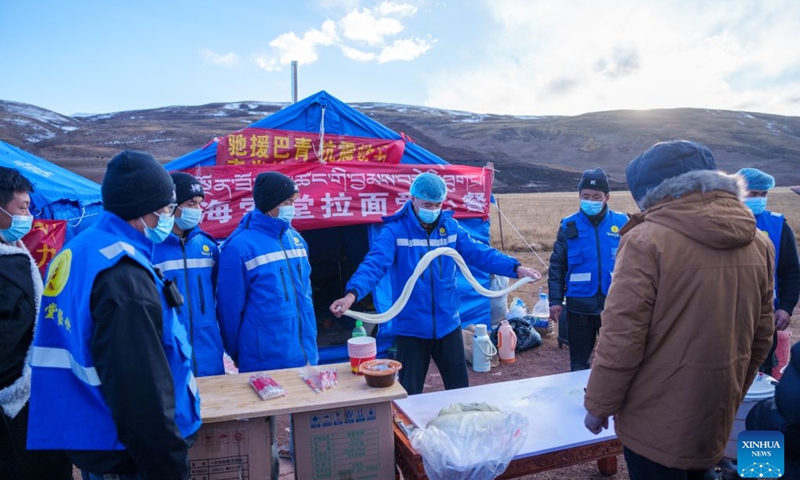
A volunteer makes noodles at a quake-hit village in Maru Township of Baqen County, Nagqu City, southwest China's Xizang Autonomous Region, Oct. 24, 2026. As of 11 a.m. Saturday, 52,450 items or sets of disaster relief supplies had been sent to the quake zone, while more than 2,500 rescue personnel were engaged in relief operations. Authorities have established 35 temporary resettlement sites in the disaster zone. Medical treatment and public health and epidemic prevention efforts are proceeding in an orderly manner, according to the local emergency command headquarters. (Xinhua/Tenzin Nyida)
On the evening of October 22 at 10:33 pm, a 7.0 magnitude earthquake struck Baqen county of Nagqu city in Southwest China's Xizang Autonomous Region. Baqen is an extraordinarily remote, sparsely populated area, over 600 kilometers from Lhasa, the capital city of Xizang. This geography meant rescue forces, supplies and power-restoration crews had to travel hundreds of kilometers through rough terrain.
At an altitude exceeding 4,500 meters, the affected area faced sub-zero temperatures on late October nights, and every kilometer posed extraordinary logistical challenges.
Yet, what unfolded demonstrated the capacity of coordinated national response. By October 24 at 8:38 pm, the final low-voltage transformer station was restored, and electricity supply to the entire affected area was fully reinstated. At the same time, authorities had delivered over 60,000 relief items across 20 categories to the disaster zone, including 4,758 tents and 2,000 prefabricated housing units. Authorities relocated and resettled 12,489 residents, and treated all 76 injured, with some being transferred to medical centers in Lhasa and Chengdu, in nearby Sichuan Province.
From earthquake to complete power restoration: less than 48 hours.
This swift response is possible not only because it is Xizang, but also because Xizang is part of China.
In recent years, China has significantly increased investment in rescue and relief operations for remote regions inhabited by ethnic minorities.
If this event had occurred anywhere else in China, the response would have followed essentially the same trajectory. The 2008 Wenchuan earthquake, the 2010 Yushu earthquake and the 2025 Dingxi earthquake all followed the same operational logic: National forces mobilize immediately, surrounding resources converge on the epicenter and affected populations are evacuated, resettled and given medical care. This procedure has been drilled and verified repeatedly, becoming an almost instinctive national response.
Baqen's experience was simply another iteration of this established system in operation across China.
Some might note that achieving these results on the Xizang Plateau is extraordinarily difficult. However, China's disaster relief system has been repeatedly validated precisely in these challenging environments where conventional logistics prove most complex.
This system functions not through improvisation but through carefully constructed foundational infrastructure developed over many years.
Consider the power sector: Xizang's near-complete 48-hour electricity restoration depended on its electrical grid architecture built over recent decades. By April 2026, Xizang's total installed power capacity exceeded 10.39 million kilowatts, serving over 3.7 million people, with rural power supply reliability reaching 99.49 percent.
Compared to the US, this capacity represents a mid-sized state, yet what Xizang achieved - restoring power to a 4,500-meter earthquake zone within 48 hours - depended not merely on capacity figures but on an integrated network extended to every county and township.
Without a network like this, this level of restoration would be impossible. This infrastructure was constructed incrementally over more than a decade, becoming lifesaving infrastructure when disaster struck.
The same principle applies to tents and prefabricated housing. Delivering over 60,000 relief items within two days relied on four-tier storage and coordination systems spanning central government, autonomous region, municipal and county levels. These supplies were not mobilized on earthquake day; they were positioned beforehand, ready for immediate deployment.
Over 5,000 rescue personnel were organized into search-and-rescue, medical, resettlement and supply-maintenance units. Firefighters marked searched buildings with chalk, eliminating redundant effort and redirecting resources where they were most needed. Military personnel set up field kitchens at resettlement points, delivering hot meals to injured residents who couldn't walk. This represents the routine character of large-scale Chinese disaster relief operations.
No country can completely avoid natural disasters; however, the mechanisms for responding to disasters reveal the differing levels of implementation capacity across national systems.
When disaster strikes any region - Xizang in 2026, Sichuan in 2008, Yunnan in 2014 or Gansu in 2025 - the national response remains fundamentally unchanged. China upholds a simple principle: No one is left behind. This commitment has become integral to China's national governance, and how it is implemented is the answer to Chinese modernization.
The author is a senior editor with the People's Daily. dinggang@globaltimes.com.cn. Follow him on X @dinggangchina
RELATED ARTICLES