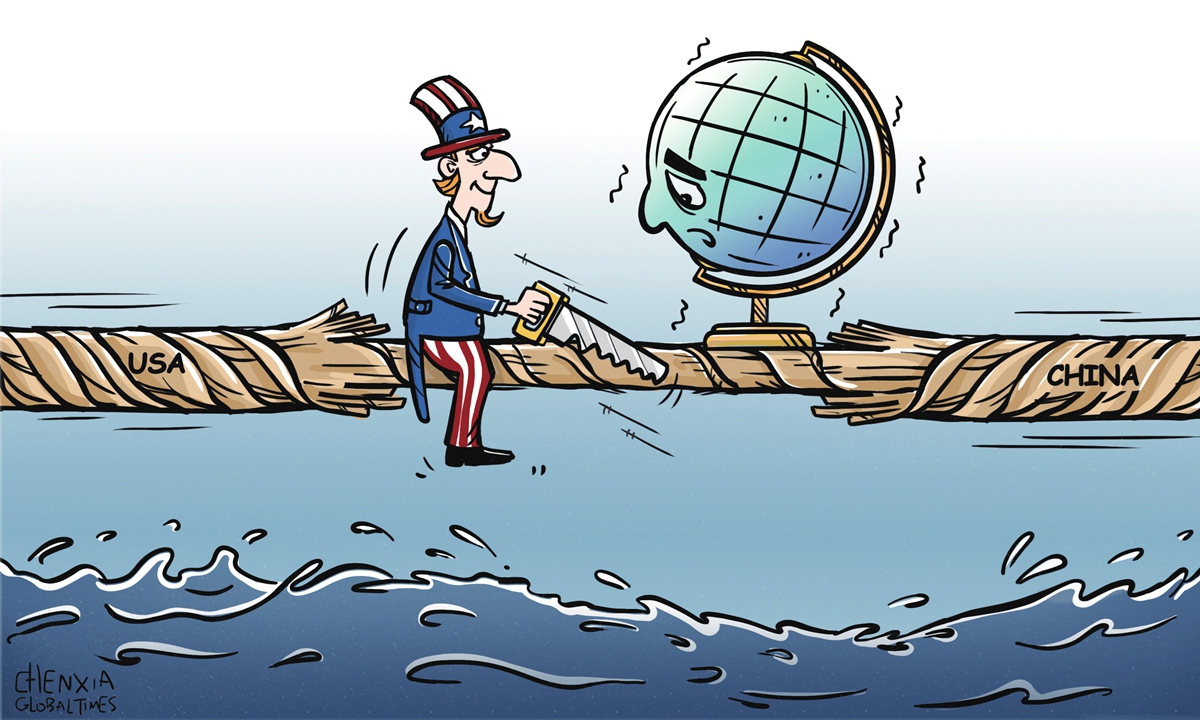
China US Illustration: Chen Xia/GT
As capital from many countries flows into China at an accelerating pace, US investors - constrained by their own country's rules - can only watch as their window of opportunity narrows. Washington should listen carefully to the concerns of US farmers, pharmaceutical companies and investors, and weigh the costs of imposing restrictions.
The US Treasury recently released a revised proposed rule on outbound investment restrictions inviting public comments through December 7. In addition to the existing restricted sectors of semiconductor technologies and microelectronics, artificial intelligence systems and quantum information technologies, the proposal seeks to bring supercomputing and hypersonic systems under more detailed controls, while adding biotechnology to the list and designating China and other countries as "countries of concern."
On October 24, China's Ministry of Commerce (MOFCOM) responded to "a recent US Treasury proposal that would expand and intensify restrictions on outbound investment in China," calling it a discriminatory move and a typical practice of overstretching the concept of national security. The proposed rules "run counter to the important consensus reached by the two heads of state," the MOFCOM spokesperson said. China will closely follow further developments and reserve the right to retaliate, the spokesperson noted.
The steady tightening of US investment controls is an attempt to contain China's emerging industries by stretching the concept of national security beyond its proper bounds. From the 2023 executive order to the expansion of the scope of restrictions through congressional legislation in 2025, and now the addition of biotechnology, the underlying logic remains consistent: to slow China's technological progress by cutting off capital flows.
The irony is that biotechnology, the latest sector to be brought under the restrictions, is also one of the most active areas of mutually beneficial cooperation between the two countries. One-third of the world's innovative drugs in development come from China. This year, US pharmaceutical companies such as Pfizer and Bristol Myers Squibb have reached licensing agreements worth billions of dollars with their Chinese partners.
Meanwhile, the US pharmaceutical industry has spent months lobbying against Washington's proposed stringent investment restrictions. Under the guise of national security, what amounts to protectionism is first and foremost tying the hands of US investors themselves.
Data show that Washington's policy direction is running directly counter to the market choices of most US companies. According to MOFCOM, investment from major sources including the US, South Korea, France and Switzerland continued to grow from January to September, with investment from the US increasing by 7.7 percent. Despite the political noise, most US companies are still putting their money where their confidence in the Chinese market lies.
On the other hand, the 7.7 percent growth rate was significantly lower than France's 31.8 percent and Switzerland's 26 percent, showing that Washington's restrictive measures are having a negative impact on corporate decision-making. Member Survey 2026 by the US-China Business Council found that 95 percent of respondents considered their China operations to be "somewhat to very important for staying competitive globally." The direction in which the market is voting of its own accord is precisely the opposite of the direction in which policymakers are trying to pull it.
Facts confirm that countries shutting their doors often end up sacrificing their own opportunities. According to the US-China Business Council survey, US exports to China fell 26 percent last year, resulting in the loss of approximately 148,000 jobs. Among US companies affected by their own country's export controls, 61 percent have watched their market share shift to competitors. International Data Corporation predicts that Washington's trade restrictions could leave the US' humanoid robotics market nearly 60 percent smaller than it would otherwise be by 2030. "Once markets are lost, they are hard to regain," US business leaders have warned.
By contrast, foreign investment in China's high-tech sector increased 33.8 percent year on year from January to September, while reinvestment of profits by foreign-invested enterprises rose 4.7 percent. The magnetic pull of China's vast market remains strong and continues to grow.
As capital from many countries around the world flows into China at an accelerating pace, US investors constrained by their own country's rules can only watch as their window of opportunity narrows.
China-US economic and trade relationship is built on mutual benefit and win-win outcomes, and it must not be undermined by the countercurrent of politicization and securitization. The strategic guidance provided by the heads of state of China and the US, along with the cooperative ties painstakingly built by businesses on both sides, should not be eroded by a proposed rule. China-US cooperation is vital to the well-being of the peoples of both countries, to the stability of global industrial and supply chains and to the growth of the world economy. Labeling legitimate business activities as "threats" and weaponizing capital flows undermine not only business confidence but also the foundations of the international economic and trade order.
The proposed rule is still at the consultation stage, and its final text has yet to be determined. The rational voices of the US business community deserve to be heard. While reserving the right to take countermeasures at any time, China will continue to counter external uncertainties through high-standard opening-up. The proposition that "investing in China means investing in the future" will only become more evident. Washington should listen carefully to the concerns of US farmers, pharmaceutical companies and investors, and weigh the costs of imposing restrictions.
The ropes used to trip others up often end up binding one's own hands first. The simple truth that cooperation benefits both sides while confrontation harms both is one Washington would do well to heed.
RELATED ARTICLES