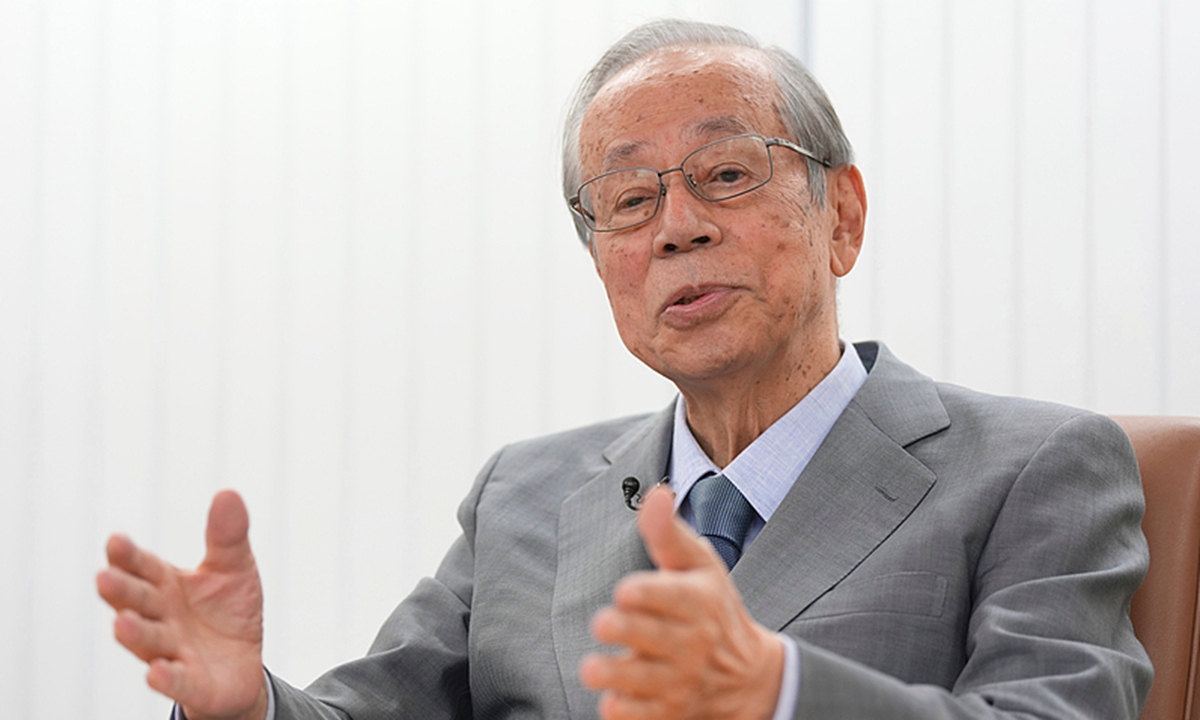
Former Japanese Prime Minister Yasuo Fukuda File photo: VCG
Former Japanese Prime Minister Yasuo Fukuda died of heart failure at a hospital in Tokyo on October 22 at the age of 90, Japanese media reported on Monday. In response to media reports of Fukuda's death, Chinese Foreign Ministry spokesperson Guo Jiakun said on Monday that China expresses deep condolences and grief over Former Prime Minister Yasuo Fukuda's passing and heartfelt sympathies to his family.
Fukuda was an old friend of the Chinese people, who actively contributed to the improvement and development of China-Japan relations. He has long been committed to the friendship between our two countries, and held a correct view of history, Guo said. During his tenure as prime minister, China and Japan signed the fourth political document. After leaving office, he visited the Memorial Hall of the Victims in Nanjing Massacre. What's more, he served for many years as Chairman of the Boao Forum for Asia, playing an important role in facilitating exchanges and cooperation in Asia.
Yasuo Fukuda once noted that the four political documents between China and Japan stipulated the principles governing bilateral relations, which we must bear in mind and never deviate from. Those firm and important remarks reflected the honor and responsibility of Japan's statesman of the older generation and should evoke self-reflection and soul-searching among those currently running the Japanese government, Guo said.
Born on July 16, 1936, in Takasaki, Gunma Prefecture, Fukuda was the eldest son of former Japanese prime minister Takeo Fukuda and graduated from Waseda University. He became prime minister in September 2007 and resigned in September 2008, according to the Xinhua News Agency.
During his tenure as prime minister, Fukuda worked to improve and develop China-Japan relations. In 2008, the two countries issued the China-Japan Joint Statement on All-round Promotion of Strategic Relationship of Mutual Benefit, Xinhua said.
His commitment to China-Japan friendship was also evident in his criticism of the current Japanese Prime Minister Sanae Takaichi's erroneous Taiwan-related remarks. Fukuda repeatedly spoke out against the comments and urged Takaichi to retract them.
In an August 20 interview with Tokyo Shimbun, Fukuda Yasuo again discussed China-Japan relations and the domestic atmosphere in Japan following Takaichi's erroneous Taiwan-related remarks. He expressed concern that "there may be a tendency to casually think that it is fine to pick a fight," stressing that Japan bears the negative historical burden toward China; Therefore, it must handle the relationship with particular caution.
"Fukuda Yasuo was one of the most China-friendly Japanese prime ministers since the beginning of the 21st century. His passing is a loss for efforts to maintain stable and steadily developing China-Japan relations," Lü Yaodong, a researcher at the Chinese Academy of Social Sciences' Institute of Japanese Studies, told the Global Times on Monday.
Lü noted that Fukuda's most significant contribution during his roughly one-year tenure was promoting the signing of the China-Japan Joint Statement on All-round Promotion of Strategic Relationship of Mutual Benefit in 2008, the fourth major political document between the two countries.
Fukuda's father, former Japanese prime minister Takeo Fukuda, helped bring about the signing of the China-Japan Treaty of Peace and Friendship. The contributions of the two generations of the Fukuda family thus became a distinctive chapter in the history of China-Japan relations, Lü stressed.
He added that Fukuda also held a clear position on the Taiwan question. During a visit to China in 2007 as Japan's prime minister, he explicitly made four commitments: Japan would not pursue "two Chinas" or "one China, one Taiwan," would not support "Taiwan independence," would not support Taiwan joining the United Nations, and would not support a referendum on joining the UN.
After leaving office, Fukuda continued to promote exchanges between Chinese and Japanese civil society and academic communities. His visit to the Memorial Hall of the Victims in Nanjing Massacre also demonstrated his willingness to confront history and advocate peace in East Asia, Lü said.
On Chinese social media, many netizens expressed condolences over Fukuda's passing. One user wrote, "Mr. Yasuo Fukuda, a conscientious politician who devoted himself to promoting China-Japan friendship." Others lamented that there are fewer and fewer Japanese politicians with a conscience.
Similar sentiments were echoed in Japanese academic circles. "Following Mr Yohei Kono, we have now lost another rare politician who played a major role in promoting exchanges between Japan and China," Atsushi Koketsu, a professor emeritus at Yamaguchi University in Japan, told the Global Times.
"I once attended a seminar in China together with Mr Fukuda. I believe he firmly held that the healthy development of China-Japan relations was Japan's greatest security guarantee. The Takaichi administration should also take seriously the former prime minister's original aspirations for China-Japan relations," Koketsu said.
The successive passing of veteran Japanese figures who supported friendship with China, including Fukuda and former House of Representatives speaker Yohei Kono, reflects the gradual loss of an older generation of Japanese politicians who were committed to promoting friendship with China and maintained a rational understanding of the country, Lü said. He added that the forces supporting China-Japan friendship continue to weaken.
The most important way to honor these figures, Lü said, is not simply to mourn their passing, but to continue promoting and passing on the consensus they upheld. China and Japan should continue to abide by their four political documents and use the principles enshrined in them as the fundamental guidelines for managing bilateral relations and differences.
This, Lü added, is essential to counter negative trends and safeguard the foundations of China-Japan relations.
RELATED ARTICLES