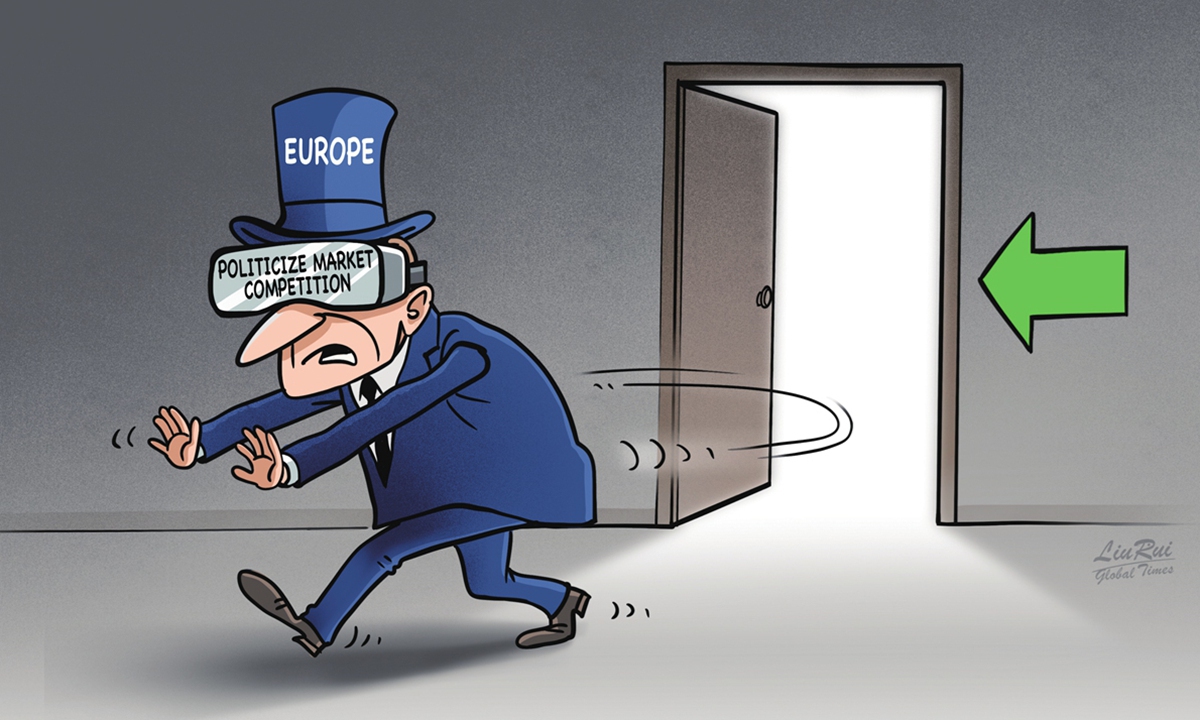
Europe Illustration: Liu Rui/GT
Recently, as the EU contemplates expanding restrictions on Chinese imports, "Europe getting tough on China" has become a headline pushed by several Western media outlets, with some even urging Washington to follow Europe's steps.For Europe, a tough stance toward China reflects a deep-seated anxiety over its shifting relative strength and growing worries about its domestic and international environment.
Currently, Europe is locked in structural economic headwinds. Although its economy gradually recovered following the sovereign debt crisis, deep-rooted issues like a lack of growth momentum have proven difficult to resolve. High energy costs, underinvestment and market fragmentation remain intertwined.
As Chinese firms gain ground in Europe's traditional strongholds and the US leverages policies to draw global capital, Europe finds itself caught in a double squeeze: terrified of its domestic industries losing their competitive edge, while fearful of capital, factories and jobs fleeing overseas at the same time.
Solving these structural dilemmas demands sustained investment, the dismantling of entrenched interest barriers and the delicate reconciliation of internal divisions. By contrast, scapegoating its troubles on a "China shock" requires far less political capital than pushing through painful domestic reforms. This largely explains why some European figures are so eager to point the finger at competitors for "not playing by the rules," while failing to reflect on their own problems.
Europe faces the dual pressure of status anxiety and security reliance. Certain European leaders worry that a relative decline in economic clout will render Europe increasingly powerless in major-power geopolitical competition.
In the calculations of some European strategists, taking a hard line on China appears to offer a catch-all solution: Domestically, framing it as safeguarding economic security addresses protectionist calls and secures support from voters and special interest groups; externally, aligning on China policy creates common ground with Washington, demonstrating to the US that Europe still holds strategic value in exchange for security guarantees.
Yet, the fatal flaw in this strategy is that a temporary alignment between Washington and Brussels on Beijing cannot paper over their divergences regarding tariffs, industrial policy and defense burden-sharing. Even if their direction of "de-risking" from China aligns on paper, endless disputes remain over who builds new capacity, who captures market share and who sets the global rules.
Furthermore, Washington has its own geopolitical calculus when managing ties with Beijing. While Europe escalates its pressure on China, the US quietly retains room for engagement and deal-making. If Europe blindly sacrifices its cooperation with China merely to prove its loyalty, it is unlikely to secure the firm security commitments it craves in return.
Taking a tough stance on China will not solve Europe's problems; it risks creating far more. Evading domestic reform by building external walls will fail to remedy Europe's competitiveness deficit. Squeezing the space for cooperation with China risks depriving European businesses of crucial market access and supply chain synergies, while piling on higher production costs and green transition burdens.
The starting point for Europe's China policy ought to be firmly grounded in its own long-term interests. While protecting industrial interests is entirely legitimate, trade protectionism must be rooted in facts and international rules. Fair market competition never guarantees that any single player will win forever.
Europe's own history demonstrates that enduring peace cannot exist without mutual respect for interests, nor without dedicated efforts to translate shared interests into reality. This historic lesson should not be tossed aside when China is involved, nor should the vast common interests between Beijing and Brussels be selectively ignored in a bid to pander to Washington. For the transatlantic relationship, casting China as a common adversary may buy a fleeting moment of alignment, but it will never foster true, long-term cohesion.
If Europe wishes to command respect and achieve genuine strategic autonomy, it must rely on its own concrete actions.
Xiong Rui is a PhD candidate at the School of International Studies of Peking University. Wang Shuo is a professor at the School of International Relations and Diplomacy of Beijing Foreign Studies University. opinion@globaltimes.com.cn
RELATED ARTICLES