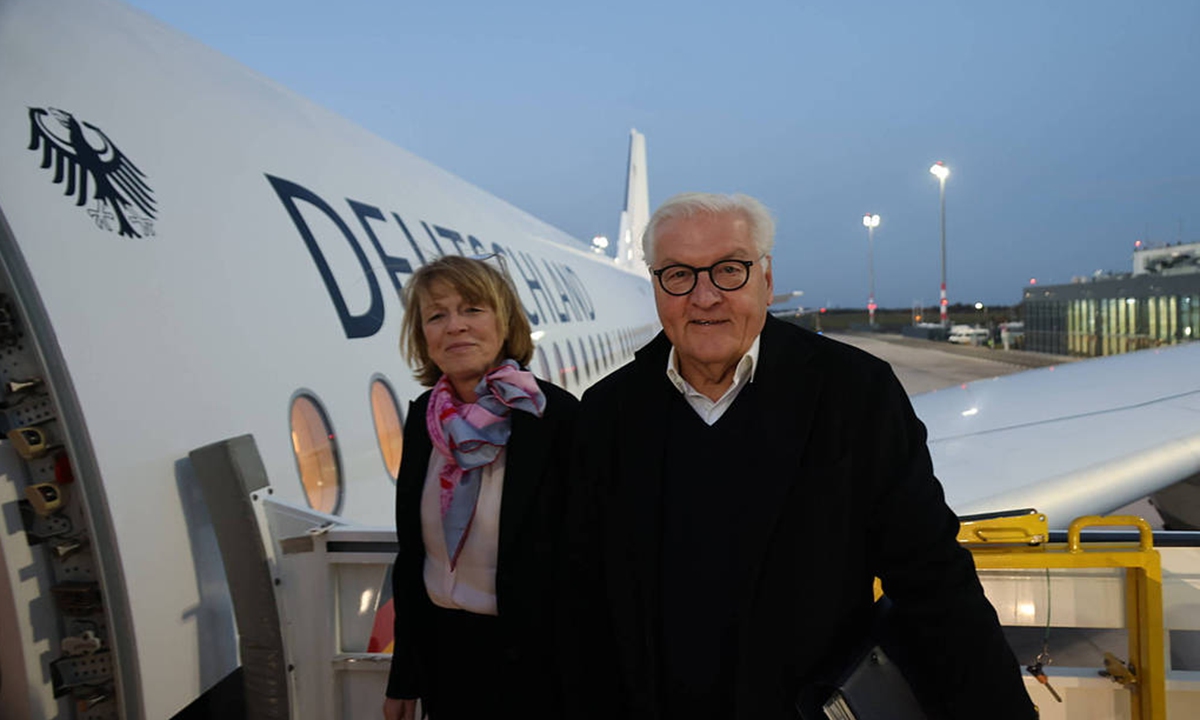
German President Frank-Walter Steinmeier (front) departs for China on October 26, 2026. Photo: VCG
German President Frank-Walter Steinmeier is set to begin a state visit to China on Tuesday, marking his first visit to the country in nearly eight years.
A Chinese expert noted that as the Merz government appears to harden its China policy under domestic and EU pressure, Steinmeier's trip represents a balancing gesture - but the German side should put the visit's potential outcomes in the proper perspective and translate short-term considerations into substantive long-term goals.
As announced by China's Foreign Ministry, Steinmeier's trip will include the capital, Beijing, and East China's Anhui Province. He is expected to outline his position on economic and trade relations in a keynote speech at Peking University on Thursday before holding high-level talks with the Chinese side, according to Germany's news agency DPA.
In Hefei, the provincial capital of Anhui, he will visit a Volkswagen facility, according to the itinerary published on the Federal President's website.
The president will use his four-day state visit to China to press for fairer economic and trade relations that benefit both countries, the report by DPA noted. This will require addressing existing imbalances in the relationship, the report cited the president's office as saying.
China's growing role on the international stage will also feature prominently in the discussions, the report said.
Since early this year, the Merz government appears to have been adopting a tougher stance amid domestic political constraints and pressures from the EU. In this context, Steinmeier's visit seems intended, in part, to serve as a balancing act, Cui Hongjian, a professor at the Academy of Regional and Global Governance at Beijing Foreign Studies University, told the Global Times on Monday.
Cui said this visit could provide an opportunity for exchanges, but it remains uncertain how much influence his moves will have or to what extent the Merz government will take them on board.
Germany needs to take a more balanced view of its economic and industrial challenges, the expert said. Rather than attributing these problems wholesale to the so-called China shock, Berlin should make a more objective assessment of their underlying causes.
Cui also pointed to encouraging momentum from the recently held second meeting of the China-EU Trade and Investment Consultation Mechanism. "The two sides seem ready to manage trade and industrial frictions through more constructive bilateral engagement, prioritizing technical solutions instead of allowing differences to become excessively politicized or securitized."
This visit is expected to help steer the Merz government away from an increasingly restrictive China policy that does not serve Germany's own interests, Cui said, noting that what better serves Germany is to broaden and actively advance relations with China, rather than continually narrowing the scope for cooperation.
Chinese Foreign Ministry spokesperson Mao Ning said during a press conference on Friday that the sound and steady growth of the comprehensive strategic partnership between China and Germany, the world's second and third largest economies, not only serves the interests of both countries, but is also what Europe and the world hope to see.
"We hope to work with the German side to take this visit as an opportunity to cement mutual trust, deepen cooperation and seek joint innovation, so as to make greater progress in bilateral relations, contribute to steady and sustained growth of China-Europe relations, and bring fresh energy to the world," Mao added.
RELATED ARTICLES