Key plenum to advance full, rigorous Party self-governance
Efforts aim to strengthen capacity to navigate risks, advance modernization
By and Shen Sheng Published: Oct 27, 2026 12:04 AM

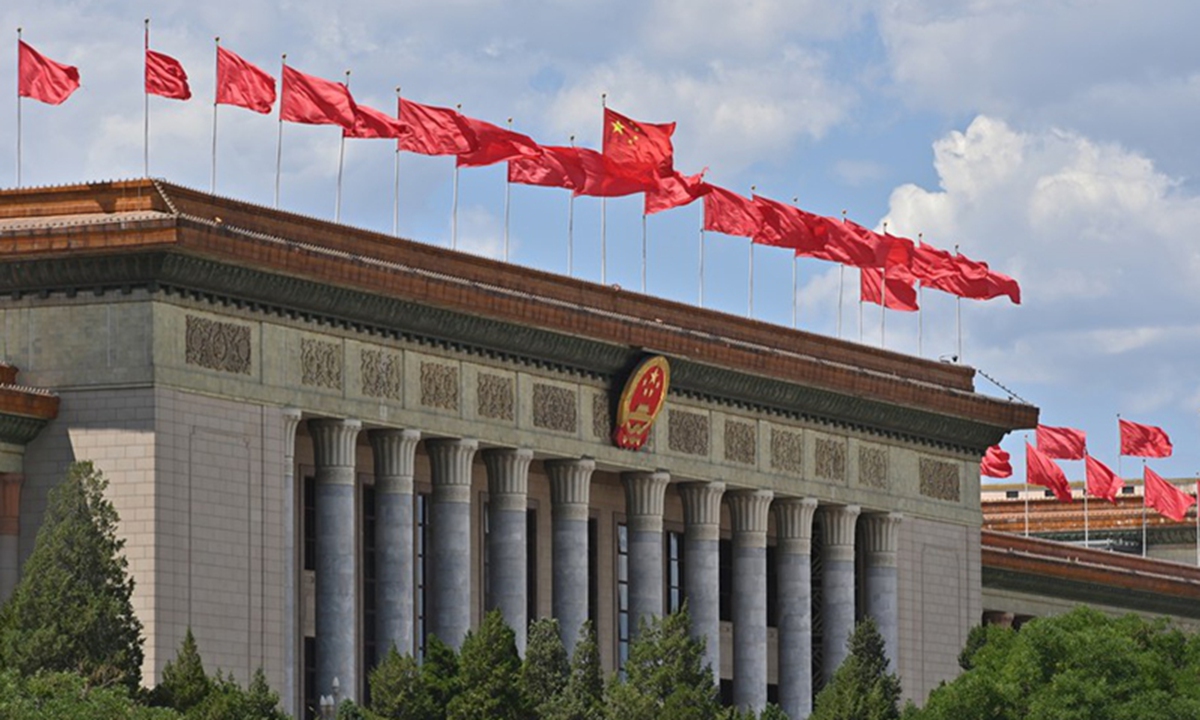
Photo:Xinhua
The 20th Central Committee of the Communist Party of China (CPC) started its fifth plenary session in Beijing on Monday morning.
Xi Jinping, general secretary of the CPC Central Committee, delivered a work report on behalf of the Political Bureau of the CPC Central Committee and expounded on a draft decision of the CPC Central Committee on some major issues concerning strengthening full and rigorous Party self-governance with perseverance, according to the Xinhua News Agency.
The draft decision summarizes the achievements and experience of full and rigorous Party self-governance in the new era in a truth-seeking manner, and offers in-depth analysis of the situation and tasks concerning Party building at present and for some time to come. It also sets out strategic plans for strengthening full and rigorous Party self-governance with perseverance, according to a Political Bureau meeting in September that decided to submit the document to the plenum for review, Xinhua reported.
Since the 18th CPC National Congress in 2012, the full and rigorous Party self-governance has made significant progress, opened up a new frontier for the century-old Party in self-reform, and brought about historic achievements and transformations in the cause of the Party and the country, said an earlier Political Bureau meeting in July that set the plenum's agenda.
The meeting said the Party and the people have won the historical initiative to build a strong Party and country, but noted that as profound changes unfold in the world, in China and within the Party, efforts to exercise full and rigorous Party self-governance also face many new circumstances and challenges.
It called for adopting higher standards and taking more concrete measures to uphold and apply the valuable experience of full and rigorous Party self-governance in the new era, resolve the prominent issues facing Party building, and consolidate and develop the sound political environment created through Party self-supervision and self-governance.
Chinese observers said the plenum underscores the CPC's determination to sustain rigorous Party self-governance as China enters a crucial stage of its modernization drive. Maintaining effective governance requires the Party to continuously address the challenges faced by the CPC, while ensuring that institutional reforms translate into stronger governance capacity, sustained economic and social development, and tangible improvements in people's lives.
Maintaining vigor
As China enters the 15th Five-Year Plan period (2026-2030), a critical stage in laying the groundwork for basically achieving socialist modernization by 2035, the CPC faces severe challenges: strengthening its governing capacity, staying connected with the people, guarding against complacency and resolutely combating corruption, read a Xinhua commentary.
Only through strong Party leadership and unwavering commitment to full and rigorous self-governance can central leadership decisions be fully implemented and the country's long-term development stay on course.
History has shown that maintaining rigorous Party governance requires a long-term commitment, particularly in the fight against corruption. Any relaxation or inconsistency in anti-corruption efforts risks allowing entrenched problems to resurface, potentially undermining years of progress, Dong Yu, executive vice dean of the China Institute for Development Planning at Tsinghua University, told the Global Times.
For China to achieve its long-term modernization goals, preventing corruption from taking root is therefore not merely a matter of political discipline, but a broader governance imperative, said Dong, noting that seen in this light, China's continued anti-corruption drive is about more than addressing immediate problems. It is also an effort to strengthen the institutional foundations needed to sustain the country's development over the long term.
In December 2012, the CPC central leadership introduced a code of conduct, known as "eight-point rules," in a bid to strengthen Party self-governance. It established regulations for Party leaders regarding research tours, meetings, documentation, and other official duties, cracking down on lavish banquets, red carpet events, pomp, entourages, unnecessary meetings, and luxury perks that had once been regarded by some as typical symbols of power. It has become a cornerstone of the CPC's efforts to ensure integrity, discipline and public trust.
Also since 2012, the Party has pressed ahead with a rigorous anti-corruption campaign targeting high-ranking officials, misconduct at the grassroots level and corruption involving officials who have fled overseas.
Some of the most senior officials - including former members of the Political Bureau and its Standing Committee, top military brass, and retirees who left their leading positions years ago -- have been brought to justice, according to an article by Xinhua.
In its crackdown on high-ranking officials, commonly known as "hunting tigers", more than 500 centrally managed officials were placed under investigation between the 18th CPC National Congress in 2012 and the eve of the 20th CPC National Congress in 2022. The Central Commission for Discipline Inspection (CCDI) and the National Commission of Supervision (NCS) launched investigations into 87 such officials in 2023, 92 in 2024 and 181 in 2025, according to an article published by Xinhua on Monday.
The campaign has also targeted lower-level corruption, an effort known as "swatting flies". In 2025 alone, the CCDI and NCS directly investigated or oversaw 8,116 cases involving misconduct and corruption affecting ordinary people. Nationwide, authorities investigated 967,000 such cases, imposed disciplinary penalties on 627,000 people and referred 22,000 people to prosecutors, according to the Xinhua report.
Rigorous Party self-governance is intended to strengthen the CPC's governing capacity by addressing practical challenges, refining its approach to governance and improving its ability to navigate risks, advance reforms and pursue the country's modernization goals, Zhuang Deshui, deputy director of the Research Center for Government Integrity-Building at Peking University, told the Global Times.
Zhuang said the broader aim is to ensure that the Party retains the resilience, political judgment and strategic foresight needed to make consequential decisions shaping China's future and the lives of its people at critical moments in history.
To strengthen full and rigorous Party self-governance, upholding the Party's overall leadership is imperative, analysts said.
Over the past years, the strong leadership of the CPC has been the key to China's great achievements in such fields as economic, scientific and social development.
Latest official data released showed China's GDP grew 4.6 percent year-on- year in the first three quarters of this year, as the economy maintained steady growth under pressure and continued shifting toward new growth drivers.
Meanwhile, the country has also achieved significant results in green transformation in recent years, including building the world's largest and most complete clean energy industrial chain, with green and low-carbon industries becoming an important engine of economic growth.
Last month, the 134.2-kilometer Pinglu Canal, stretching from Hengzhou in South China's Guangxi Zhuang Autonomous Region to the Beibu Gulf, officially opened. It is the first nationally planned and coordinated canal project since 1949 to connect an inland river with the sea, providing southwestern China with its shortest, most cost-effective and most convenient route to the sea.
Global significance
By steadily tackling these problems faced by the CPC, China is also creating a more transparent environment for international cooperation. The "rigorousness" in official documents must be translated into a level playing field where merit and the rule of law prevail over connections and bribery. It is hardly surprising that many foreign observers have said that the CPC's ability to reform itself is a key factor in its success, reads the Xinhua commentary.
The 20th Central Committee of the CPC's fifth plenary session has also been closely watched by foreign media outlets, with some focused more on the Party discipline theme of this session.
International attention to the fifth plenary session reflects more than an interest in the country's domestic politics. It also points to growing concerns over the limitations of established governance models worldwide. Against this backdrop, China's emphasis on long-term strategic planning and policy continuity has drawn attention, particularly among other countries grappling with their own governance challenges and exploring alternative approaches, said Chinese experts.
Many governance challenges around the world arise not because countries lack policies, but because institutions lack effectiveness, coordination, or public confidence. The Chinese experience suggests that governance capacity depends not only on economic resources but also on institutional discipline, accountability, and the ability to adapt to changing circumstances, Essam Sharaf, former Egyptian Prime Minister, told the Global Times in a previous interview.
One of the most important lessons is that self-renewal is essential for long-term success. Institutions must regularly evaluate their performance, address shortcomings, and pursue continuous improvement. Without such efforts, even capable systems may struggle to sustain effectiveness over time, said Sharaf.
"From my observations, one 'secret' of the CPC is the professionalism of officials, which is not limited to senior leaders. High-quality public management is pervasive. The CPC Central Committee's Organization Department is responsible for selecting, training, monitoring, assessing, and promoting Party and government officials - and, when necessary, demoting or firing them. The process is rigorous, quantitative and continuous," Robert Lawrence Kuhn, chairman of The Kuhn Foundation, creator and host of Closer to Truth, and a recipient of the China Reform Friendship Medal, told the Xinhua News Agency in an interview.
"CPC rules on work style and personal conduct have become stricter. The Eight Rules of the Party Central Committee reject extravagance and reduce ceremonial visits, meetings and 'empty talk'. A training campaign emphasizes strict standards in morality, power and self-discipline, as well as integrity in decision-making, official conduct and personal behavior. Over more than 35 years of engaging with Chinese officials at all levels, I have generally found them to be among the most competent administrators anywhere," said Kuhn.
The CPC's experience offers a valuable lesson for political parties around the world, particularly those that have governed for extended periods: sustaining effective governance depends not merely on organizational strength or institutional arrangements, but also on the ability to identify shortcomings, correct mistakes and continuously renew themselves, said Dong.
The effectiveness of the CPC's self-reform and strict Party governance should therefore be assessed not only through institutional changes, but also through their tangible outcomes. The key is whether these efforts have strengthened governance, advanced economic and social development, and improved people's lives, Dong noted.
RELATED ARTICLES