German president kicks off China visit, eyeing dialogue opportunities amid trade tensions
By Published: Oct 27, 2026 03:42 PM

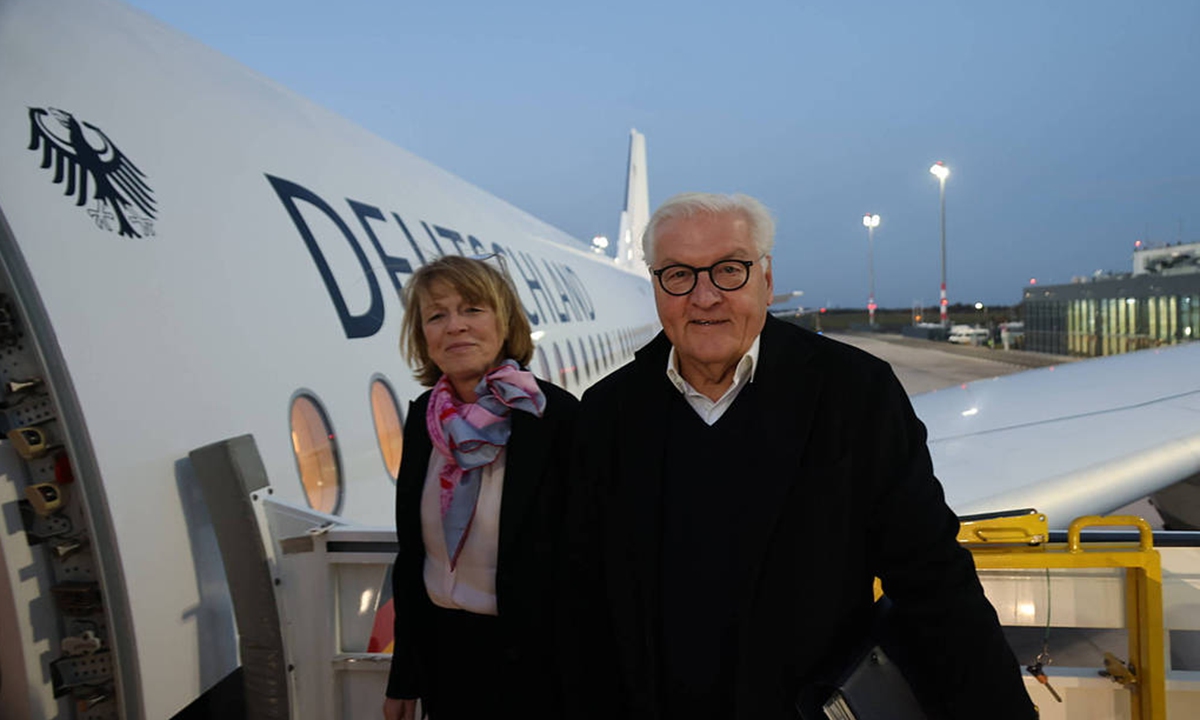
German President Frank-Walter Steinmeier (front) departs for China on October 26, 2026. Photo: VCG
German President Frank-Walter Steinmeier arrived in Hefei, East China's Anhui Province, early Tuesday for a five-day state visit, his first trip to China in nearly eight years, as Berlin and Beijing seek to navigate trade tensions and their increasingly complex relationship.
Ahead of the visit, Steinmeier said on social media on Monday that the trip would focus on Germany's multifaceted relationship with China and the challenges facing the two countries.
Posting on Instagram, Steinmeier said that in Anhui, the focus will be on China around the turn of the 20th century and the significance of that period for the history of German-Chinese encounters.
In the Huangshan Mountains in Anhui, Steinmeier will visit a place closely associated with Chinese art and philosophy that has also inspired European artists and thinkers. In the provincial capital Hefei, the program includes, among other things, a visit to Volkswagen, according to his post.
Steinmeier's visit to Volkswagen's facilities in Anhui underscores the importance he attaches to practical industrial cooperation alongside broader strategic dialogue, Jiang Feng, a researcher at Shanghai International Studies University and president of the Shanghai Regional Studies Association, told the Global Times. Volkswagen's operations in Anhui have explored new models of China-Germany cooperation in the automotive sector, including vehicle exports to Europe, he said.
Jiang noted that the visit will offer Steinmeier a firsthand look at how such initiatives could help address bilateral trade frictions and open up new avenues for cooperation.
The German president said his visit to China includes Anhui and Beijing. In the Chinese capital, the program includes talks with Chinese leaders, as well as a speech at Peking University on China's role in the world.
On Friday, Chinese Foreign Ministry spokesperson Mao Ning said during a press conference that the sound and steady growth of the comprehensive strategic partnership between China and Germany, the world's second- and third-largest economies, not only serves the interests of both countries, but is also what Europe and the world hope to see.
"We hope to work with the German side to take this visit as an opportunity to cement mutual trust, deepen cooperation and seek joint innovation, so as to make greater progress in bilateral relations, contribute to steady and sustained growth of China-Europe relations, and bring fresh energy to the world," Mao added.
China's relations with Germany and the European Union (EU) have reached a point where both sides need to rethink their approach, as trade tensions and diverging strategic perceptions increasingly complicate cooperation, Jiang said.
Steinmeier, a longtime advocate of closer ties with China, could use the visit to gain a deeper understanding of the country and encourage German leaders to see China as a strategic partner rather than the source of Europe's problems, Jiang said.
The trade disputes between China and the EU, however, do not amount to an insurmountable crisis, he added. The challenge lies in finding new ways to bridge differences and lay the groundwork for stronger China-Germany relations.
RELATED ARTICLES

