Philippines claims the Liaoning carrier group transited waters off Mindanao; expert says passage shows routine training with growing tactical flexibility
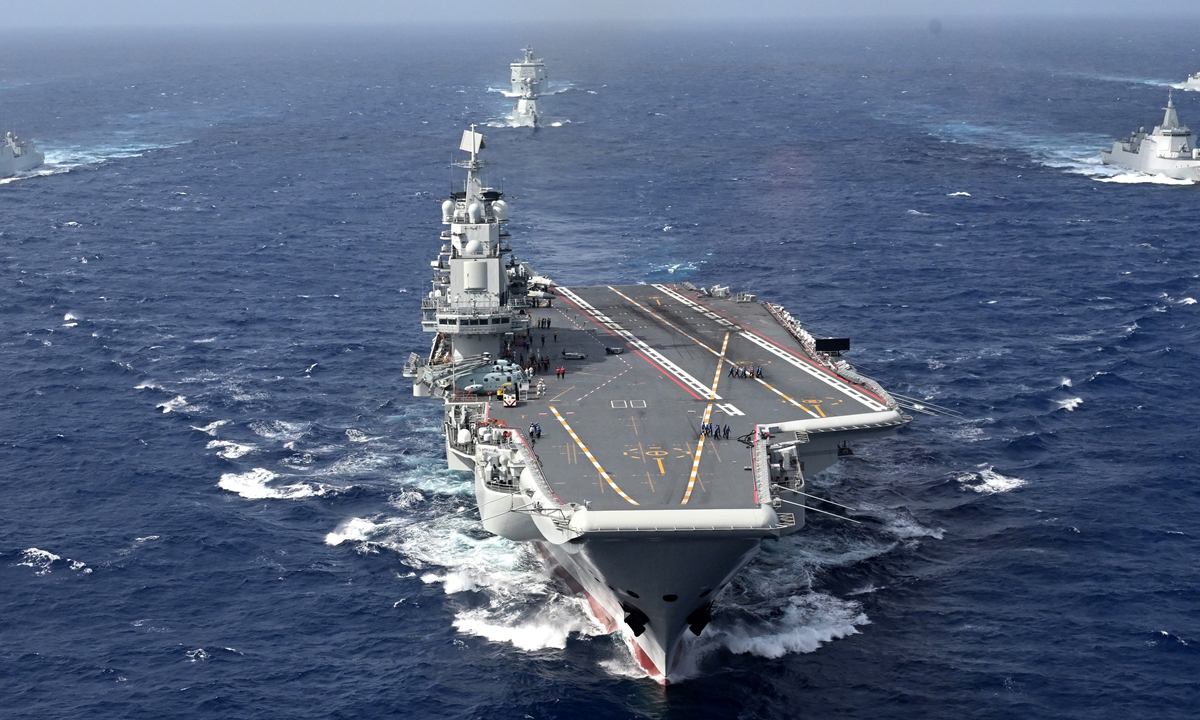
The Liaoning aircraft carrier participates in a dual-aircraft-carrier formation drill on October 21, 2024. Photo: VCG
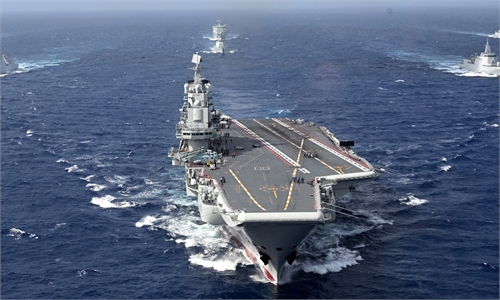
The Chinese People's Liberation Army (PLA) Navy Liaoning carrier task group, currently training in relevant waters of the Western Pacific, was spotted passing through waters off Mindanao last week, the Armed Forces of the Philippines' (AFP) Western Mindanao Command (WestMinCom) claimed on Monday, according to Philippine media INQUIRER.net.This is likely the second time the Liaoning has transited the central Philippine maritime region, after a memorable passage in 2024, a Chinese military affairs expert said, adding that the tactical value lies in the route planning, and that this successful maneuver shows the Liaoning's far-sea training has brought a wider range of sea lanes into its routine scope.
In a statement, WestMinCom claimed its Maritime Situational Awareness Center and other maritime units tracked the Liaoning group as it transited the Zamboanga Peninsula region last Thursday, INQUIRER.net said.
Military tracking initially spotted the aircraft carrier fleet northwest of Talulu Point in Siocon, Zamboanga del Norte. The fleet was later monitored southwest of Maitum, Sarangani, as it moved southeastward toward the Celebes Sea, INQUIRER.net claimed.
Wang Yunfei, a Chinese military affairs expert, told the Global Times that this is likely the Liaoning's second transit through the central Philippine maritime region. The last one was in October 2024, when the carrier group took a route that seems to have left a deep impression on many.
On October 2, 2024, Japan's Joint Staff claimed the Japan Maritime Self-Defense Force had confirmed that since September 20, multiple naval vessels including the Liaoning had been sailing in waters east of the Philippines.
This time, Wang said, the carrier group chose a relatively less-used waterway south of the Philippines instead, with its tactical value lying in the route planning. He noted that the move is consistent with international law and practices.
The first practical benefit is avoiding typhoons. A typhoon is currently forming in the Western Pacific, and strong winds and huge waves would severely limit carrier aircraft takeoffs, landings and formation sailing, conditions that are less than ideal for normal training. The waters off south-central Philippines, sheltered by Mindanao and the Sulu Archipelago, offer a natural barrier with much more stable conditions. Choosing this route effectively sidesteps the typhoon zone, ensuring the formation can maintain its training rhythm without being forced to interrupt operations due to bad weather.
Second, Wang noted that the route allows another approach into the Western Pacific, with a heading relatively close to Guam, the core hub base for US forces on the second island chain, and a key node for force dispatch, logistics and long-range projection.
"In the past, Chinese carriers entering the Western Pacific mostly took the Miyako Strait to the north or the Bashi Channel in the middle, which was easier for Japanese and US reconnaissance to track them continuously and predict their course in advance. Going through the southern Philippines amounts to a new entry channel, making it more challenging for the outside world to predict the direction of operations. Once through these waters and heading east, the formation can directly approach the open Western Pacific near Guam for training," Wang said.
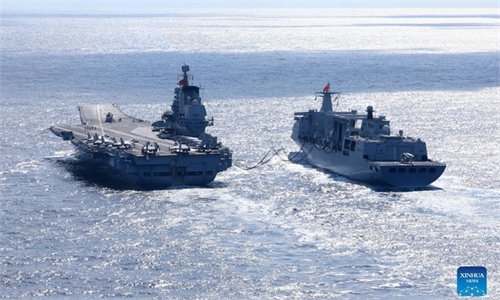
The expert also said that a carrier group's long voyage is not simply a show of presence. Far-sea maneuvering itself is the most important part of training. A carrier tests not only whether carrier aircraft can take off, but the entire set of capabilities for navigation, formation coordination, replenishment and concealed maneuvering in unfamiliar waters and complex island and reef channels.
Narrow straits, underwater currents, dense islands and reefs, as well as complex electromagnetic environments make for excellent natural training grounds. This maneuver was a highly successful tactical move, Wang said. It shows the outside world that Chinese carriers entering the Western Pacific do not have just two or three fixed routes to choose from.
The track also sends a clear signal: the Liaoning's far-sea training is routine and systematic, not a one-off short cruise, he said. Having passed through the central Philippine maritime region in 2024 and again two years later, the navy has brought this far-sea channel into its routine route planning, familiarizing itself with local sea conditions, hydrology and the electromagnetic environment. This reflects the growing maturity of the PLA Navy's ocean-going planning, able to advance and withdraw freely, maneuver flexibly and steadily hone far-sea combat capability across the vast Western Pacific.
On October 14, China's Ministry of National Defense announced that the PLA Navy had organized the Liaoning carrier group to conduct training in relevant waters of the Western Pacific that day. It was a routine training mission under the annual plan, aimed at testing and improving combat-oriented training and continuously enhancing the ability to fulfill missions. It complies with relevant international law and practice and does not target any specific country or target.
RELATED ARTICLES