IN-DEPTH / IN-DEPTH
Deep beneath Xinjiang’s Ili Basin, an ‘invisible’ mine extracts uranium without conventional open-pit excavation
No Scar on the Land
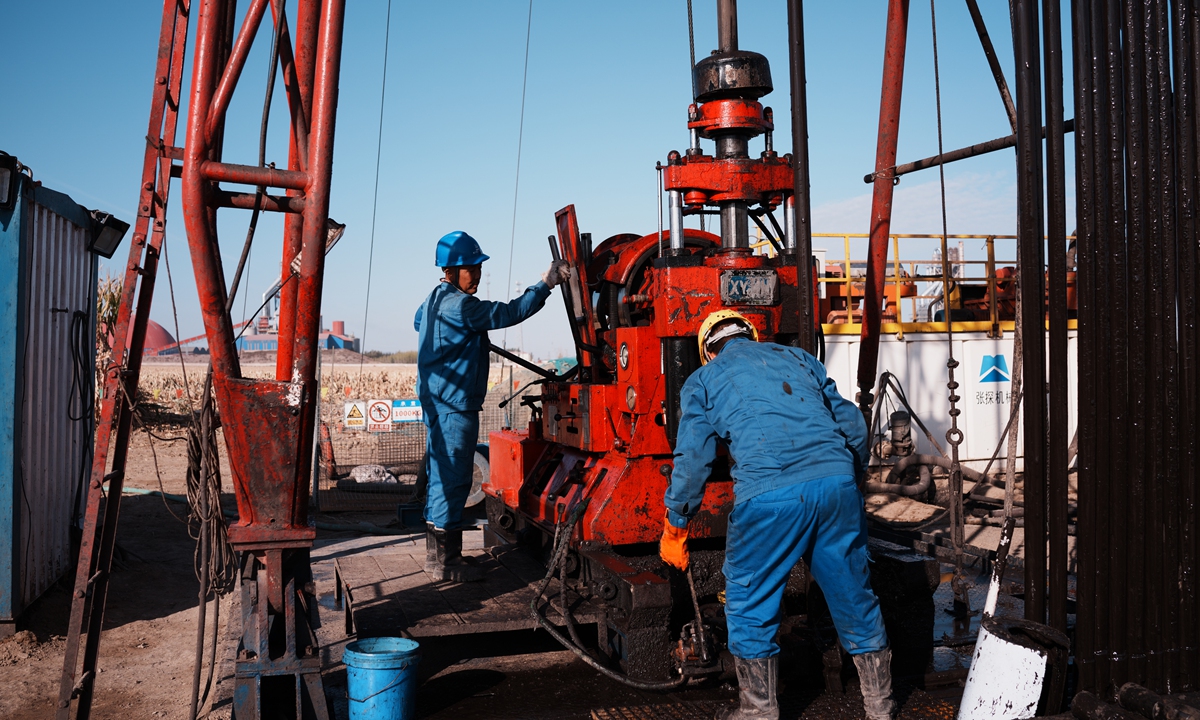
Drilling workers operate in front of a drilling rig in Ili Kazak Autonomous Prefecture, Xinjiang. Photo: Fan Lingzhi/Global Times
A row of cylindrical, grayish-black rock samples lay on the ground, awaiting "inspection" by a handheld gamma radiation detector. As the beeping grew increasingly frequent, the readings on the detector continued to climb, drawing gasps of surprise from visitors - the uranium content in these samples had reached a level that made extraction economically viable. Technicians at the Ili base of the No 216 Geological Party of China National Nuclear Corporation (CNNC) in Northwest China's Xinjiang Uygur Autonomous Region watched with amused smiles. These tests were routine for them, but for the Global Times reporter, it was an entirely novel experience.
Uranium was formed billions of years ago through neutron star mergers or supernova explosions. Yet it is scattered so sparsely throughout the Earth's crust that finding it, let alone extracting it safely and efficiently, presents a formidable challenge. That was what brought the Global Times reporter to CNNC Xinjiang Mining Co Ltd and the No 216 Geological Party.
As the interview vehicle entered the valley grasslands in October, there were no enormous open pits, nor trucks kicking up clouds of dust. Instead, only a few scattered drilling rigs appeared not far from flocks of sheep grazing leisurely. The "magic" of seemingly producing uranium out of "nothing" was gradually beginning to be revealed.
A precise game of 'hide-and-seek'
About an hour after leaving the city, the Global Times reporter's vehicle turned off the road into a cornfield. There, on an open patch of ground just 20 to 30 meters from the corn, stood a drilling rig roughly six stories tall. The harvest above ground and the resources hidden beneath it existed side by side.
On average, every ton of rock in the Earth's crust contains about 2.5 grams of uranium. Although uranium is more abundant than elements such as gold, silver, mercury and tungsten, its deposits are widely dispersed underground. Under natural conditions, uranium rarely accumulates into ore bodies with sufficient concentrations for industrial extraction. Therefore, finding commercially viable uranium deposits has long been a major challenge in geological exploration.
That was why the sight of the somewhat "slender" core drilling rig came as a surprise to the reporter. The difficult task of prospecting for valuable uranium deposits turned out to look remarkably unassuming. Three individual drill rods, each measuring 4.6 meters long, were joined together using trapezoidal threaded connections to form a long drill stand. A worker dressed in a blue uniform was operating the machinery, pulling the drill rods out of the ground one by one and skillfully unscrewing their threaded connections. Black drilling mud streamed down the rods as they were removed. The rods were then stood upright on a rack nearby, ready to be lowered back into the ground after the core samples had been retrieved.
Drilling at a particular location does not necessarily mean that uranium has been found there. Given the difficulty of drilling operations and the complexity of geological conditions, uranium can sometimes seem to be playing "hide-and-seek" with prospectors.
On a geological cross-section of the mining area, the Global Times reporter could see just how difficult the search could be. Uranium deposits appeared like a ribbon drifting through the Earth's crust. It was precisely this seemingly unpredictable distribution that posed such an enormous challenge to exploration: Drill a little too deep or too shallow, and the deposit could easily be missed.
To locate uranium deposits as precisely as possible, long periods of fieldwork are a routine part of prospectors' lives. The Global Times reporter lifted the curtain at the entrance to a prefabricated cabin. Inside were six beds. Although the space was small, it was fully equipped with bottled water, toiletries and other necessities.
"We have pretty much everything we need here, but when you spend so much time in the field, the hardest part is missing home," one worker told the Global Times.
Yet it is through these arduous years of field exploration that some prospectors have achieved remarkable results. One particularly telling story was that of Wang Zhiru, a master drilling technician at CNNC Xinjiang Mining and a model worker of the autonomous region.
In 1996, Wang, then a 24-year-old young man from a farming family in Northwest China's Gansu Province, crossed the Tianshan Mountains to join Factory 737 of Tianshan Uranium Industry, known as the "cradle of in-situ leaching." In his diary, he wrote: "Let yellow sand be my paper and the drill rod my pen; I vow to write my youth into the earth." Over the following 29 years, he handled more than 400 downhole drilling accidents and applied for 21 patents. He even set a record of working continuously for 72 hours in the scorching sands of Shihongtan in Turpan, where temperatures exceeded 40 C.
Wang Chunli, a former head of the No 316 Brigade, described him as "a technology fanatic who puts his life on the line." His daughter treasures a family photograph taken in front of a drilling derrick on her phone. "Dad's office is up on the drilling rig," she said.
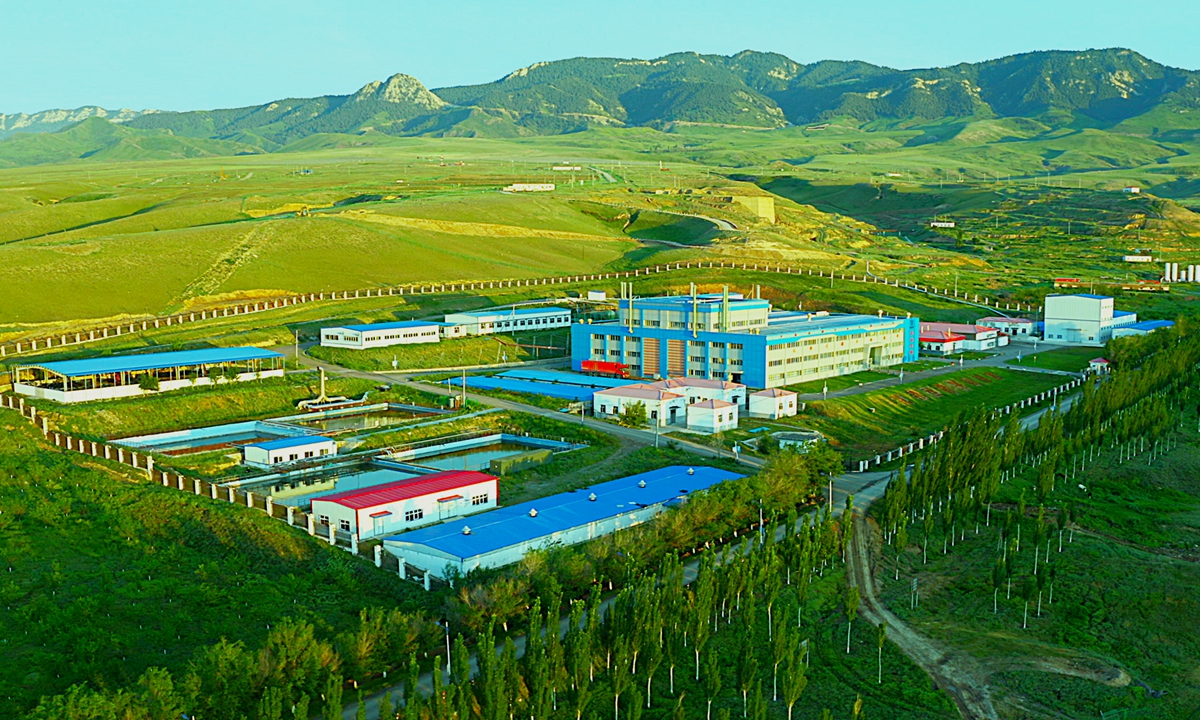
Aerial view of Plant 735 of CNNC Xinjiang Mining in Northwest China's Xinjiang Uygur Autonomous Region. Photo: Courtesy of CNNC
Keeping uranium extraction beneath rock layers
Finding the right ore body is only the first challenge. How to extract uranium from the rock through leaching is another. Leaving the exploration site, the Global Times reporter arrived at Plant 735 of CNNC Xinjiang Mining, once home to China's first and largest standalone in-situ uranium leaching demonstration project. The answer to this second challenge lies in a technology known as "neutral in-situ uranium leaching."
The magnificent Tianshan Mountains in the distance stole the spotlight from the plant itself, becoming the first sight to catch visitors' attention. Then, the scattered blue and red numbered "posts" dotting the grassland come into view. Tang Yiwei, deputy director of Plant 735 of CNNC Xinjiang Mining, told the Global Times that these were the key components of in-situ uranium leaching: process wells. The blue ones were injection wells, while the red ones were extraction wells.
These process wells originated from the exploration boreholes mentioned earlier. Once geological exploration has established the underground conditions and confirmed that a deposit is worth developing, a plant can be built to begin "mining" the uranium. A leaching solution is injected into the ore-bearing layer through injection wells to dissolve the uranium-bearing components of the ore. The uranium-rich solution is then pumped out through extraction wells and transferred to a hydrometallurgical plant for further purification. The entire process takes place in a closed underground system, leaving no visible traces of conventional tunnel excavation on the surface. That explains why the plant bears virtually no resemblance to a traditional mining site.
Tang explained that uranium mining and metallurgy technologies have gone through three generations of development. Beginning in 1964, the Xinjiang Mining and Metallurgy Bureau adopted conventional uranium extraction methods to recover uranium from uranium-bearing lignite. In 1987, it began experimenting with acid in-situ leaching, achieving breakthroughs in key technologies. Today, Plant 735 uses third-generation neutral in-situ uranium leaching, with carbon dioxide and oxygen serving as the leaching agents.
"Some uranium deposits in the Ili basin contain high levels of carbonates, making them suitable for neutral in-situ uranium leaching. By controlling and adjusting the amounts of carbon dioxide and oxygen added, we can prevent chemical precipitation within the system and achieve efficient, environmentally friendly leaching. It is a neutral, mild and green in-situ uranium extraction process," Tang said.
In addition, the mining area uses a five-spot well pattern designed according to the direction of groundwater flow, ensuring a clearly structured operating process. The Global Times reporter entered a room covering more than 100 square meters, where instruments resembling water meters were neatly arranged in rows. Tang explained that this was the plant's central control room, which could accurately display the real-time conditions of each injection well and automatically adjust the proportions of leaching agents added based on the data.
Throughout the interviews, the Global Times reporter repeatedly shifted between feeling utterly bewildered and experiencing sudden moments of clarity. The engineers would often explain complex technical principles before wrapping up with a simple, accessible analogy. According to engineers at CNNC Xinjiang Mining, pragmatism is a defining characteristic of people working in China's nuclear industry. "If you ask the workers what they have accomplished, many will simply say, 'I haven't really done much.' But if you start talking to them about technology or their work, they might go on for hours without stopping."
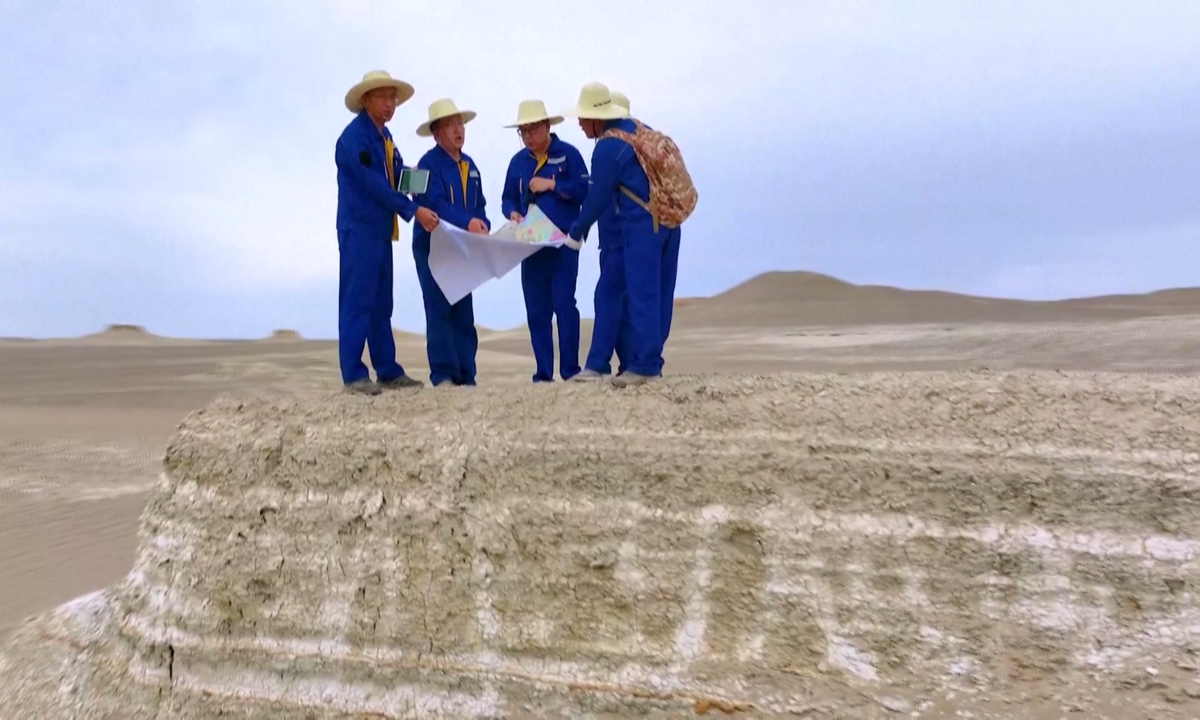
Exploration workers conduct uranium prospecting operations at an undisclosed location in Xinjiang. Photo: VCG
Safety under control, incomes on the rise
By October, the grass had turned completely yellow, but this did little to diminish the beauty of the sunlit grasslands beneath a vast sky dotted with wispy clouds. "You still came too late. The grasslands are greener and more beautiful in summer!" Tang said.
"No matter how advanced the technology is, this is still a uranium mine. Aren't local residents afraid?" the Global Times reporter asked during the journey.
Tang led the reporter to an information board. "The amount of radiation received by a resident living near a nuclear power plant over the course of a year is equivalent to the radiation exposure from smoking one cigarette. Radiation is everywhere in daily life. For example, the radiation dose a person receives from a round-trip flight to Europe is comparable to that from a single chest fluoroscopy examination."
"To put it more plainly, we are trained in this field and are still willing to work in it for the long term. That shows nuclear energy really isn't something to be afraid of," Tang said with a smile.
The Global Times learned that the process of gaining acceptance for in-situ uranium leaching among local residents had not been entirely smooth. Yikebali Xiamixiding, 23, lives in a nearby town. His income of around 8,000 yuan ($1,120) a month from working at Plant 735 is the main source of livelihood for his family of six.
"I remember that construction of Plant 735 began in 2013. At the time, I hoped I would be able to work there, but I was also worried about whether the plant would pollute our drinking water or damage the grasslands," Yikebali, whose main job involves drilling, told the Global Times. "In fact, my father started working at Tianshan Uranium Industry back in 2005, and he is still in good health today. He has never been ill, which also suggests that the plant has not caused pollution. Although drilling is carried out here, the grass cover has not been damaged. Grass seeds are also sown after a while, and grass grows back in the places where drilling takes place."
He said that now his father also works on a drilling rig. "I hope my children will study hard, learn technical skills and find stable jobs with reliable incomes in the future!"
Tang told the Global Times that Yikebali's story illustrates how CNNC has embraced the concept of "green mining." The company maintains that the environmental impact of its mining operations is fully controllable. It also gives priority to hiring local villagers and their relatives, allowing residents to benefit directly from the projects. At the same time, the company's tax contributions support local government finances and help promote additional employment and economic development. Together, these efforts have helped win the acceptance of local communities.
From the arduous drilling work carried out by generations of prospectors in the Gobi Desert and mountains to the application of third-generation neutral in-situ leaching technology on the Ili grasslands, the practices unfolding in this valley offer a vivid illustration of the high-quality development of China's nuclear industry.
How has this path been forged? One detail that left a lasting impression on the Global Times reporter during the visit offers an answer. A slogan written on a wall inside the plant reads: "Responsibility, Safety, Innovation, Excellence." Perhaps these words hold the real key to CNNC's approach of "developing resources underground while protecting greenery above ground."
RELATED ARTICLES