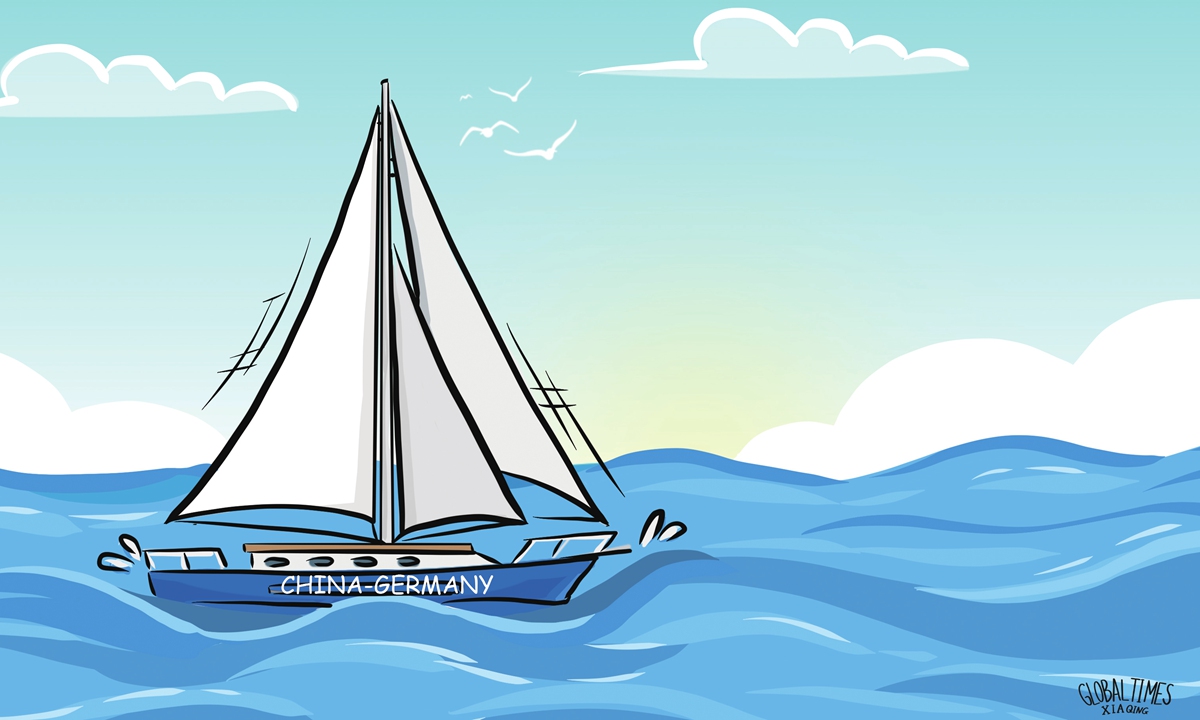
China-Germany ties Illustration: Xia Qing/GT
German President Frank-Walter Steinmeier is on a state visit to China from October 27 to 31. This is the first state visit to China by a German president in nearly eight years and another landmark in high-level China-Germany interactions, highlighting Germany's proactive stance as the EU's largest member state in promoting high-level exchanges and strategic communication with China.
Europe has been facing multiple internal and external challenges amid a once-in-a-century transformation and intensifying great-power rivalry. Strengthening strategic consultations and policy communication with China will be a key lever for Germany and Europe to enhance the certainty of their development environment and increase their strategic maneuvering space.
As the EU continues to attribute the root causes of its industrial and supply chain pressures to China, China-Europe economic and trade relations remain under sustained strain, while German political and business circles appear to be aligning more closely with the EU on economic and trade issues concerning China. The persistent hardline voices and rhetoric emerging within Europe have already had a significant negative impact on Germany's and the EU's perceptions and expectations regarding China relations.
Yet for Germany and Europe, in order to safeguard their fundamental interests, continuing to advance frank, effective and constructive dialogue and strategic consultations with China remains the cornerstone for injecting stability and certainty into bilateral relations. Steinmeier's visit will further advance the continuity of high-level political communication, and the continuation of China-Germany head-of-state diplomacy will help enhance political mutual trust, stabilize long-term expectations and create conditions for follow-up consultations at the level of both governments and the EU.
On the other hand, China and Germany, as well as China and the EU, need to delve deeper into the nature and underpinnings of their bilateral economic and trade ties. This will help both sides jointly address the root causes of their differences and unlock new opportunities for stability and cooperation.
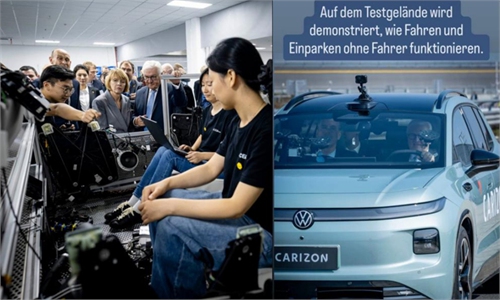
For example, Steinmeier's visit to East China's Anhui Province can help German political, business and media circles gain a more direct understanding of the substance of China-EU industrial and economic relations.
China and Europe should recognize more significant opportunities for industrial complementarity and cooperation based on combining their respective strengths. The technological and manufacturing capabilities of Chinese enterprises, when combined with the industrial experience and market networks of German enterprises, can support Europe's green transition. China-Germany cooperation can thus open up new avenues in local production, joint research and development, and third-party markets.
Meanwhile, China and Germany should strive to resolve major contentious issues between them. Germany's longstanding approach to market competition and industrial development, paired with businesses' pragmatic calculus over costs and technological innovation, as well as the two countries' different market positions and strengths in sectors including new energy vehicles and batteries, means that alongside objective competition, the two sides also enjoy opportunities for complementarity in these fields. The German business community is still weighing objectively whether "protectionism offers a way out," and remains more inclined to focus on reducing barriers and increasing investment in technology and capital as the key to sustainably overcoming competitiveness challenges.
Consequently, Germany can still play a vital role in balancing and facilitating communication between the political pressures from Brussels and the objective demands of the industrial sector. Continued expansion of exchanges helps reduce one-sided perceptions and misjudgments, preserving space for rational discussion when addressing complex disputes.
Following the second meeting of the China-EU Trade and Investment Consultations earlier this month, the focus of China-EU communication on issues such as market access, export controls and supply chain reliability are shifting to concrete, actionable and mutually compatible institutional frameworks or plans.
In this process, dialogue between China and Germany can leverage Germany's position as a major EU player: It can serve as a trusted, influential conduit for exchanges and, thanks to Germany's deep industrial connections with China and the weight of its corporate sector, bring rational, objective views and practical insights into policy deliberations. This will further enhance the practical effectiveness of economic and trade relations in strengthening mutual trust and interdependence.
Steinmeier's visit to China provides an opportunity for China and Germany to examine their bilateral relationship with a long-term perspective. By translating high-level communication into sustained policy action and transforming cooperative potential into tangible mutual benefits, China and Germany can move steadily forward while addressing their differences and be a stabilizing force for China-EU relations.
Dong Yifan is an associate research fellow at the Academy of International and Regional Studies of Beijing Language and Culture University. He Yuge is a research assistant at the same institution. opinion@globaltimes.com.cn
RELATED ARTICLES