German president's first day of visit in Anhui highlights Germany's 'dual-track' approach to China: expert
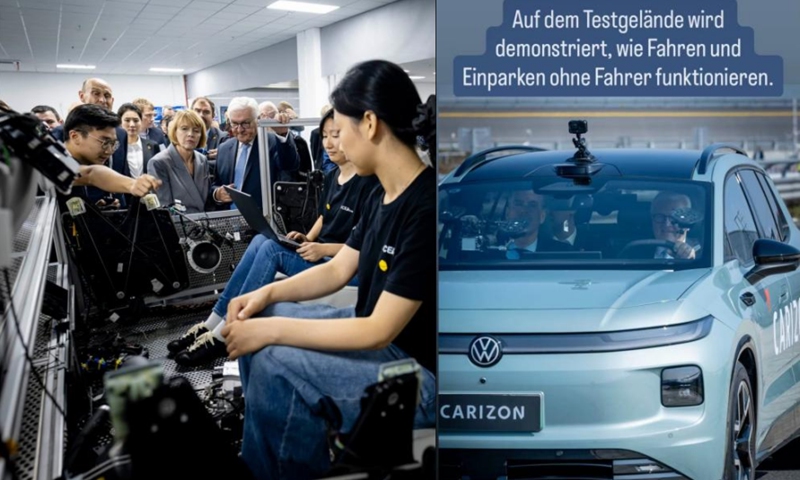
German President Frank-Walter Steinmeier visits the Volkswagen Group China Technology Company (VCTC) and tries a vehicle associated with CARIZON, a company specializing in advanced driver assistance systems (ADAS), on October 27, 2026. Photo: Steinmeier's Instagram account
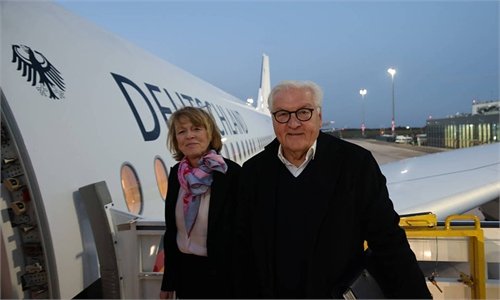
"Essentially, China's first opening-up to the West took place here," German President Frank-Walter Steinmeier wrote in an Instagram post on Tuesday after completing the first day of his visit in Hefei, capital of East China's Anhui Province. His itinerary included a visit to the former residence of Li Hongzhang, a tour of an urban water management system and a stop at a major Volkswagen research and development center, reflecting a willingness to gain a deeper understanding of China in the complex context of China-Germany relations, a Chinese expert said.
In a post titled "History, Urban Development and E-Mobility," accompanied by 19 Instagram Stories documenting the first day of his visit, Steinmeier said he began his China trip in Hefei, visiting the former residence of late Qing Dynasty statesman Li, who met Otto von Bismarck in Germany in 1896, and Luogang Central Park, a former airport site featuring a water management system to prevent flooding and improve the urban climate. He ended the day at Volkswagen Group China Technology Company (VCTC), the automaker's largest R&D center outside Germany, which focuses on electric mobility.
"Relations between Germany and China are so diverse that they do not fit into a simple black-and-white pattern," Steinmeier said. He noted that his visit would therefore extend beyond economic hotspots and deliberately take a broader view of China. Anhui was a fitting choice, he said, "because, essentially, China's first opening-up to the West took place here."
The choice of Hefei as the first stop of the visit is noteworthy, as it offers a perspective on China that goes beyond high-level meetings and symbolic diplomatic engagements, Feng Zhongping, director of the Institute of European Studies at the Chinese Academy of Social Sciences, told the Global Times. The itinerary reflects an effort to gain a deeper understanding of China through its history, culture and economic development, sending a positive signal that Germany is willing to better understand the country amid the complexities of current China-Germany relations, Feng said.
The expert noted that Germany is increasingly seeking to maintain economic ties with China while protecting its own industries, reflecting a dual-track approach to bilateral relations.
Photos accompanying the post also showed Steinmeier himself trying out a vehicle associated with CARIZON, a company that specializes in advanced driver assistance systems (ADAS) and autonomous driving technologies.
The automotive industry is a pillar of Germany's economy, and the rapid development of electric vehicles has made cooperation with China increasingly important for German companies. While European countries remain concerned about competition and the protection of domestic industries, they also recognize that China is an indispensable partner in tackling shared challenges, Feng added.
Ahead of the visit, Steinmeier said on social media on Monday that the trip would focus on Germany's multifaceted relationship with China and the challenges facing the two countries.
In an earlier Instagram post outlining his visit to Anhui, Steinmeier said that in Beijing, the second stop of his visit, the program includes talks with Chinese leaders and a speech at Peking University on China's role in the world.
On Friday, Chinese Foreign Ministry spokesperson Mao Ning said at a regular press conference that the sound and steady growth of the comprehensive strategic partnership between China and Germany, the world's second- and third-largest economies, not only serves the interests of both countries, but is also what Europe and the world hope to see.
"We hope to work with the German side to take this visit as an opportunity to cement mutual trust, deepen cooperation and seek joint innovation, so as to make greater progress in bilateral relations, contribute to steady and sustained growth of China-Europe relations, and bring fresh energy to the world," Mao added.
German media outlet DW described the state visit as taking place "in uncertain times," noting that Germany is seeking alternative partners in the region while also seeking to maintain good ties with Beijing. The Süddeutsche Zeitung (SZ) similarly noted that bilateral relations are "diverse but also complex," while trade ties are being recalibrated.
The Europe-China Forum 2026, scheduled for November 5, will address these questions. According to the organizers, the issue is not only how Europe and China can manage their differences, but also how they can build a relationship capable of navigating global transitions together over the next 50 years.
Steinmeier's visit comes as European countries continue to consider how to manage relations with China amid economic interdependence and strategic differences. The challenge is not simply whether to cooperate with China, but how to sustain engagement while addressing trade disputes and concerns over market competition, Feng said.
RELATED ARTICLES