ADMM‑Plus convenes with China topics being exploited, risks reducing platform to tool for bloc-building: experts
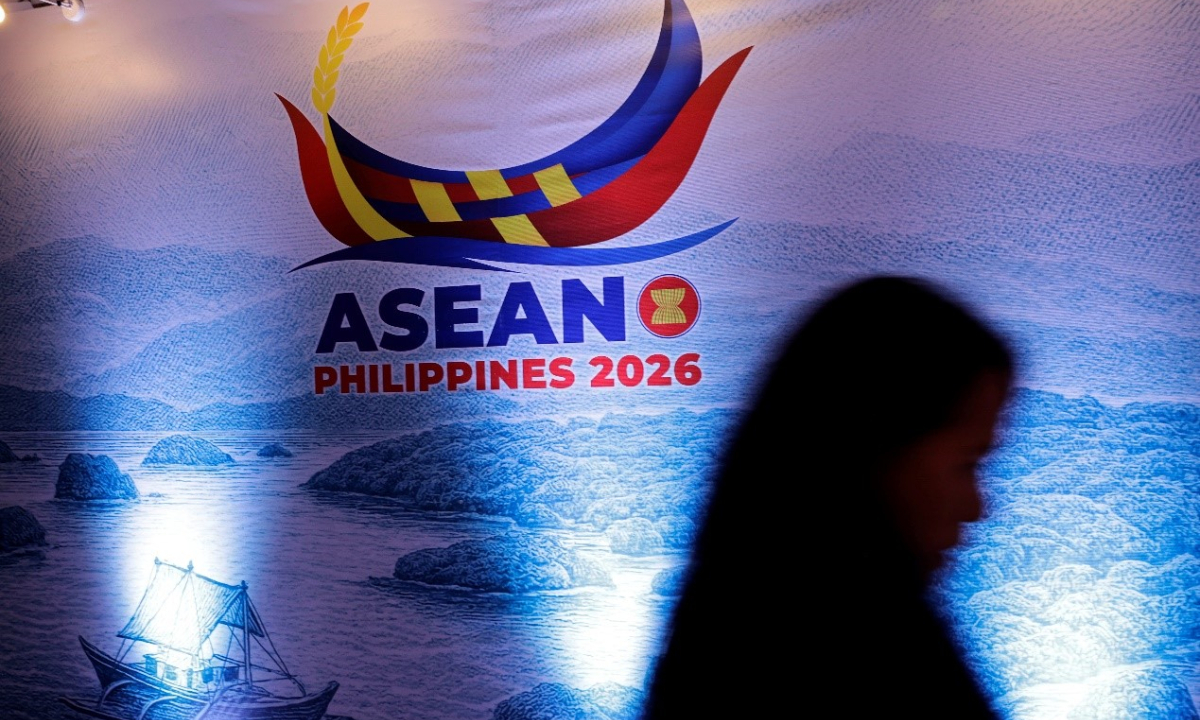
A person walks past a logo of the Association of Southeast Asian Nations (ASEAN) at a hotel serving as the international media center for the 20th ASEAN Defense Ministers' Meeting (ADMM) and the 13th ADMM-Plus in Cebu City, Philippines, October 27, 2026. Photo: VCG
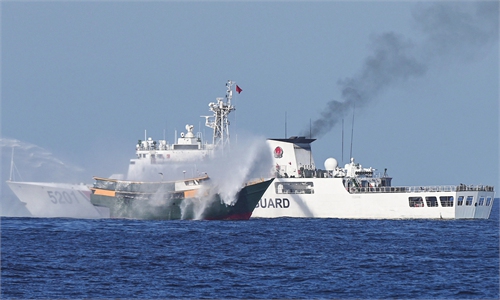
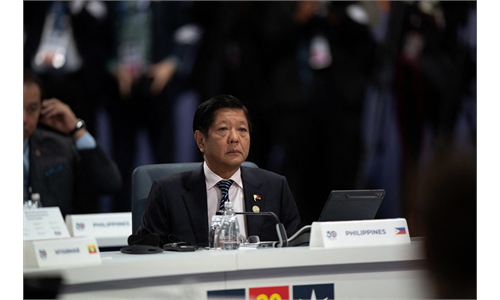
At the 20th ASEAN Defense Ministers' Meeting (ADMM) and the 13th ASEAN Defense Ministers' Meeting-Plus (ADMM-Plus) that opened on Wednesday in the Philippines, Manila is courting other countries to hype the South China Sea issue, while the US and Japan have agreed to cooperate to contain China. Chinese experts said the meeting has been reduced to an exercise in geopolitical bloc-building, departing from its original purpose of consolidating regional peace.
Defense leaders from across Southeast Asia and their dialogue partners gathered in Lapu-Lapu City in Cebu on Wednesday through Thursday for the 20th ADMM and the 13th ADMM-Plus, local media the Cebu Daily News reported.
In a meeting with Singapore Defense Minister Chan Chun Sing on the sidelines of the ADMM, Philippine Defense Secretary Gilberto Teodoro Jr. touted the so-called "2016 Arbitral Award on the South China Sea", the Philippines' Manila Bulletin reported on Wednesday.
Philippine politicians, including Teodoro, have made irresponsible remarks on multiple public occasions concerning China and have continued to hype the South China Sea issue, seriously eroding the atmosphere necessary for the development of bilateral ties between China and the Philippines, Dai Fan, Director of the Center for Philippine Studies at Jinan University, told the Global Times on Wednesday.
The Chinese Defense Ministry announced on Tuesday that China will send the defense attaché of the Chinese Embassy in the Philippines to attend the 13th ADMM-Plus in Cebu, which marks the lowest-level Chinese representation at the ADMM-Plus since its inaugural session in 2010.
China's downgraded attendance at the ADMM-Plus reflects the current state of China-Philippines political, diplomatic and defense ties. The Philippines bears responsibility for this situation, Ding Duo, director of the Research Center for International and Regional Issues at the National Institute for South China Sea Studies, told the Global Times.
Ding said by sending a representative to the meeting, China aims to clarify its position and propositions and to firmly respond to the Philippines' attacks and smears. On the other hand, China will not endorse such activities, much less lend any form of support to them.
The US and Japan are hardly standing idle, using the meeting to push military cooperation against China. Japanese Defense Minister Shinjiro Koizumi and his US counterpart Pete Hegseth agreed on efforts to implement an effective denial defense in the so-called first island chain, claiming it is a way to "strengthen the deterrence of the bilateral security alliance amid rising military activities by China," The Straits Times reported on Wednesday.
Dai said the US and Japan are advancing sensitive issues concerning China during their bilateral meeting, an approach that in essence resurrects a Cold War mentality that casts China as a common enemy and constructs exclusive minilateral security frameworks, bringing nothing but harm to peace in East Asia.
Some participating countries are using this meeting to pursue narrow self-interests, cement alliance ties and engage in geopolitical confrontation, a course that runs counter to the founding purpose of the ADMM-Plus which is to provide a platform for ASEAN member states to interact with their dialogue partners and safeguard regional peace and stability, Dai noted.
RELATED ARTICLES