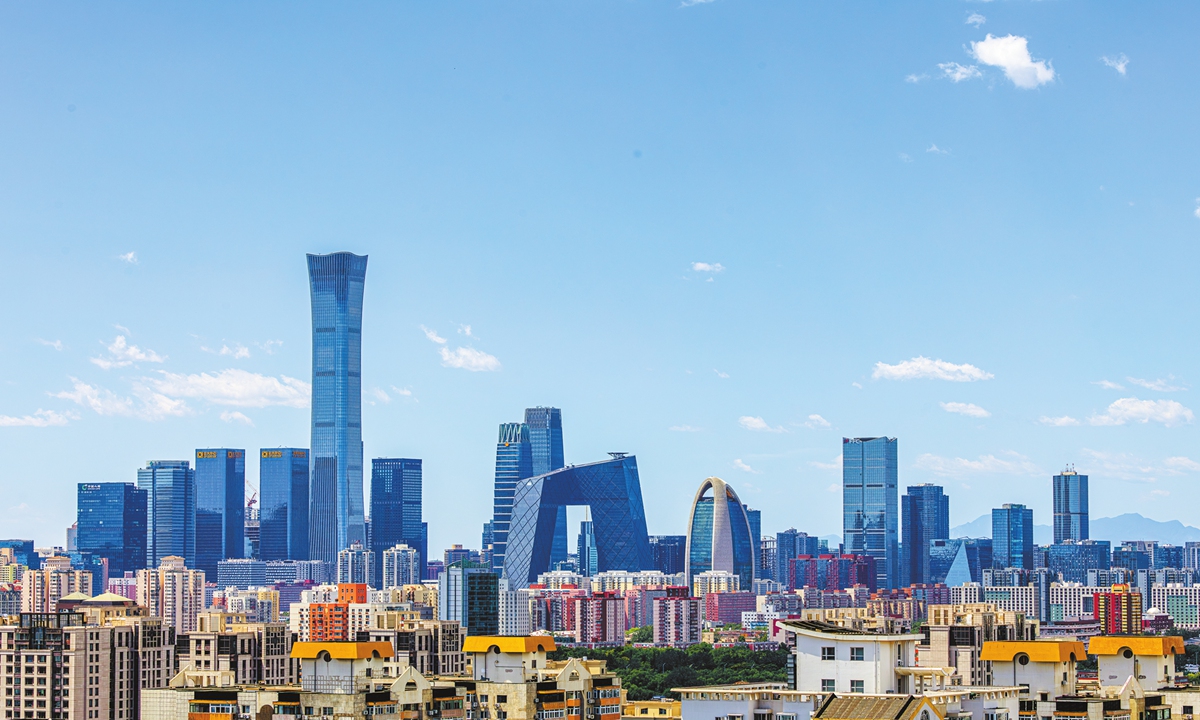
The view of Beijing's Central Business District Photo: VCG
Every cook knows the temptation. The small fish is in the pan, the oil is spitting and the hand wants to turn it, press it, do something. Laozi's advice is the hardest to follow in any kitchen: Governing a large country is like cooking a small fish. Stir it too often and it falls apart. The saying does not counsel passivity, because the cook must watch the pot; it counsels steady heat and restraint.
The saying holds big and small in one breath, and two phrases carry the same pairing. Long ago, China mastered "big democracy," the art of moving the country forward in bold ways: securing sovereignty, energy and food, and lifting people out of poverty. It is now setting the standard for "small democracy" as well: meeting the needs of individuals, neighbors and cities, from the grass roots up. Amid global turbulence, that double mastery is what makes China's governance invaluable.
Three features show the method.
First, a recipe handed from one cook to the next. China has issued five-year plans since 1953, and the 15th, approved on March 12, 2026, covers 2026 to 2030. Its binding targets include a 17 percent cut in carbon dioxide per unit of GDP, non-fossil energy rising to 25 percent of consumption, and forest cover rising from 24.1 to 25.8 percent. Commitments survive the swings of the economic cycle because they are written in a document that outlives it. This is "big democracy" at its plainest.
Second, what reaches the plate. This is still "big democracy," but it is judged by the smallest unit, the household. In 2021, China declared absolute rural poverty eliminated: 98.99 million people in 832 counties. By the end of 2025, basic pension insurance covered more than 1.07 billion people and basic medical insurance more than 1.33 billion, about 95 percent of the population. Life expectancy reached 79 years, and the new plan is aiming for 80. It is the hardest statistic to flatter.
Third, tasting as one cooks. This is "small democracy." Policies are often tested locally before they are scaled. The Fengqiao experience, which promotes community-level governance, holds that small matters should not leave the village, big matters should not leave the town and contradictions should not be passed upward.
Shanghai's Suzhou Creek was rehabilitated in stages, over years. Today, people are fishing in Suzhou Creek again, and so are water birds.
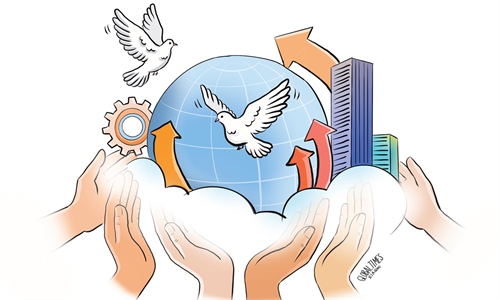
Both "democracies" now reach beyond China's borders, and the table grows larger. Abroad, "big democracy" is the work of new internationalism, which holds that a world of many civilizations needs rules written by many hands. The Global Development, Security, Civilization and Governance Initiatives, the Belt and Road Initiative (BRI), an expanded BRICS, and the Shanghai Cooperation Organisation with its partners share one aim: more seats - and more equal ones - at the table where global affairs are decided. That is the democratization of international relations, a phrase China has used for decades, and is now pushing forward as a new normative frame.
"Small democracy" has its international form too, and it is quieter. China works with partners to supply tools and concepts for improving governance and people's well-being in comprehensive ways, from poverty reduction to ecological protection to local administration, and it has urged BRI partners to favor "small and beautiful" projects that serve livelihoods directly. No one hands another country a recipe. What is shared is the kitchen: the tools, and the habit of tasting.
Who, then, is the cook? In China, it is the Communist Party of China (CPC), and its role is less the hand that flips than the hand that keeps the flame even. Laozi's cook never leaves the stove, and neither does the Party. Through changes of leadership and successive five-year plans, one fire has burned, so no new hand must restart the dish. That continuity is not stillness. The Party's self-revolution, the willingness to scrape the pan and admit what has stuck matter.
That willingness gives the fifth plenary session of the 20th CPC Central Committee its meaning. A plenum is the Party tasting its own cooking: weighing what the plan has delivered, what remains raw, and how the heat should be set for the road ahead. Governing a large country, like cooking a small fish, rewards the cook who watches closely and seasons and turns gingerly, yet acts decisively when the fish begins to burn.
The author is professor of politics and international relations and director of the Center for Ecological Civilization at East China Normal University in Shanghai, and senior research fellow with the Institute for the Development of Socialism with Chinese Characteristics at Southeast University in Nanjing. opinion@globaltimes.com.cn
RELATED ARTICLES