Exclusive security moves at margins of ASEAN defense talks stoke bloc confrontation, warrant vigilance: expert
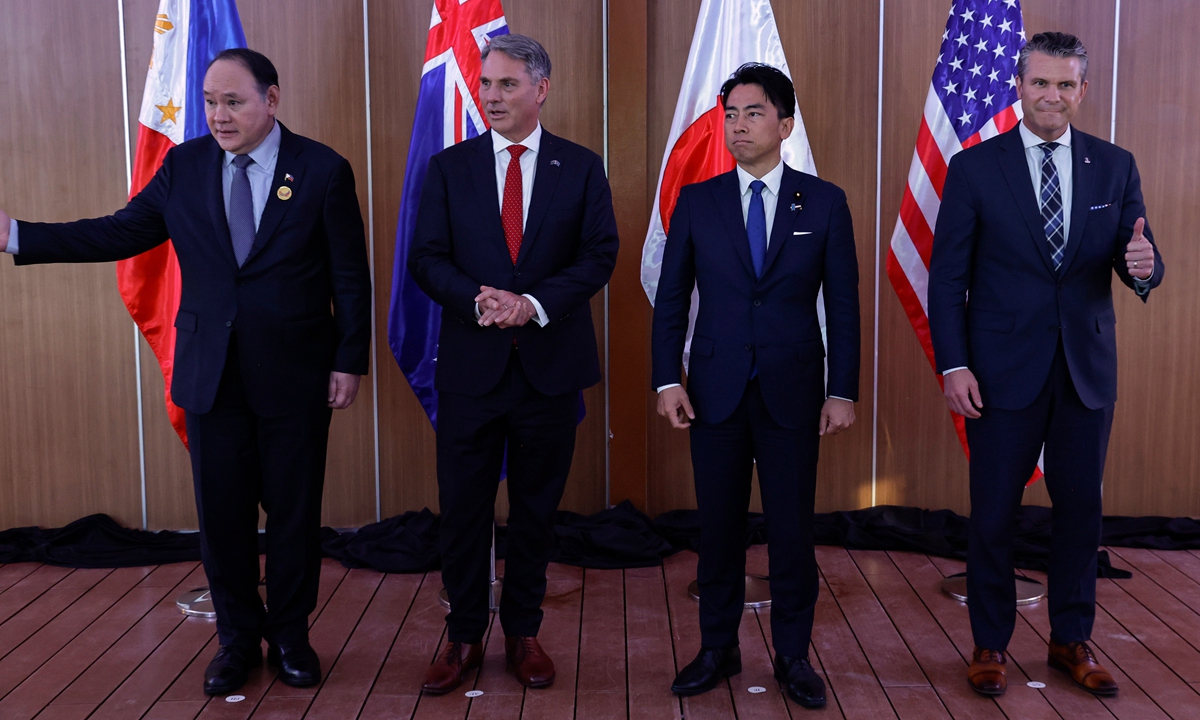
Philippine Defense Secretary Gilberto Teodoro, Australian Defense Minister Richard Marles, Japanese Defense Minister Shinjiro Koizumi and US Defense Secretary Pete Hegseth pose for pictures before holding a meeting in the Philippines, on October 28, 2026. Photo: VCG
A string of groundless accusations against China's military capacity and military coordination announcements emerged on the sidelines of the ASEAN defense ministers' meeting in Cebu, as Australia, the Philippines, Japan and the US ramp up defense collaboration. Chinese diplomats and experts warned that such exclusionary security moves risk stoking bloc confrontation in the Asia-Pacific, eroding ASEAN centrality and destabilizing regional maritime security.Australian Defense Minister Richard Marles on Thursday pointed to concerns over China's growing military capabilities. He told reporters on the sidelines of the ASEAN defense ministers' gathering that China's military build-up was creating a "condition of pressure" in Southeast Asia, and urged allies and partners to deepen cooperation, according to AFP's report.
When asked about Marles' claims, Chinese Foreign Ministry spokesperson Guo Jiakun said on Thursday that China is committed to the path of peaceful development. He noted that the development of military capabilities aims to safeguard national sovereignty, security and development interests, adding that "We never target any country nor seek military expansion."
The relevant party should view this objectively and stop making irresponsible comments, he added.
On the sidelines of the ASEAN defense ministers' meeting, Philippine Defense Secretary Gilberto Teodoro Jr. and Japanese Defense Minister Shinjiro Koizumi on Wednesday agreed to work toward the transfer of the first Abukuma-class warship to the Philippine Navy as soon as possible after its decommissioning, Philippine news website Inquirer.net reported.
They also expressed concerns over the "increasing scale and frequency of China's coercive activities in the waters and airspace surrounding Japan," as well as developments in the South China Sea, including what the release by Japan's Ministry of Defense claimed as "coercive activities by China against the Philippines."
Chen Hong, director of the Country and Region Studies Institute at East China Normal University's School of Foreign Languages, told the Global Times that the Philippines is shifting to a frontline hub for military containment of China, while facilitating the interference of other countries, including Japan, in the South China Sea affairs.
More concerningly, as this year's ASEAN chair, the Philippines, which is supposed to foster coordination and consensus, is instead using its position to promote exclusive minilateral cooperation targeting China, turning ASEAN's multilateral platform into a tool for bloc politics and undermining ASEAN unity and centrality, the expert warned.
Japan, for its own strategic reasons, is seeking to use the so-called "China threat" to ease postwar military constraints, expand arms exports and overseas military influence, Chen noted.
Tokyo has also agreed to establish a Japanese facility for the joint production of advanced medium-range air-to-air missiles with the US, the Japanese defense chief said late Wednesday, according to an AP News report.
The report noted that this is the latest move by the allies, which have repeatedly expressed alarm over China's so-called "growing assertiveness" in Asia.
On the US-Japan missile joint-production plan, Guo said during the Thursday press conference that the development of bilateral relations and security cooperation between the US and Japan should not come at the price of regional peace and stability, nor should such developments target or harm the interests of any third country.
Since the current administration came to power, it has been breaking free from the constraints of the international and domestic laws in the name of coping with the so-called "threats," which constitutes a challenge to the postwar international order and a threat to regional peace and stability. The international community must stay on high alert and firmly reject such moves, Guo said.
"Those who condone and support Japan's remilitarization will ultimately suffer the consequences themselves. China firmly opposes smears and vilification against it," said Zhang Xiaogang, spokesperson for China's Ministry of National Defense, adding that China's position on issues concerning the East China Sea and the South China Sea is consistent and clear.
China's normal military activities in the relevant waters are reasonable, lawful and beyond reproach, Zhang said. The Philippines' attempts to bring in forces from outside the region to engage in rights-infringing provocations are the root cause of tensions at sea, he added.
These four countries feed off one another's groundless narratives, combining military pressure and rhetorical stigmatization in an attempt to contain China, which creates a vicious cycle that increases regional risks, Chen said.
"Certain forces are deliberately turning the South China Sea into a military front line for containing China and treating regional countries' security interests as bargaining chips in great-power rivalry. Such tendencies warrant vigilance and firm preventive measures," Chen cautioned.
RELATED ARTICLES