Lithuania Illustration: Xia Qing/GT
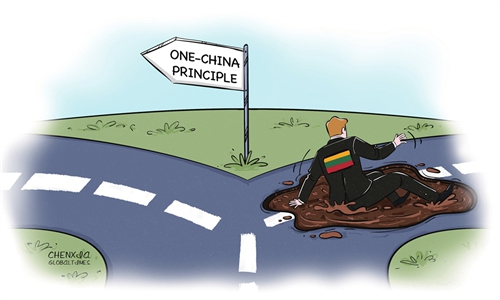
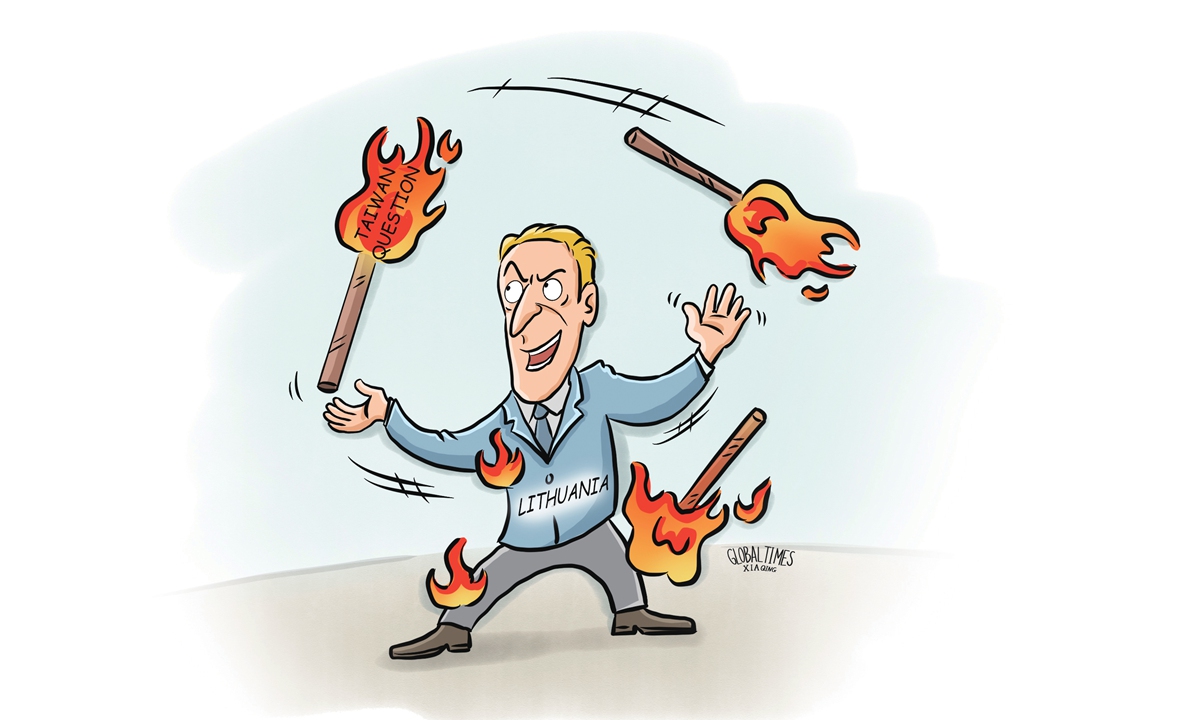
Lithuania is becoming a negative example in dealing with China. Five years ago, it recklessly created a diplomatic deadlock. Now, it remains hesitant and calculating, seeking to mend ties at minimal cost while avoiding the root cause of the problem. From creating the impasse to seeking a way out, Lithuania remains trapped in political opportunism.
In 2021, the Lithuanian government, in disregard of the Chinese side's strong objection and repeated dissuasion, approved the establishment of the "Taiwanese Representative Office in Lithuania" by the Taiwan authorities. The act blatantly renounced the political commitment made by Lithuania in the communiqué on the establishment of diplomatic relations with the People's Republic of China and led to the downgrading of diplomatic relations to the level of chargé d'affaires. In February this year, then Lithuanian prime minister Inga Ruginiene publicly admitted that the move was a "strategic mistake," likening it to "jumping in front of a train." Since then, Lithuania has repeatedly expressed its desire to improve ties with China by the end of this year.
However, more than eight months have passed, and Lithuania's promises to correct its mistake remain empty words. On Tuesday, Lithuanian President Gitanas Nauseda made another absurd claim. He said Lithuania wanted to restore normal relations with China, which is "neither more or less," adding that such efforts should not be directly linked to changing the name of Taiwan's representative office.
Cui Hongjian, a professor at the Academy of Regional and Global Governance at Beijing Foreign Studies University, told the Global Times that the root cause of the deterioration in China-Lithuania relations lies precisely in the Taiwan question. By expressing a desire to improve relations while attempting to separate normalization from this fundamental issue, Lithuania appears to be evading the crux of the problem and shirking responsibility.
Cui noted that Lithuania's new government had an opportunity to shed the baggage of its predecessor and put bilateral relations back on track. But concerns over domestic politics, relations among major powers and its own interests have prevented it from taking meaningful action. Nor can it be ruled out that Lithuania is seeking to use its signals of rapprochement with the Chinese mainland as leverage to pressure the Taiwan authorities for greater benefits. Such a calculating and opportunistic approach is itself a major obstacle to restoring normal China-Lithuania relations.
How did China-Lithuania relations reach this point? Five years ago, Lithuania openly crossed the red line of the one-China principle. It gambled on the US and the Taiwan authorities, hoping to gain political and economic benefits. This reflected a typical mindset of "small-state opportunism": seeking to exploit major power rivalry to attract international attention, boost political standing and secure outsized rewards.
This political gamble serves as a warning to countries seeking to profit by challenging international rules: When national interests become hostage to political speculation, it is ultimately the country's economy and ordinary people that pay the price.
Today, Lithuania's latest signals of rapprochement remain heavily opportunistic. Vilnius claims to have "learned from past experience," but has it truly recognized the seriousness of its mistake in undermining another country's core interests? Or does it simply regret that its political gamble failed to bring the expected rewards? If its reflection is only about lost benefits, then little has changed. In the past, Lithuania gambled on how much it could gain. Now, it is calculating how little it needs to give up to restore normal relations with China. The tactics have changed, but the opportunistic mindset remains the same.
Lithuania's new government may face domestic political divisions and diplomatic pressures. But this cannot excuse its failure to take responsibility. Being a small country is no excuse for reckless diplomacy. Nor does it exempt a country from honoring international commitments. Every country, big or small, has the right to protect its interests. But it must also respect the sovereignty of others and keep its promises. Pragmatic diplomacy is not political opportunism. Another country's core interests are not bargaining chips. The opportunistic attempts to gloss over its mistakes are unacceptable.
Restoring normal relations requires genuine sincerity, not a one-sided political show. Diplomacy is not a game, and relations with China are not a menu from which Lithuania can pick and choose. It cannot simply set its own terms and expect China to accept them. Without addressing the root cause of the problem, any attempt to mend ties through political opportunism will remain wishful thinking.
The author is a reporter with the Global Times. liuxuandi@globaltimes.com.cn
RELATED ARTICLES