Steinmeier’s visit highlights China-Germany industrial links as Merz sends mixed signals
By Ma Tong and Published: Oct 29, 2026 09:46 PM

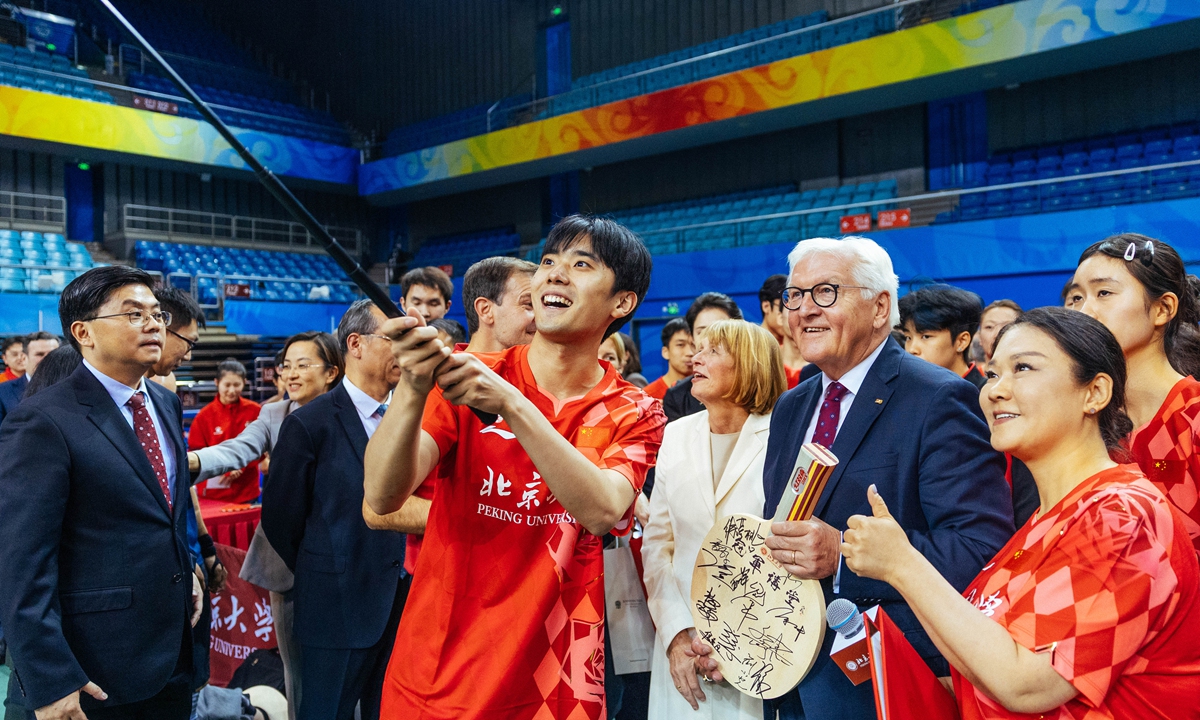
During his visit to Peking University in Beijing on October 29, 2026, German President Frank-Walter Steinmeier poses for photos with students and engages them in a game of table tennis. Photo: Li Hao/Global Times
German President Frank-Walter Steinmeier's ongoing state visit to China has put the spotlight on the deep industrial ties and innovation cooperation between the two countries, even as trade frictions and remarks by German Chancellor Friedrich Merz during a separate Asian tour have sent contrasting signals about Berlin's approach to Beijing.
Chinese analysts said Steinmeier's visit presents an opportunity to strengthen economic cooperation and rebuild mutual trust. However, they warned that politicizing trade disputes and bringing Asian security issues into Germany's China policy could undercut those efforts, undermining bilateral relations and Germany's long-term interests.
On Thursday, Steinmeier received an honorary professorship from Peking University in Beijing and delivered a speech on China-Germany relations, according to the dpa German Press Agency.
The German president's October 27-31 state visit marks his first trip to China in nearly eight years. During a stop in Hefei, East China's Anhui Province, on Tuesday, he toured Volkswagen's largest research and development center outside Germany and experienced intelligent electric vehicles developed locally.
Steinmeier is scheduled to hold talks with the Chinese president, while the Chinese premier and top legislator will also meet with him, according to China's Foreign Ministry.
The visit has raised expectations among German businesses and industry representatives for deeper bilateral economic ties and closer cooperation in technological innovation.
On Wednesday, Volkswagen announced that its Compact Main Platform (CMP) and China Electronic Architecture (CEA), developed in Hefei with Chinese partners, would underpin next-generation vehicles for Global South markets, starting with South America by the end of the decade, according to Reuters.
"China is a key innovation engine for the Volkswagen Group - and increasingly a product and tech hub for our global markets," Volkswagen Group CEO Oliver Blume said in a statement. "We call it in China, and beyond."
Such deep industrial integration reflects market-driven cooperation and has become an important source of German industrial competitiveness, Chen Hong, director of the Country and Region Studies Institute at the School of Foreign Languages, East China Normal University, told the Global Times on Thursday.
China is no longer merely a major market for German products but has also become an important partner in technological innovation and industrial upgrading, particularly in electric vehicles and intelligent manufacturing, Chen said.
However, the strength of these commercial ties contrasts with a more complicated political climate. Germany and the broader EU face mounting domestic economic pressures, while calls to reduce "dependence" on China and tighten trade restrictions have grown louder.
China-EU trade differences should be handled through professional negotiations, rather than cast as ideological or national security disputes. Such an approach risks undermining mutual trust, said Jiang Feng, a senior researcher at the Shanghai International Studies University and president of the Shanghai Regional Studies Association.
China has repeatedly emphasized that it is not the source of the problems facing the EU, but a partner in finding solutions, Chinese Commerce Ministry spokesperson Huang Ling said on Thursday, responding to reports that the EU was considering extending trade arrangements reached with China over hybrid vehicles to other sectors, including chemicals.
However, China firmly opposes any form of protectionism involving the abuse of trade defense instruments. "If the EU insists on imposing discriminatory restrictions on Chinese products, China will take all necessary measures to firmly safeguard its own interests and the legitimate rights and interests of Chinese companies," Huang said.
While German President Frank-Walter Steinmeier visits China, Chancellor Friedrich Merz is touring Singapore, Japan and South Korea, pursuing a more China-wary agenda that underscores the growing complexity of Berlin's approach to Beijing, according to media reports.
Merz met Japanese Prime Minister Sanae Takaichi in Tokyo on Wednesday, where the two leaders agreed to deepen cooperation in areas including security, economic security and advanced technologies, according to the Japan Times.
At a press conference, Merz expressed concern over rising tensions in the Indo-Pacific, particularly in the Taiwan Straits, claiming that the UN Charter's prohibition on the use of force also applies to the region and urging all sides to exercise utmost caution, according to the German government's official website.
Merz's remarks during his Asian tour could diminish the positive signals emerging from Steinmeier's China visit, erode mutual trust and introduce new uncertainties into regional security, Chinese analysts said, adding that deep industrial ties underscore the need for dialogue rather than confrontation.
Jiang pointed to both countries' historical responsibilities for World War II and the suffering inflicted on Asian nations by militarism, warning that Merz's remarks could largely undercut the positive signals sent by the German president's visit to China.
"Germany should recognize that the Taiwan question concerns China's core interests and should not become a political instrument for strengthening military cooperation with Japan," Chen said.
During his visit to Singapore on Tuesday, Merz warned against full economic decoupling from China but called for reducing what he described as "unhealthy, one-sided dependencies" in supply chains, technology and raw materials, Reuters reported.
Responding to Merz's remarks, Chinese Foreign Ministry spokesperson Guo Jiakun urged Germany and the EU to stay objective and rational and work in the same direction with China, so that the two sides can resolve differences and disputes through dialogue and consultation, keep global industrial and supply chains stable and unimpeded, and provide more certainty for cooperation between their business communities.
RELATED ARTICLES