Exclusive: How the Philippines put up barriers to China’s participation in ADMM-Plus

Philippines Defense Secretary Gilberto Teodoro speaks during a press conference following the 20th Association of Southeast Asian Nations (ASEAN) Defence Ministers' Meeting (ADMM) and 13th ADMM-Plus Meetings in Cebu, Philippines, 29 October 2026. Photo: VCG
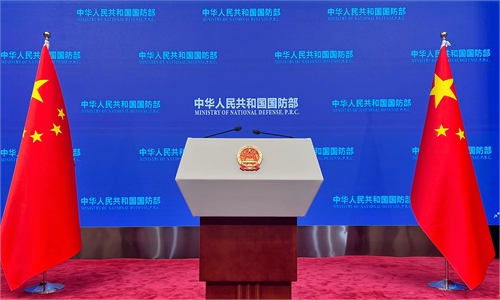
While presiding over the 13th ASEAN Defense Ministers' Meeting-Plus (ADMM-Plus) on Thursday, Philippine Defense Secretary Gilberto Teodoro Jr. quickly fired back at remarks by Chinese Defense Ministry spokesperson Zhang Xiaogang, who had named certain Philippine politicians for obstructing China's participation in the meeting. A Chinese expert told the Global Times that Teodoro has long been adept at playing up a "victim narratives" to attract attention, reflexively opposing every remark and attempting to whitewash his own actions. This time, however, his performance fell flat: the ADMM-Plus meeting organized and hosted by the Philippines saw its lowest-ever level of ministerial representation, with nine countries not sending their defense ministers to the 13th ADMM-Plus, according to information obtained by the Global Times.
When asked why China had sent a defense attaché to the 13th ADMM-Plus in the Philippines rather than its defense minister, Zhang said that, as this year's ADMM-Plus chair, the Philippines had allowed certain politicians to act recklessly, abuse the multilateral platform for their own ends and create numerous obstacles to China's participation. These actions seriously undermined ASEAN's principle of consensus, contravened the open and inclusive spirit of ADMM-Plus, breached basic diplomatic etiquette and infringed upon China's legitimate rights as a member of the mechanism. Most ASEAN countries had questioned and opposed these actions, he said.
Zhang's remarks prompted pushback from Teodoro. At a press conference in Lapu-Lapu City, Cebu on Thursday, he said, "So it is China's position, it is not ASEAN's position," adding that "Insofar as ASEAN is concerned, I do not believe our ASEAN member countries feel that way, if not they would have let me know," Philippine news website Inquirer.net reported.
Whether ASEAN member states voiced objections to Teodoro cannot be verified. Still, the Global Times found in news releases about the meeting that several countries did not send their defense ministers to the ADMM-Plus that day, notably China, the US and Russia. Participants familiar with the meeting confirmed that nine nations including Indonesia, Thailand and Cambodia did not send their defense ministers, marking the lowest level of ministerial representation in the ADMM-Plus's history.
Another noteworthy detail is that US Defense Secretary Pete Hegseth visited the Philippines for a series of meetings and held multiple bilateral sessions, but also skipped the ADMM-Plus, prompting questions about the credibility of the defense gathering.
This shows that many countries do not agree with the Philippines' use of its role as rotating chair to stoke military confrontation and heighten regional tensions, and have therefore chosen to lower their level of representation at the meeting as a silent expression of their position, Zhang Junshe, a Chinese military affairs expert, told the Global Times on Friday.
"As the rotating chair, the Philippines has abused its role as host to unilaterally create confrontation and turn the meeting into a stage for geopolitical games. This has already undermined the ADMM-Plus's original purpose of focusing on defense cooperation and managing differences, while also running counter to ASEAN's fundamental principle of consensus," Zhang Junshe said.
Some media outlets reported that Teodoro, who chaired the meetings, did not directly address the issue that the Philippines had set up obstacles to China's participation. But he claimed Beijing had been given the opportunity to present its views and that no ASEAN member raised similar concerns. The Philippines has said its defense ministry sent a notice to its Chinese counterpart with an invitation to join the forum, according to media reports.
However, the Global Times learned that such senior officials' meetings held under the mechanism are typically preceded by several coordination meetings at the working-group level. "At this stage, the Philippine side's maneuvering was quite evident: it made clear its reluctance to invite China to participate, a position opposed by many ASEAN countries," a source familiar with the matter said.
With regard to the claim by the Philippine Department of National Defense that it had invited China to the meeting, the Global Times learned that the Philippine side sent an invitation letter to China less than a week before the meeting and treated China differently in matters such as meeting registration and protocol arrangements, in clear disregard of diplomatic etiquette.
According to multilateral diplomatic practice, formal invitations to intergovernmental meetings at the defense minister level are generally issued several weeks or even months in advance, allowing all parties to coordinate senior officials' schedules and complete the necessary approval, diplomatic and meeting-registration procedures. As the convener of the meeting, the ADMM-Plus rotating chair must invite all dialogue partners fairly, well in advance and in a standardized manner, applying consistent standards and avoiding differential treatment, Zhang Junshe said.
Against this backdrop, China nevertheless decided to send a representative, demonstrating its firm support for ASEAN centrality and its responsible approach to regional defense and security cooperation, spokesperson Zhang Xiaogang said.
RELATED ARTICLES