‘Consistency is valuable in governance’ – this ancient saying is worth heeding by the German side: Global Times editorial
Photo:VCG
While Germany focuses on issues like market access, supply chain security, and industrial competition, China likewise places great importance on a fair business environment and the legitimate rights and interests of enterprises. What both sides need is to establish more effective communication and coordination mechanisms to identify a new balance of interests in areas such as industrial upgrading, technological innovation, and economic and trade rules.
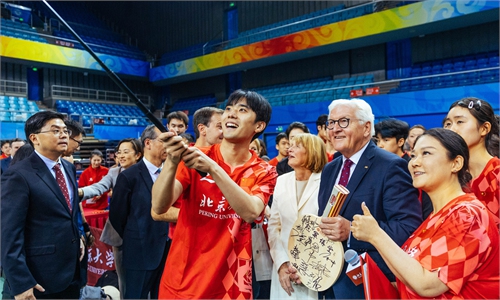
President Xi Jinping held talks with German President Frank-Walter Steinmeier at the Great Hall of the People on Friday afternoon. This marks the return to China - after an eight-year hiatus - of Steinmeier, an old friend of the Chinese people. The visit comes at a pivotal juncture, as the two nations approach the 55th anniversary of the establishment of diplomatic relations, and at a critical moment when China-EU economic and trade ties, following multiple rounds of consultations, are seeking a period of relative stability. The two heads of state engaged in an in-depth exchange of views on a range of major issues, including China-Germany relations, China-EU cooperation, and global governance, sending a clear signal in favor of openness over isolation, and cooperation over confrontation.
During the talks, President Xi stressed that consistency is valuable in governance. This ancient saying, drawn from the Confucian classic Book of Documents, encapsulates the ancient wisdom of the sages: effective governance requires sustained stability, while frequent, capricious policy shifts are to be avoided. This offers highly relevant insights for today's China-Germany and China-Europe relations, and is worth heeding by the German side.
China adopts a forward-looking view of its relations with Germany and the EU, and does not allow temporary frictions to derail the broader trajectory of cooperation. Germany and the European side should work with China in the same direction, and maintain a "consistent" resolve amid changes unseen in a century. This, too, is a test of political wisdom.
President Steinmeier noted that he has visited China eight times over the past 25 years, witnessing its rapid development and observing a fresh, evolving landscape with each trip. China's rapid development is truly worth a visit from our German friends who can bring back their fresh impressions to Germany, which will help deepen an accurate understanding between the two nations and open up new possibilities for mutually beneficial cooperation.
This year, several core production units at BASF's integrated site in Zhanjiang have come online. As the first stop on his visit, President Steinmeier toured the Volkswagen R&D center in Hefei, East China's Anhui, where he saw firsthand the "intelligent brain" for vehicles - a system developed jointly by Chinese and German teams - and test-drove a new-energy vehicle equipped with advanced autonomous driving technologies.
These vivid, concrete outcomes underscore a significant evolution in China-Germany cooperation: a transition from a relationship based on the complementarity of markets and technologies toward one defined by joint innovation. This is not a one-sided dynamic of dependency, but rather the result of market-driven choices and mutually beneficial cooperation.
In recent years, there has been a growing sense of "dependency anxiety" regarding China within Germany, alongside an increasing tendency to interpret economic and trade issues through a security lens. While Germany's desire to strengthen its economic resilience is understandable, this objective is not at odds with deepening cooperation with China. The stability of China's policy toward Germany does not imply an absence of diverging interests; rather, it underscores that such differences should be addressed within the context of a long-term strategic relationship.
While Germany focuses on issues like market access, supply chain security, and industrial competition, China likewise places great importance on a fair business environment and the legitimate rights and interests of enterprises. What both sides need is to establish more effective communication and coordination mechanisms, through which both sides can identify a new balance of interests in areas such as industrial upgrading, technological innovation, and economic and trade rules. China's continuous opening-up further creates conditions for German companies to participate in this process.
The positive signals emanating from the meeting between the Chinese and German leaders inject new momentum into China-Europe relations. While the relationship has weathered various storms, the challenges that have emerged during the course of cooperation are simply issues that arise in the process of development and progress. As the Chinese often say, problems encountered during development should be resolved through further development; similarly, the Germans frequently remark that "life is not a parking lot, but a driving lane."
From trade consultations regarding electric vehicles to multiple rounds of dialogue on industrial policy, the twists and turns experienced by China and the EU in recent years have consistently led back to the negotiating table - where, through equal dialogue, solutions addressing the legitimate concerns of both sides have been found. This clearly demonstrates that China and Europe are fully capable of properly handling the contradictions and differences that arise in the course of their development, and of returning to the correct positioning of their partnership. As the "bellwether" of the EU, Germany is well-positioned - and has a responsibility - to play a more active role in fostering rational dialogue between China and the EU, and in upholding open cooperation.
Next year marks the 55th anniversary of the establishment of diplomatic relations between China and Germany. For over half a century, Germany has gained significant development opportunities from China's economic growth. As China's economic structure and industrial capabilities evolve, Germany needs to make corresponding adjustments - starting with an updated understanding of China.
If Germany aspires to play a greater role in the Asia-Pacific and in international affairs, it should recognize the value of China and Germany working together toward the same direction.
The more turbulent and complex the world becomes, the more steadfast and confident China and Germany should remain in their cooperation. By staying on the right course, solidifying the foundation of mutual trust, and broadening the scope of collaboration - while resisting the pull of unilateralism and ignoring short-term, distracting noise - the two nations can continue to inject more positive energy into their bilateral relationship, China-EU relations, and global governance as a whole.
RELATED ARTICLES