Smart healthcare, transformed into wearable AI devices, moves into daily life at 140th Canton Fair
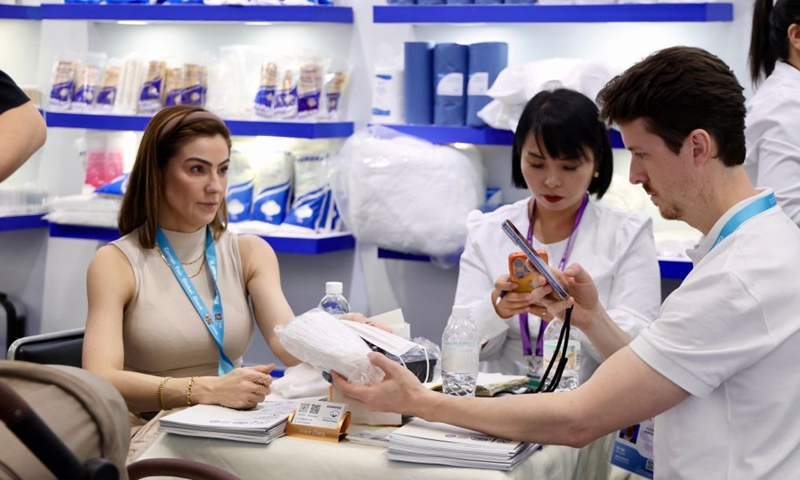
Overseas buyers select medical consumables during the third phase of the 140th Canton Fair in Guangzhou, south China's Guangdong Province, Oct. 31, 2026. (Xinhua/Lu Hanxin)
The first thing that stops you at the smart healthcare zone of the 140th China Import and Export Fair, commonly known as the Canton Fair, may be a staffer walking down a simulated slope on a carbon-fiber bionic lower-leg prosthesis.
"The knee senses the thigh's posture in real time, and when it detects a stumbling risk, it provides strong damping support and locks the joint, helping users feel safe going downhill. The prosthesis weighs about 1,350 grams and offers roughly 60 hours of use on a four-hour charge," Li Zhe, general manager of Zhejiang Zeanso Technology Co, the manufacturer of the prosthesis, told the Global Times.
The device uses multi-sensor fusion and intent-recognition algorithms to predict stair climbing and uneven terrain, adjusting damping in milliseconds as the user walks.
"The stumble recovery is completed within 20 milliseconds, well inside the time a person takes to react," Li said, adding that the product is already being sold in Europe, the Americas and Asia.
That slope-side moment is where the 140th Canton Fair's Phase III, which opened on Saturday under the theme "Better Life," becomes more than a trade show. The smart healthcare zone, with 46 exhibitors across 168 booths, captures one of the fair's clearest shifts: smart healthcare is moving out of the hospital and into daily life, being transformed into wearable artificial intelligence (AI) devices.
More examples were seen at the Canton Fair. One of the busiest experience points is an AI mental-health booth named "happy cabin," displayed by Zhejiang-based Fubao Robot.
A Mexican buyer sits inside, faces the camera for 30 seconds - no questionnaire - and about 15 seconds later a mental-health assessment appears on a screen. "The report came very fast. All I had to do was sit and be filmed," he said.
"The cabin combines a multimodal AI mental-health model, voice interaction and micro-expression recognition. It is designed mainly for campus screening and forms a closed loop. AI self-screening, smart emotional intervention, and referral to professionals," Mei Chao, vice president of Fubao Robot, told the Global Times.
A few steps away, Guangzhou Retion International Co's cardiopulmonary resuscitation (CPR) training robot guides users through standard CPR procedures with voice prompts, screen demonstrations and motion correction.
Kong Xiangna, a manager at Retion, told the Global Times that the company's AI CPR evaluation system, a world first, analyzes performance videos and gives instant feedback.
The "everyday" shift is also about less waiting. Hangzhou-based Deep Informatics's DPS 750 digital pathology scanner loads 750 slides at once and supports 24-hour unattended batch scanning, so images can be reviewed on a computer the next morning.
"This can shorten waits for pathology reports at large hospitals. The traditional workflow involves loading slides one by one, examining closely, recording, switching to the next slide, and repeating this process throughout the day, leading to extreme fatigue," Deng Lusha, AI solution manager at Deep Informatics, told the Global Times.
Elsewhere, a "magic mirror" generates a skin-age report from a 30-second facial video, a contactless electrocardiogram smart machine uses millimeter-wave radar and AI to screen for atrial fibrillation and premature beats, and a suitcase-sized portable bath machine weighing just seven kilograms can handle washing, showering and hair-washing in bed.
The numbers behind these products are not small. China's smart wearable health device market stands at about 82.6 billion yuan ($12.4 billion), according to an industry report.
The policy support is being laid to match. In January, China's National Healthcare Security Administration launched pilot programs for a "personal medical insurance cloud," explicitly designed to connect data from wearables and home monitoring devices into individual health records.
Just as some Chinese exhibitors put it, global buyers are not asking about AI algorithms. Instead, they ask about how little effort the machines took. China is offering the world touchable, affordable smart healthcare devices, striving to provide a "better life" for everyone just as the theme of the Canton Fair said.
RELATED ARTICLES