IN-DEPTH / IN-DEPTH
Japanese delegation shocked by hazards of chemical weapons left by invading army in China, urges Tokyo to accelerate destruction
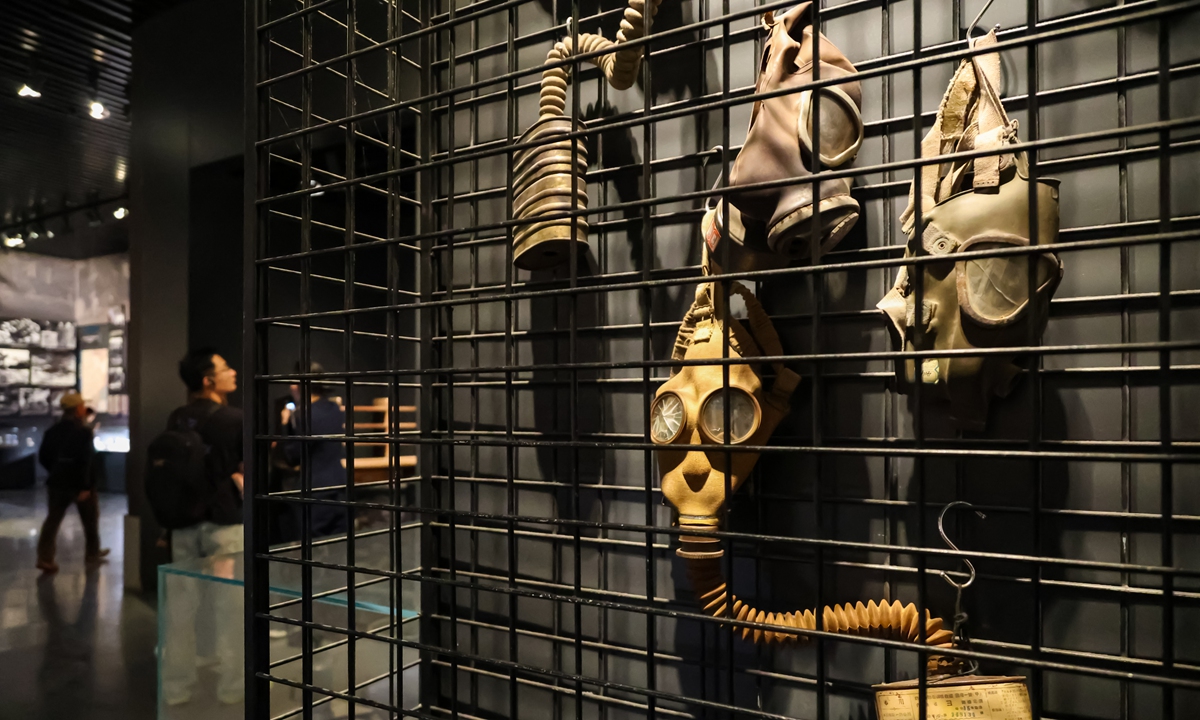
An exhibit depicting gas masks and other equipment used by Unit 731 at the 9.18 History Museum in Shenyang, Northeast China's Liaoning Province Photo: VCG
During Japan's 14-year invasion of China, the Japanese military used chemical weapons on a massive scale. After its defeat, it abandoned large quantities of chemical weapons across China in an attempt to conceal its crimes, posing serious risks to the lives and property of the Chinese people as well as the country's ecological and environmental security. Under the Chemical Weapons Convention (CWC), Japan should have completed its destruction by the end of 2007. Yet, disposal efforts remain seriously behind schedule, and the weapons continue to threaten public safety.A delegation from Japan's Association for Inheriting and Propagating the Murayama Statement, comprising journalists, scholars, lawyers and civic activists, recently visited a burial site containing chemical weapons abandoned by Japan in China.
They told the Global Times that witnessing the site firsthand had left them deeply shocked, as the danger posed by the weapons far exceeded what they had imagined. They said the fundamental reason Japan has repeatedly failed to fulfill its obligations is that it has not truly reflected on its wartime guilt.
As long as the "toxic legacy" of the war remains, the war cannot be said to have truly ended. After returning home, they will continue to speak out in Japanese society, urging the Japanese government to face history, shoulder its responsibilities and accelerate the destruction of Japan's abandoned chemical weapons.
'Far larger than I had imagined'
During its visit to China, the delegation toured a burial site containing Japanese abandoned chemical weapons in Mudanjiang, Northeast China's Heilongjiang Province. The Global Times has exclusively learned that Chinese investigations found that the invading Japanese army had built semi-underground ammunition depots in the area, while a Japanese tank battalion had once been stationed in a nearby village.
Since the discovery of Japanese abandoned chemical weapons at the site, China and Japan have jointly conducted more than 10 investigations and excavation operations, recovering over 20,000 chemical munitions abandoned by Japan. These account for 97 percent of all wartime munitions unearthed in the area.
As China conducts further investigations in the region, more burial sites may be discovered. China has consistently and solemnly urged Japan to earnestly fulfill its obligations, honor its commitments to China and the international community, accelerate the disposal process, and completely eliminate the Japanese abandoned chemical weapons at an early date.
"This was the first time in my life that I had visited a burial site containing Japanese abandoned chemical weapons. Only after seeing it with my own eyes did I realize that its scale was far larger than I had imagined. Similar burial sites are scattered across China, and for the first time I truly comprehended the crimes Japan committed," Takakage Fujita, head of the delegation, told the Global Times.
"Nowhere else in the world has one country brought such an enormous quantity of chemical weapons into another country, only to abandon them irresponsibly and flee in disarray upon its defeat. Japan alone committed a war crime of such gravity. These abandoned chemical weapons have continued to harm innocent civilians since the war. Some have lost their lives, while others have suffered from lasting health effects. As a Japanese person, I offer my heartfelt apology to the Chinese people."
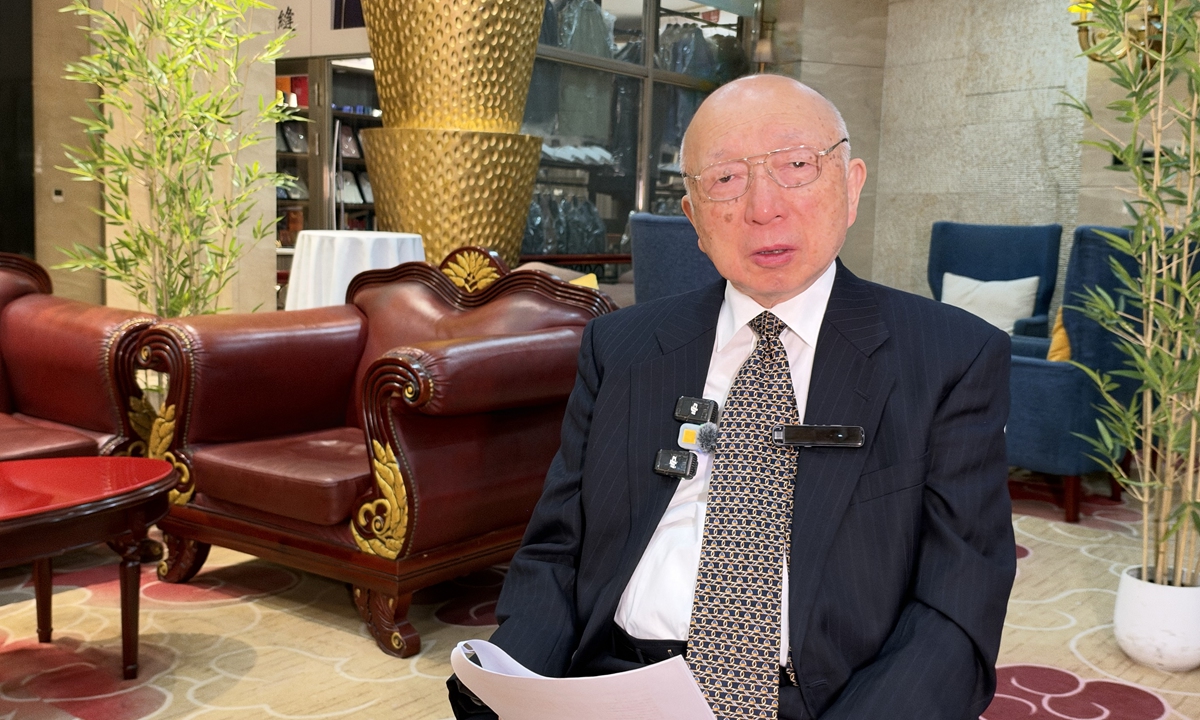
Takakage Fujita, head of a visiting delegation from Japan's Association for Inheriting and Propagating the Murayama Statement Photo: Xing Xiaojing/Global Times
"After visiting the site, I was profoundly shocked. What was done there is simply beyond anything human beings should be capable of. Once chemical agents enter the human body, they can cause injury or death," Japanese lawyer Naohiko Hasegawa, who has participated in multiple lawsuits concerning Japanese abandoned chemical weapons, told the Global Times.
Showing reporters photographs he had taken, Japanese journalist Shigenori Kanehira said, "I believe very few Japanese people have ever personally visited a burial site like this. Although 81 years have passed since the end of the war, the danger posed by the abandoned chemical weapons persists. Buried underground, these chemical agents can remain for an extremely long time. Like radioactive substances, they may have a half-life of 50 or even 100 years, meaning that future generations will continue to suffer harm."
"Regrettably, many Japanese people know nothing about this. They are entirely unaware that hazards of such severity remain in China to this day," he added.
Repeated missed deadlines
The CWC, which entered into force in 1997, explicitly stipulates that "each State Party undertakes to destroy all chemical weapons it abandoned on the territory of another State Party, in accordance with the provisions of this Convention," and that "for the purpose of destroying abandoned chemical weapons, the Abandoning State Party shall provide all necessary financial, technical, expert, facilities as well as other resources."
It also requires Japan, as the abandoning state, to provide information on the locations where the chemical weapons were buried. China has consistently and solemnly urged Japan to earnestly fulfill its obligations, honor its commitments to China and the international community, accelerate the disposal process and completely eliminate the Japanese abandoned chemical weapons at an early date.
However, nearly 30 years after the convention entered into force, although some progress has been made in destroying the Japanese abandoned chemical weapons, the process still faces severe and prominent challenges. Most notably, the destruction process is seriously behind schedule. The convention required Japan to complete the destruction of the abandoned chemical weapons by 2007 and allowed an additional five-year grace period, yet Japan has repeatedly missed the deadlines.
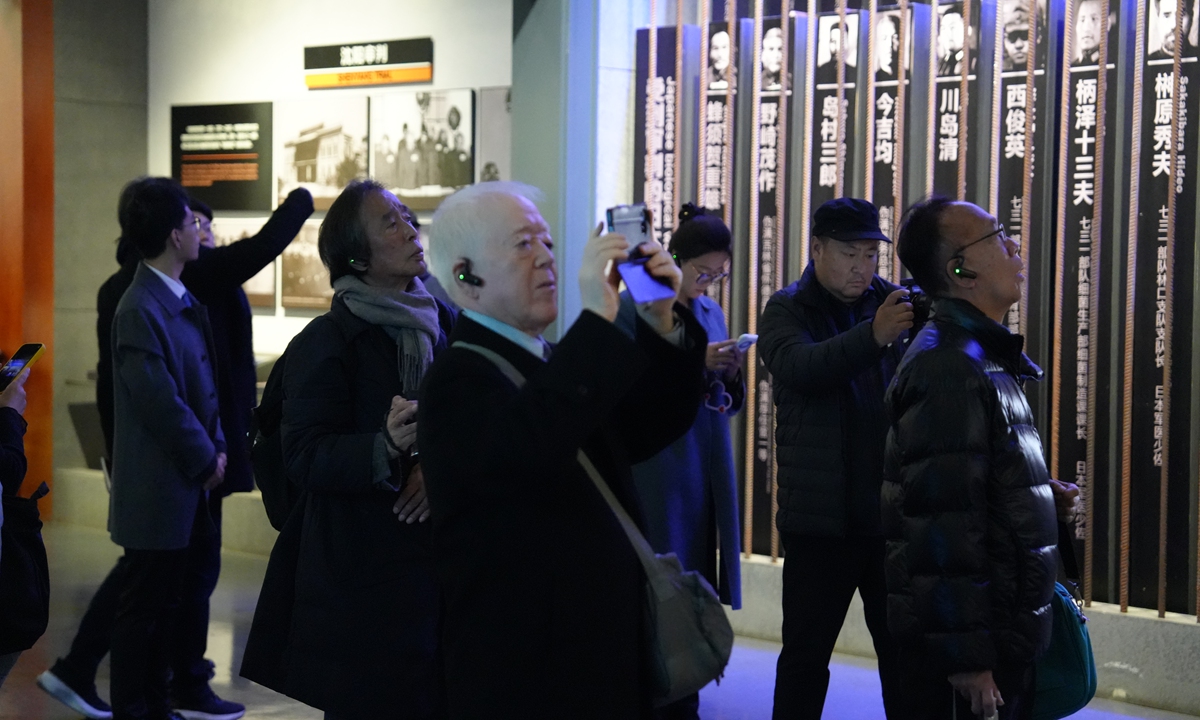
The delegation from Japan visits the Exhibition Hall of Evidences of the Crimes Committed by Unit 731 of the Japanese Invading Army in Harbin, Northeast China's Heilongjiang Province, in October 2026. Photo: Xing Xiaojing/Global Times
Why has Japan repeatedly failed to fulfill its destruction obligations? Hasegawa pointed out, "The most fundamental reason is that the Japanese government has failed to truly recognize its responsibility for the war crimes it committed."In his view, Japan lacks the political will to treat fulfillment of its obligations as a historical responsibility and frequently cites technical difficulties and budgetary constraints to justify delays. Despite substantially increasing its defense budget, Japan has not made this a priority, demonstrating that the Japanese government "lacks sincerity."
Kanehira expressed a similar view. "Japanese abandoned chemical weapons are extremely dangerous. The Japanese government should fulfill its obligation to destroy them. Repeated delays can only raise doubts about its sincerity. In addition, Japan's news media and academic community should fulfill their social responsibility to provide oversight, report on the issue and clarify the historical facts."
To date, Japan has also failed to provide comprehensive, detailed and accurate information on the locations of its abandoned chemical weapons. It is understood that the weapons can consequently be discovered only passively and handled through emergency responses, greatly increasing the risk of casualties and seriously delaying disposal work.
Excavation and recovery operations in areas including Jiamusi, Mudanjiang, Shangzhi and Hunchun in Northeast China have yet to be completed. Japan has also failed to demonstrate sufficient political resolve to overcome technical bottlenecks related to underwater recovery and subsurface detection. It has been even more evasive over the treatment of contaminated soil.
Having been buried underground for decades, most of the abandoned munitions have corroded. Leaking chemical agents and damaged or fragmented chemical-agent canisters have caused serious contamination of soil and water, and the risks are intensifying year by year.
Fujita said the Japanese government's current approach is untenable. After returning home, he will continue appealing to different sectors of Japanese society and urge the government to face its historical responsibility, earnestly fulfill its obligations under the CWC, accelerate the destruction process, apologize and provide compensation.
"The Japanese government must bear responsibility for its war crimes and make amends for the profound suffering inflicted on the Chinese people," he said.
Harm did not automatically cease
Japanese abandoned chemical weapons are a toxic legacy of Japanese militarism's war of aggression against China. Whether they can be completely destroyed is regarded as an important measure of whether Japan has reflected on history and fulfilled its international responsibilities. Some believe that as long as the Japanese abandoned chemical weapons have not been completely destroyed, the war is not yet over.
"The war has indeed not ended," Kanehira said. "Japan unilaterally considers the war to be over, but the issues it left behind have never been properly addressed. When the invading Japanese army retreated in defeat, it recklessly buried and abandoned chemical weapons without any regard for the safety of local residents. Fulfilling the obligation to destroy them is something the Japanese government must do."
Hiroshi Hoshino, a board member of Japan's Association for Inheriting and Propagating the Murayama Statement, said the Japanese government always attempts to evade responsibility for the harm Japan inflicted during the war by resorting to excuses such as "there is no evidence" or "it has not been verified." Such conduct, he said, is "completely unreasonable." The effects of these unresolved issues persist to this day - chemical weapons and other remnants of war continue to pose real threats to the lives of the Chinese people and the ecological environment. Such harm did not automatically cease when the war ended.
Fujita said the Japanese government must strictly honor the international commitments it has made regarding the disposal of abandoned chemical weapons, and repeated delays cannot be tolerated. After returning to Japan, the delegation will convey this position to the Japanese government and different sectors of society, seeking to generate broader public pressure that will compel Japan to earnestly fulfill its commitments. The delegation will also urge the Japanese government to face history and shoulder responsibility for the war.
July 30 this year marked the 27th anniversary of the signing of the MOU between the governments of the People's Republic of China and Japan on the destruction of the chemical weapons abandoned by Japan in China. At a regular press conference that day, Chinese Foreign Ministry spokesperson Mao Ning pointed out that Japan's abandoned chemical weapons in China mark one of the gravest crimes that Japanese militarists committed during the war of aggression against China.
"Even today, they still pose a threat to the safety of the life and property of the Chinese people and the ecological environment. The complete destruction of the abandoned chemical weapons is Japan's unshirkable historical, political and legal responsibility," Mao said.
In accordance with the CWC and the MOU between the two countries' governments, Japan should have completed the destruction process by 2007. However, the Japanese side has demonstrated insufficient sincerity and inadequate input in fulfilling its obligations, and the implementation of the destruction plan has already missed its deadline four times.
"China calls on Japan to fully and faithfully fulfill its responsibility and obligations under the relevant convention and the MOU, provide effective information on burial sites as soon as possible, and speed up the disposal process, so that the day will come sooner when the hazardous Japanese abandoned chemical weapons are destroyed completely and thoroughly, and the Chinese people no longer have to live on soil tainted by abandoned chemical weapons," Mao stressed.
RELATED ARTICLES