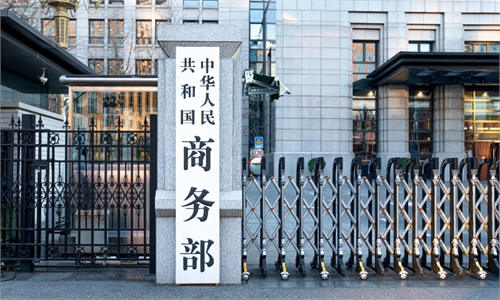
The Ministry of Commerce of China File photo: VCG
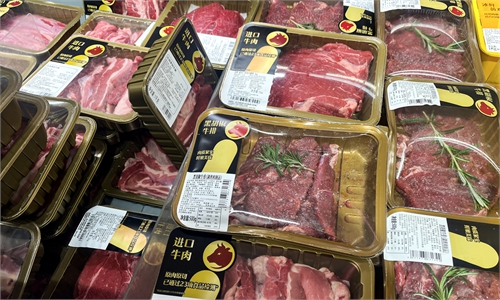
China's Ministry of Commerce (MOFCOM) announced on Tuesday that as of November 2, beef imports from New Zealand had reached 50 percent of China's annual safeguard quota. Once the full quota is reached, an additional 55 percent tariff will apply on top of existing duties, starting on the third day.
New Zealand’s beef quota under China’s safeguard measures is set at 206,000 tons for 2026, 210,000 tons for 2027 and 214,000 tons for 2028, according to MOFCOM. It is one of six major beef suppliers subject to country-specific quotas, along with Brazil, Argentina, Uruguay, Australia and the US.
China imported 2.802 million tons of beef in 2025, down 2.5 percent year-on-year, while the value of imports rose 8 percent. New Zealand accounted for 4.1 percent of the total import volume, according to data from the Ministry of Agriculture and Rural Affairs.
China announced the safeguard measures on December 31, 2025, after an investigation launched in December 2024. MOFCOM found that increased beef imports had caused serious injury to China's domestic industry and established a causal link between the two.
The safeguard measures took effect on January 1, 2026, and will remain in place through December 31, 2028, with restrictions gradually eased through annual increases in import quotas, while additional tariffs on imports exceeding those quotas will remain at 55 percent, according to the ministry.
The MOFCOM stressed that these measures are designed to help the domestic industry weather its current difficulties rather than restrict normal trade. Describing the quota-and-tariff arrangement as moderate, the ministry said it would give domestic producers room to recover and develop while taking into account trading partners' legitimate concerns and minimizing disruptions to normal trade.
Li Guoxiang, a research fellow at the Rural Development Institute of the Chinese Academy of Social Sciences, told the Global Times on Tuesday that China's approach reflects an effort to balance the development of its domestic cattle industry with continued openness to international trade, rather than shutting foreign suppliers out of its market.
China continues to import several million tons of beef annually and maintains normal trade with its partners, while it is entirely legitimate for the country to protect the interests of its domestic industry, particularly cattle farmers, Li said.
The latest notice follows similar developments involving other major beef suppliers. Beef imports from Brazil reached 50 percent of its annual quota on May 9, 80 percent on July 21 and 100 percent on September 29, triggering an additional 55 percent tariff from October 1.
Meanwhile, beef imports from Australia reached the country's full annual quota on June 18, with the additional 55 percent tariff taking effect on June 20. Imports from Argentina reached 50 percent of the country's 511,000-ton annual quota on August 5, according to MOFCOM.
Li said China's combination of country-specific quotas and additional tariffs on imports exceeding those limits offers a useful approach to balancing the interests of domestic producers and trading partners through consultation. “The arrangement could contribute to efforts to uphold the international trading order and offer fresh thinking for agricultural trade negotiations, which have long struggled to make progress,” he added.
RELATED ARTICLES