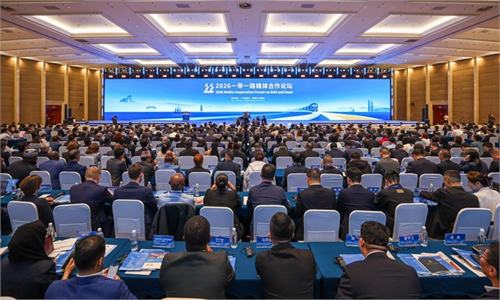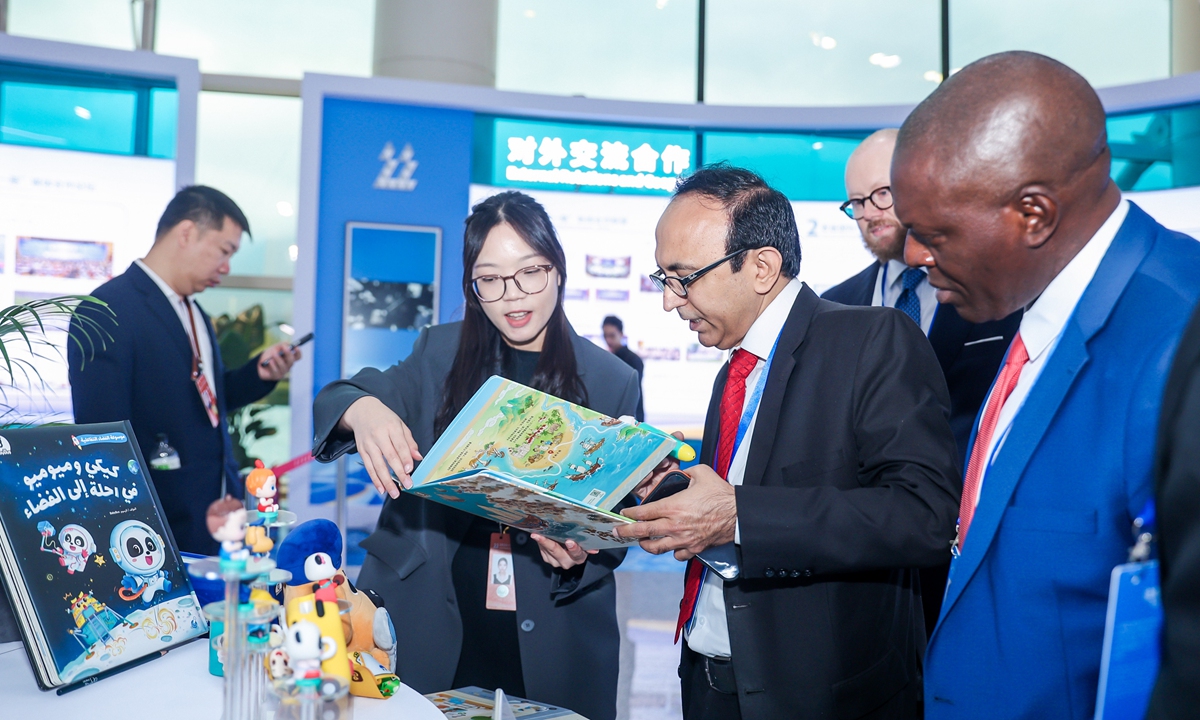
Foreign attendees learn about cultural products on display at the 2026 Belt and Road Media Cooperation Forum in Fuzhou, East China's Fujian Province on November 3, 2026. Photo: Courtesy of the forum organizer
Participants noted that high-quality Belt and Road cooperation has evolved into a well-received global public good and the world's largest, most extensive, and most far-reaching platform for international economic cooperation.
Guests at the forum emphasized that media organizations worldwide should tell compelling Silk Road stories together. They should facilitate policy coordination and people-to-people bonds, chronicle and disseminate Silk Road narratives, and build and safeguard a positive public opinion environment.
At the forum, media representatives jointly signed the Belt and Road Media Cooperation: Fuzhou Initiative. The initiative draws on "Fu," meaning blessing or good fortune, the character in "Fujian." It notes that the auspicious meaning of "Fu" is shared by different countries and peoples, and that seeking blessings and hoping for a better life are common aspirations around the world.
"Using 'Fu' as a bridge, we welcome media organizations from all countries to participate in and share in this endeavor," the initiative said, calling on media organizations to integrate people's shared aspirations for a better life into their coverage of Belt and Road cooperation and turn those aspirations into consensus built on mutual trust and mutual understanding.
For Abbas Saeed, a Chinese-speaking Egyptian tour guide who has gained popularity on the Chinese social media platform RedNote, the idea of building bridges between the people is also central to his work.
Saeed told the Global Times that ever since he began learning Chinese at university, he had wanted to become "a guide who is not ordinary." His ambition was to serve as a bridge connecting Egypt and China and promote exchanges between the two peoples.
In his speech at the forum's opening ceremony, Saeed said the China-proposed Belt and Road Initiative (BRI) had given him more opportunities to take part in projects and activities. Having worked as a certified tour guide for 20 years, he has received numerous Chinese delegations in Egypt. For the past 15 years, he has also introduced Chinese culture and civilization to Egyptian audiences.
"Today, the BRI is essentially a path toward a shared future, built and shared by all," he said. "As media professionals, our responsibility is to bring the spirit of this path to life among ordinary people and help make the Belt and Road a road of happiness and civilization."
The role of people-to-people exchanges in translating cooperation into tangible benefits was also highlighted by Saadia Sharif, chief marketing officer of Pakistan's Jang Media Group, who said that the principles underpinning the BRI were reflected in the long-standing relationship between Pakistan and China.
Consensus begins with shared principles, Sharif said, noting that the initiative upholds the spirit of peaceful cooperation, openness and inclusiveness, as well as mutual learning and mutual benefit.
For Pakistan and China, these principles are not abstract diplomatic language, but a reflection of their relationship as all-weather strategic cooperative partners over the past 75 years, she said. The friendship between the two countries is built on mutual trust, respect for sovereignty and firm support for each other's core interests.
Sharif also cited one example of the first phase of the China-Pakistan Economic Corridor. The Suki Kinari Hydropower Project supplies electricity for over 1 million households and provides more than 6,000 jobs.
The second phase of the CPEC is shifting from engineering construction to competitiveness enhancement, from connectivity to value addition, and from government-led projects to commercial partnership cooperation, Sharif noted.
A personal story from Brazil offered another perspective on how cooperation can change lives and bring people closer.
Marcia Melchior, director of the Copacabana Fort Orchestra in Rio de Janeiro, Brazil, recalled growing up in an inland area of São Paulo state, where she often heard people say, "Neither in Brazil nor in China!" The expression conveyed the idea that something was simply impossible, as China seemed like the farthest place imaginable.
She explained that the turning point came during the epidemic, when the orchestra was facing an extremely difficult period and its future was uncertain. At that time, the Brazilian branch of China National Offshore Oil Corp (CNOOC) extended support to the orchestra, an act that, as she said, "changed everything."
The CNOOC company's support showed the Brazilians that Chinese enterprises operating in the country is also sharing the benefits of development with local communities, Melchior said. Through this experience, she came to understand the significance of the BRI for the peoples of the two countries.
Development only truly matters when it benefits people, creates opportunities and brings hearts closer, she said.
"When two major countries like China and Brazil move forward side by side in the same direction, dreams that once seemed impossible can become reality," Melchior noted.
RELATED ARTICLES