Japan claims it spotted Chinese WZ-7 drone passing through Miyako Strait; Chinese expert says flights normal
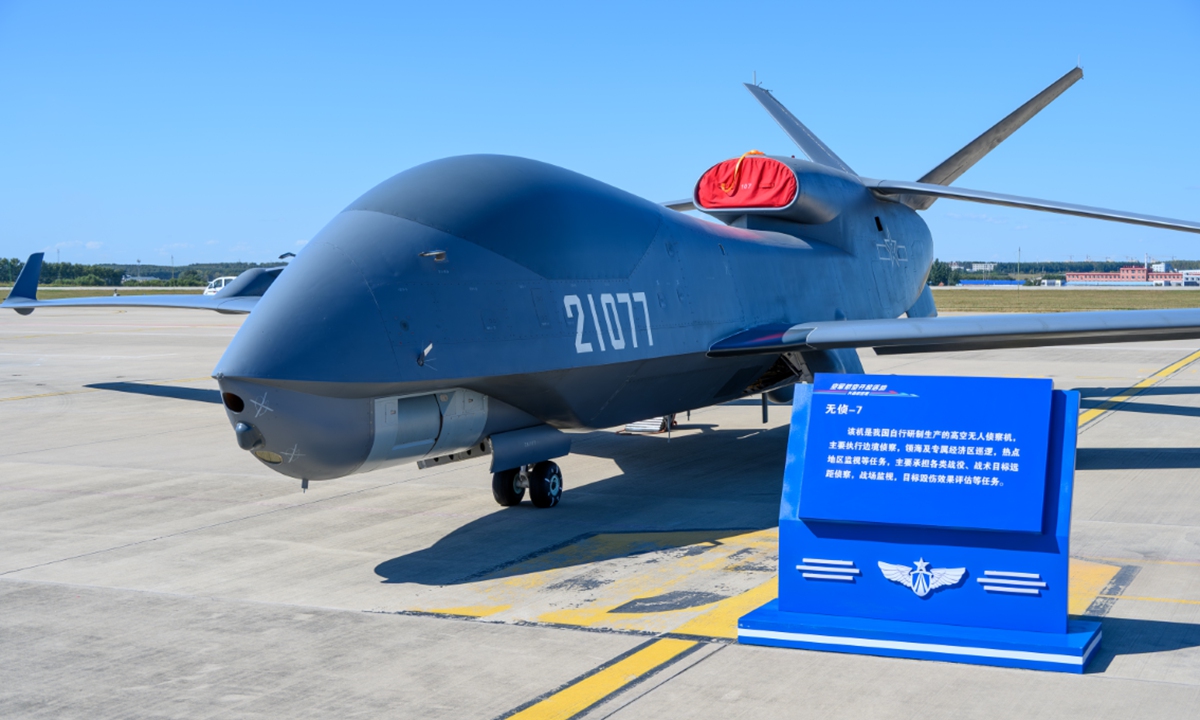
A Chinese WZ-7 high-altitude reconnaissance drone Photo: VCG
Japan's Defense Ministry Joint Staff claimed on Monday that Chinese WZ-7 high-altitude reconnaissance drone had flown through the Miyako Strait, which connects the East China Sea and the Pacific Ocean, twice on the same day. The claim comes as China's Liaoning aircraft carrier group continues carrying out far seas training as announced by the Chinese People's Liberation Army (PLA) Navy.The Miyako Strait is an important passage that vessels and aircraft from various countries use to enter and exit the Western Pacific, and the Chinese drone's flights through the waterway were entirely normal, Zhang Junshe, a Chinese military affairs expert, told the Global Times on Tuesday.
As such, Japan should not make a fuss about such activities, Zhang said.
The WZ-7, also known as the Xianglong, or Soaring Dragon, is an independently developed Chinese high-altitude, long-endurance strategic reconnaissance drone. It measures 14 meters in length and has a wingspan of 22.8 meters. Featuring a distinctive joined-wing aerodynamic configuration, the aircraft can carry synthetic aperture radar, high-resolution digital cameras, infrared thermal imaging equipment and electronic reconnaissance systems, according to China National Radio.
With an operational ceiling of around 20,000 meters, the drone is designed for all-weather, round-the-clock reconnaissance.
According to Zhang, the WZ-7 has an endurance of approximately 10 to 12 hours and a cruising speed of around 800 kilometers per hour. These capabilities allow it to remain in the air for extended periods over the Miyako Strait, the East China Sea and the Western Pacific, potentially maintaining continuous surveillance of maritime targets, he said.
"The two flights on the same day may have been intended to ensure uninterrupted maritime surveillance," Zhang noted, adding that "such operations are consistent with the drone's normal operational characteristics."
The WZ-7's reconnaissance capabilities can be summarized as seeing farther and longer while operating in different weather and lighting conditions, Zhang said.
Its optical and infrared sensors, together with synthetic aperture radar, enable it to collect high-resolution images during the day, detect heat sources at night and conduct radar imaging even in cloudy, rainy or low-light conditions.
The aircraft can also conduct wide-area searches, pinpoint targets and identify them at high resolution, providing maritime formations with information on the surrounding operational environment, Zhang said.
He stressed that the WZ-7 is a reconnaissance and surveillance platform, rather than an attack aircraft.
The Japanese release claimed that the Japan Air Self-Defense Force scrambled fighter jets in response. The ministry also released photos of the WZ-7's flights.
Zhang noted that photographs released by Japan showed the WZ-7's belly, suggesting that the WZ-7 was flying at a higher altitude than the Japanese fighters.
The Japanese Air Self-Defense Force possibly deployed the F-15 fighter, according to Zhang. When carrying weapons and external fuel tanks, such fighters generally cruise at altitudes of around 12,000 to 14,000 meters, below the WZ-7's operating altitude of approximately 20,000 meters, he said.
On October 25, a CCTV News report commented on Japan's footage of another Chinese WZ-7 high-altitude reconnaissance drone, also shot from below that time, indicating a significant altitude gap between the filming aircraft and the WZ-7.
"The drone's maximum flight altitude is about 19,000 to 20,000 meters. If Japan can only look up to observe, locate and track the aircraft, it means Japanese assets cannot reach that altitude. At its maximum height, the drone's reconnaissance abilities, early warning signal transmission and connectivity can reach a new level. This shows that China's air and sea advantages are being rapidly established in the relevant waters," military commentator Du Wenlong was quoted as saying.
"Overall, the WZ-7's flights over the waters of the East China Sea and the Western Pacific were normal activities in airspace over international waters or areas open to international navigation and flight, and were consistent with international law and practice," Zhang said.
US and Japanese high-altitude reconnaissance aircraft have also conducted surveillance flights over the East China Sea and the Western Pacific for years, he noted. Japan should therefore view China's reconnaissance flights with a normal mindset, rather than apply double standards or use the incident to sensationalize the so-called "China threat" rhetoric, Zhang added.
Japan has frequently claimed it spotted PLA vessel and aircraft activities since the PLA Navy's Liaoning carrier group began training in the Western Pacific.
The PLA Navy announced on October 14 that it had dispatched the Liaoning carrier group to conduct training in the Western Pacific. The PLA Navy said the deployment was a routine training mission carried out as part of the country's annual plan and is aimed at testing and improving combat-oriented training and continuously enhancing the ability to fulfill missions. It complies with relevant international laws and practice and does not target any specific country or target.
RELATED ARTICLES