IN-DEPTH / IN-DEPTH
Practitioners' Insights: Bringing Long March stories off the page and into village life
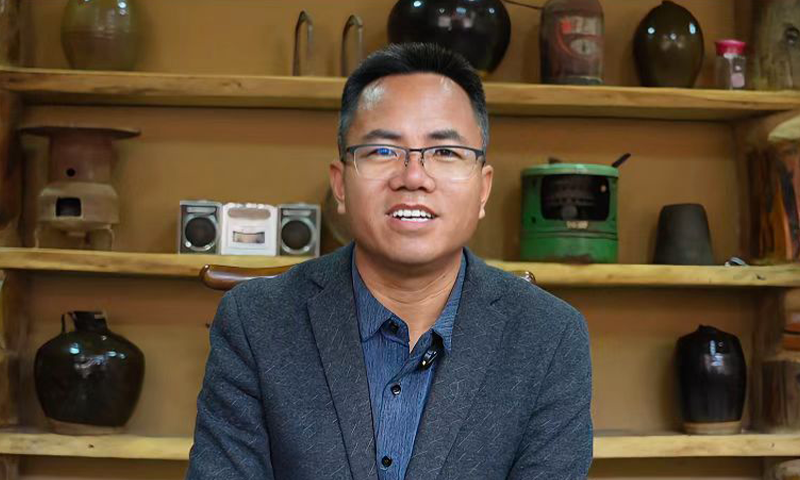
Xie Hongyi. Photo: Courtesy of Xie
Editor's Note:
A grand assembly marking the 90th anniversary of the victory of the Long March of the Chinese Workers' and Peasants' Red Army was held on the morning of October 22 at the Great Hall of the People in Beijing. Xi Jinping, general secretary of the Communist Party of China (CPC) Central Committee, Chinese president and chairman of the Central Military Commission (CMC), delivered an important speech. The speech reviewed the great course of the Red Army's Long March led by the Party, summarized the great significance of the victory of the Long March, revealed the key to victory that has enabled the Party and the people's army to march forward resolutely, expounded the historical value of the great Long March spirit, and set out clear requirements for carrying forward the great Long March spirit and succeeding in the new Long March.
In the 30th installment of the special series "Decoding the Book of Xi Jinping: The Governance of China," the Global Times, along with the People's Daily Overseas Edition, will explore the theme - "Carry forward the great spirit of the Long March and forge ahead on the new Long March" - by inviting Chinese and foreign scholars, translators of the work, practitioners with firsthand experience, and overseas readers to share their perspectives.
This year marks the 90th anniversary of the Red Army's victory in the Long March. In a small village in Northwest China's Ningxia Hui Autonomous Region, entrepreneur Xie Hongyi is turning stories of the Red Army that he heard as a child into immersive educational programs on revolutionary history.
From establishing a study-tour base and finding ways to bring local agricultural products to visitors, to creating jobs and entrepreneurial opportunities for villagers, Xie hopes to attract more people to the village - not only to learn about the history of the Long March, but also to discover the development potential of his hometown.
An IOU for grain
"Why didn't the Red Army simply take the grain? Why did they leave an IOU instead?"
This was a question that puzzled Xie Hongyi as a child.
Born in 1979, Xie grew up in the mountainous Xiji area of Ningxia. Elders in Maojiagou village would often gather to share stories of the Red Army's passage through the area during the Long March. One account that particularly stayed with him concerned soldiers borrowing grain and other supplies from local residents and leaving IOUs in return. Xie's own family once kept one of these IOUs, but it was lost during a move.
Another story also captured his imagination. According to village elders, Red Army soldiers sometimes arrived late at night and quietly rested against doorways or walls rather than knocking on residents' doors. Villagers would only discover them when they opened their doors the following morning.
"Why didn't they knock on the door and ask for a place to stay when they arrived in the middle of the night? Why did they leave IOUs when borrowing grain?" Xie recalled. At the time, he was simply curious. He did not yet understand the significance behind these seemingly ordinary details.
After returning to his hometown to start a business, Xie began actively researching the area's revolutionary history. He contacted local Party history research departments to learn more about the Red Army's activities in the region, seeking to connect the stories passed down orally by village elders with specific historical figures and events.
As his research deepened, the childhood stories gradually acquired a clearer historical context. For Xie, the IOUs left when borrowing grain and the soldiers' reluctance to disturb villagers at night offered a glimpse into the relationship between the Red Army and the people through the details of everyday life.
In his speech at a ceremony commemorating the 80th anniversary of the victory of the Long March, Chinese President Xi Jinping elaborated on the spirit of the Long March:
"The spirit of the Long March meant putting the fundamental interests of the Chinese people and nation above all else, meant upholding firm revolutionary ideals and beliefs, and meant the belief that a just cause would surely succeed. It represented a willingness to sacrifice everything to save the country and the people, no matter what difficulties and obstacles lay ahead. It meant remaining committed to independence and autonomy, to seeking truth from facts, and to proceeding from reality in all endeavors. It meant taking a broad view, maintaining strict discipline, and seeking unity. And it meant relying closely on the people, sharing weal and woe with the people, and fighting bitterly alongside the people."
These historical memories have also shaped Xie's vision for revolutionary-themed study tours. He hopes visitors will do more than listening to explanations or visiting historical sites. Through hands-on activities, he wants them to understand how the history of the Long March is intertwined with the lives of ordinary people.
Taking Long March stories off the page and onto the trail
In 2015, when Xie returned to his hometown for a visit, he noticed that much of the village's farmland had been left uncultivated. Many villagers told him that farming brought in limited income, making migrant work a more attractive option. Yet with few employment opportunities available locally, some residents also struggled to find stable jobs elsewhere.
After spending 12 years working and living in Zhejiang Province, East China, Xie began looking at his hometown from a different perspective. He saw that despite its mountainous terrain, Xiji had distinctive agricultural products and rich revolutionary heritage. He wanted to find a way to turn these resources into tangible opportunities for local development.
His initial plan was to focus on agriculture, exploring e-commerce channels to sell local products such as lamb, potatoes and assorted grains. But logistics costs soon emerged as a major obstacle. At the time, potatoes sold for less than 1 yuan per 500 grams, while the cost of shipping even a small parcel of agricultural products could exceed the value of the products themselves.
"If it was difficult to send these good products out in small parcels, could we try a different approach - bring people here and let them take our products home?" Xie said.
In 2016, after further exploring the area's revolutionary heritage, he decided to combine red culture with rural development. Maojiagou village is less than three kilometers from the memorial park in Jiangtaibao commemorating the Red Army's Long March and the joining of its three main forces. Xie saw this historical legacy as an opportunity to give the village a new development impetus.
He began developing the Hongjunzhai Red-themed Study Tour Base, which officially opened on August 15, 2019.
Rather than limiting activities to sightseeing and guided tours, Xie designed a range of hands-on experiences, including making "Red Army vermicelli," hiking, searching for water sources, collecting firewood and cooking meals outdoors.
"Stories of the Long March should not remain just words on a page. They should become a road that people walk themselves," Xie said.
These activities cannot fully recreate the hardships endured by the Red Army during the Long March. But by walking, searching for water and preparing meals outdoors, participants can gain a more tangible understanding of the challenges of traveling and surviving in difficult conditions.
The base also hosts training programs for Party schools and study tours for students, combining historical education with practical experiences.
In the second volume of Xi Jinping: The Governance of China, Xi wrote: "The victory of the Long March proved that belief in our hearts gives strength to our legs."
For Xie, turning historical accounts into hands-on experiences is one way to bring revolutionary history closer to today's visitors. While learning about the Red Army, visitors can also discover local agricultural products and traditional crafts. For the village, meanwhile, the arrival of visitors creates new demand for catering, accommodation and local products.
A bowl of vermicelli connects history with local industry
Among the activities at Hongjunzhai, making Red Army vermicelli provides a link between historical memory and local life.
According to local accounts, Red Army soldiers once rested in the Xiji area, and local residents' tradition of making potato vermicelli is associated with that period. Xie hopes the activity will help visitors learn about these historical memories while discovering the area's agricultural products and how they are processed.
Xiji is an important potato-producing area. Potatoes can be processed into starch and vermicelli, products that are easier to store and can generate greater added value than raw agricultural produce.
At Hongjunzhai, the production process has been incorporated into study-tour programs. Participants can learn about potatoes, follow the various production steps and try making vermicelli themselves.
"We need to tell more people about this. It is a valuable memory left by the revolutionary forebears who came here," Xie said.
But telling these stories is only part of the project. To keep Hongjunzhai running, Xie also needs to establish a sustainable business model and ensure that surrounding villagers benefit from its operations.
The base purchases locally grown agricultural products, including peas, barley, millet, broomcorn millet and flaxseed, sometimes paying prices above the market rate. It also sells products supplied by local residents, such as free-range chicken eggs and honey, to visiting tourists.
This means that visitors' spending does not stop at the base itself. Ingredients needed for study-tour activities, daily purchases for catering and accommodation, and local specialties taken home by tourists can all create business opportunities for surrounding households.
From processing potatoes into vermicelli and purchasing local grains to selling agricultural products supplied by villagers, Xie is seeking to connect resources that were once scattered across the village.
For revolutionary-themed study tours to become a sustainable business, he believes they must offer engaging experiences while establishing meaningful links with local production and everyday life.
Villagers become participants, not bystanders
Since officially opening in 2019, Hongjunzhai has gradually expanded its operations to include accommodation, catering, study-tour programs and agricultural processing.
According to Xie, the base employs more than 20 people in daily operations, including services, catering, accommodation and training. During periods when more labor is needed for planting, weeding and maintenance, it also hires additional temporary workers.
The base has also brought some previously idle land into use through land transfers, generating rental income for landowners. Meanwhile, its purchases of local agricultural products and sales of goods supplied by villagers have created business links with more households in the village.
However, Xie does not want villagers to participate only as employees or suppliers. He hopes to gradually expand their role and create more opportunities for those interested in starting their own businesses.
"Building Hongjunzhai is not something one person can do alone. It is a project for the entire village, and it needs the support and recognition of local residents," he said.
In his vision, the base can serve as a platform for villagers and returning entrepreneurs. Residents can get involved in receiving visitors, selling products or running their own businesses according to their individual circumstances. Those with entrepreneurial ideas can also make use of the base's existing visitor network and facilities to try out their projects.
This vision stems from Xie's observations of the challenges facing rural development. Financial resources and policy support are important, he said, but the long-term success of a project also depends on whether local people are willing to participate and whether they can gain tangible benefits from it.
He hopes Hongjunzhai will bring more than tourists and business revenue. It should also give villagers more choices and help make better use of the village's land, agricultural products and underutilized resources.
Everyone has their own Long March
Returning home to start a business has not been an easy journey for Xie. He acknowledged that financing, road construction, and gaining understanding and support from his family and others have all presented challenges during the development of the base. At times, when faced with difficulties, he has questioned why he chose this path in the first place.
But whenever he thinks about the Long March undertaken by the Red Army, his own difficulties seem much less daunting.
"Compared with the Long March our revolutionary forebears went through, the challenges we face today are really nothing," he said.
As the base has gradually taken shape, Xie's understanding of what it means to return home and start a business has also evolved. Initially, he wanted to find a development path suited to his hometown. Today, he is increasingly focused on how to involve more villagers and ensure that the benefits generated by the project extend beyond a single business operator.
He also hopes young people will venture out, see more of the world and learn about development opportunities elsewhere before considering how they can reconnect with and contribute to their hometowns.
"Rural areas offer vast opportunities. Returning to our hometowns and contributing to rural vitalization is our generation's own Long March," Xie said.
From the childhood stories of the Red Army borrowing grain to today's activities in which visitors hike, cook meals and make potato vermicelli, Xie is finding a more tangible way to bring the history of the Long March to life. At the same time, Hongjunzhai is exploring how revolutionary culture, local agricultural products and villagers' livelihoods can be brought together.
Looking ahead, attracting more visitors, ensuring stable business operations and creating more opportunities for villagers to participate remain challenges he must address.
For Xie, bringing Long March stories off the page and into village life means more than helping people learn about a chapter of history. It also means forging, step by step, a path toward development on the land where he grew up.
RELATED ARTICLES