Translators' Voices: Understanding the Long March spirit through the story of the 'half a quilt': An Urdu translator's perspective

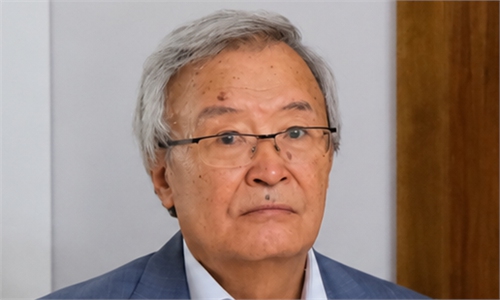
Farrukh Sohail Goindi Photo: Courtesy of Goindi
Editor’s Note:
A grand assembly marking the 90th anniversary of the victory of the Long March of the Chinese Workers' and Peasants' Red Army was held on the morning of October 22 at the Great Hall of the People in Beijing. Xi Jinping, general secretary of the Communist Party of China (CPC) Central Committee, Chinese president and chairman of the Central Military Commission (CMC), delivered an important speech. The speech reviewed the great course of the Red Army's Long March led by the Party, summarized the great significance of the victory of the Long March, revealed the key to victory that has enabled the Party and the people's army to march forward resolutely, expounded the historical value of the great Long March spirit, and set out clear requirements for carrying forward the great Long March spirit and succeeding in the new Long March.
In the 30th installment of the special series “Decoding the Book of Xi Jinping: The Governance of China,” the Global Times, along with the People's Daily Overseas Edition, will explore the theme – “Carry forward the great spirit of the Long March and forge ahead on the new Long March” – by inviting Chinese and foreign scholars, translators of the work, practitioners with firsthand experience, and overseas readers to share their perspectives.
In the 30th article of the "Translators' Voices" column, the Global Times interviewed Farrukh Sohail Goindi, a Pakistani author and analyst who also served as the translator of the Urdu edition of the book Xi Jinping: The Governance of China.
In November 1934, three female Red Army soldiers slept at the home of a villager, Xu Jiexiu, in Shazhou Village, Rucheng County, Central China’s Hunan Province. Before leaving, they cut their only quilt in half and left one half with her. The story, now widely known as “half a quilt,” has become a vivid symbol of the deep bond between the Red Army and ordinary people during the Long March.
This year marks the 90th anniversary of the victory of the Long March of the Chinese Workers' and Peasants' Red Army. The story of “half a quilt” is not only deeply embedded in the Chinese people's collective memory of the Long March, but also serves as an entry point for Goindi to reflect on this defining chapter of Chinese history.
The bond between the Red Army and the people
For Goindi, the close bond between the Red Army and the people is central to understanding the Long March. The story of "half a quilt" offers one of the most vivid illustrations of this relationship.
In October 1934, after the CPC failed to repel the Kuomintang regime's fifth encirclement and suppression campaign, the Red Army was forced to leave its base and embark on the arduous Long March. Along the way, it faced not only relentless pursuit and attacks from enemy forces, but also food shortages, exhaustion from long-distance marches, and the formidable challenges posed by harsh natural conditions, including snow-covered mountains and marshlands.
Under such circumstances, Goindi noted, the Red Army's ability to find shelter, obtain food and secure guides familiar with the mountain paths was crucial to its survival. The willingness of local people to risk their lives to help the soldiers was closely tied to how they viewed the Red Army.
In the Pakistani scholar's view, the spirit embodied in the story of "half a quilt" – a spirit of the CPC sharing hardships with the people, standing together in times of adversity and persevering against all odds – continues to find expression in China's development today.
In 2021, China announced that it had achieved a complete victory in the fight against poverty, lifting nearly 99 million poor rural residents living below the poverty line out of poverty. Goindi noted that more than 3 million officials were sent to rural areas as part of this "people's war" against poverty, living and working alongside poor households. He also highlighted China's approach to targeted poverty alleviation, which emphasizes understanding the specific circumstances of each household and tailoring measures to meet its actual needs. In his view, this approach has something in common with the Red Army's efforts to understand villages along its route and win the support of local people during the Long March.
"The Long March teaches that power comes from serving the people, not ruling over them. This is why China's governance today puts people's livelihoods first," the scholar said.
A chapter of Chinese history that influenced revolutions around the world
Beyond the relationship between the Red Army and the people, Goindi also sees the Long March as an event of historical significance extending far beyond China. In his view, it fundamentally changed perceptions of the path to revolution.
"It proved that a communist revolution did not need to follow the October Revolution's model of urban worker uprising. The idea of a rural-based, protracted people's war directly inspired national liberation movements."
The Pakistani expert pointed out that this approach exerted a profound influence on Vietnam's struggle against colonialism. Its influence also extended to Laos, Cambodia, the Philippines, Thailand, Malaya, India and Nepal, as well as later to Africa and Latin America.
Every generation must undertake its own Long March
Ninety years on, the Long March is not merely a chapter of history; it also has a close bearing on China's development today. Goindi believes that although the technological blockades, economic decoupling pressures and complex international competition facing China today are very different from the circumstances confronting the Red Army, these challenges make the spirit of the Long March all the more relevant.
"Self-confidence, self-reliance, and struggle are the answer," he noted.
In Goindi's view, many of China's current development goals require sustained, long-term efforts. He draws a connection between the goal of building China into a great modern socialist country in all respects by the middle of this century, the Belt and Road Initiative, ecological civilization and the vision of building a community with a shared future for mankind, framing these as part of a new Long March in the new era.
He noted that the pursuit of these goals is far from a smooth journey. Technological bottlenecks, environmental challenges, and unbalanced development all require gradual solutions. Just as the Red Army had to cross snow-covered mountains and vast marshlands during the Long March, China today must overcome obstacles on its path to development.
Goindi believes that the spirit of the Long March, with its emphasis on long-term struggle, helps explain why China attaches importance to long-term planning and chooses to pursue its goals step by step rather than focusing solely on short-term gains.
Why does the Long March continue to attract international attention?
In recent years, an increasing number of foreign scholars, journalists and young people have come to China to retrace the route of the Red Army's Long March. Goindi believes that the Long March continues to attract international visitors not only because of its astonishing history, but also because the hardships it involved resonate with the challenges people face today.
"It is a powerful story showing that human beings can overcome seemingly impossible difficulties through belief and unity. That is why it is compared internationally to the world’s great epics of endurance," noted the Pakistani scholar.
In his view, retracing the Long March is not simply about looking back at history; it also offers international friends a window through which to understand contemporary China.
Through the Long March, they can come to understand a China that remembers where it came from, knows why it chose its path, and has the confidence and perseverance to continue its own Long March in the new era, said Goindi.
RELATED ARTICLES