Translators’ Voices: China’s people-centered philosophy of urban development turns the vision of a better life for people into reality: Hungarian translator
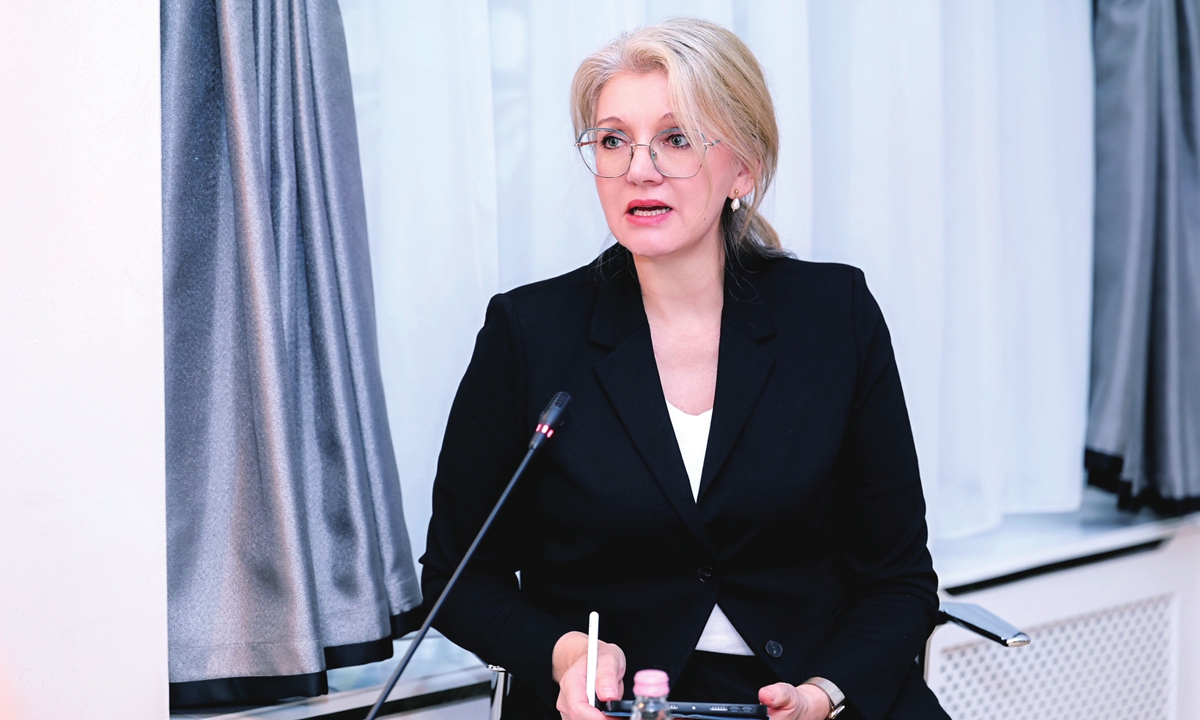
Simon Adrienn Photo: Courtesy of Simon
Editor's Note:
In November 2019, during an inspection tour in Shanghai, Chinese President Xi Jinping first put forward the concept that "cities should be built by the people and for the people." This July, also during an inspection tour in this city, Xi stressed the need to fully embrace the people-centered philosophy of urban development and adhere to the principle of understanding the people's needs, soliciting their suggestions, and assessing their evaluation of the effectiveness of urban renewal.
Urban renewal initiatives should be carried out in a thorough, meticulous and effective manner to continuously enhance the people's sense of fulfillment, happiness and security, Xi said.
The concept that "cities should be built by the people and for the people," is a concentrated expression of the development thinking of putting people first in urban governance. Volumes I through V of Xi Jinping: The Governance of China include a series of Xi's important remarks on urban work.
In the article "Bring a sense of gain, happiness and security to the people" in Volume III of Xi Jinping: The Governance of China, Xi gave specific instructions on urban shantytown renovation and waste sorting. He said that "we cannot have cities with skyscrapers on the one side and slums on the other," and that "garbage sorting concerns the public's living environment and resource conservation." In Volume V, Xi said "we will carry out urban renewal projects and improve urban infrastructure to build livable, resilient and smart cities," and emphasized, "guided by the principle that cities should be built by the people and for the people, the new era should witness the development of beautiful cities that are green, low-carbon, habitable, safe, healthy, smart and efficient."
In the 29th installment of the special series "Decoding the Book of Xi Jinping: The Governance of China," the Global Times, along with the People's Daily Overseas Edition, continue to explore this theme - "Cities should be built by the people and for the people" - by inviting Chinese and foreign scholars, translators of the work, practitioners with firsthand experience, and overseas readers to engage in a deeper discussion of the practical value and broader significance of this concept.
In the 29th article of the "Translators' Voices" column, the Global Times (GT) interviewed Simon Adrienn (Simon), translator of the Hungarian edition of the book Xi Jinping: The Governance of China.
GT: In Volume V of the book Xi Jinping: The Governance of China, Chinese President Xi Jinping pointed out that "cities should be built by the people and for the people," closely linking urban development with enhancing people's sense of fulfilment, happiness and security. Why does China attach such great importance to urban development?
Simon: The Communist Party of China (CPC) repeatedly stresses that the people stand at the center of its work, and cities are where this idea becomes very concrete. Cities are the places where people access jobs, healthcare, education and social services. Better housing, safer streets, cleaner environments and modern infrastructure can strengthen people's well-being and sense of security. At the same time, cities are engines of modernization, concentrating industry, technology and talent, and creating space for innovation. The idea that "cities should be built by the people and for the people" captures a people-centered approach: listening to residents, solving practical problems and ensuring that development is inclusive and sustainable. The strong focus on cities reflects a broader goal - using urban development to turn the vision of a better life for the people into reality.
GT: The 2025 Central Urban Work Conference noted that urban growth is transitioning from large-scale incremental expansion to a stage focused on improving the quality and efficiency of existing capacity. The meeting called for the shifting of the urban development philosophy to place more emphasis on the well-being of the people, and faithfully practicing the vision of developing people-centered cities. How do you understand the concept of "people-centered cities" proposed by China as urban development enters a new stage?
Simon: The idea of building "people-centered cities" marks a clear shift from expansion-driven development to a focus on residents' daily well-being. Instead of judging success mainly by GDP, city size or the number of new projects, this approach prioritizes the quality of life in existing urban areas. Compared with traditional models, the emphasis moves from building outward to improving what is already there: upgrading infrastructure and housing, strengthening public services, and making sure people have better access to healthcare, education, transport and green spaces.
It also highlights public participation, giving residents more say in decisions that affect their neighborhoods, so planning is based on real community needs. In the Chinese context, this concept responds to the new stage of urbanization, where managing infrastructure, environmental pressures and social integration has become more important than simple expansion. It also reflects the CPC's broader commitment to making the people's aspiration for a better life the starting point and ultimate goal of urban development.
GT: The 2025 Central Urban Work Conference also proposed building modern, people-centered cities that are innovative, livable, beautiful, resilient, culturally vibrant and smart. Based on your experience of studying and living in China, what changes in China's urban development in recent years have left the deepest impression on you?
Simon: Based on my experience living and studying in China, several changes in urban development have left a deep impression on me. One major change is the rapid spread of digital technologies. Mobile payments, transport apps and online government platforms have made daily life much more convenient - people can pay bills, book medical appointments or access public services directly on their smartphones, which makes cities feel truly smart and efficient.
I have also seen a remarkable improvement in urban mobility. When I was a student, Beijing's first metro loop was not yet fully connected, and in Shanghai the metro was still under construction. Today, both cities have extensive metro networks, and high-speed rail links between major cities have dramatically reduced travel times. It is striking to think that, back in my student days, a train journey from Beijing to Shanghai could take 16-18 hours, whereas now it can be completed in just a few hours. At the same time, there is a clear effort to make cities more liveable and culturally vibrant - expanding green spaces and improving historic neighborhoods while upgrading infrastructure.
GT: During his Shanghai inspection tour in July this year, President Xi said that the high-quality urban renewal is a vital part of urban modernization, stressing the need to fully embrace the people-centered philosophy of urban development and adhere to the principle of understanding the people's needs, soliciting their suggestions and assessing their evaluation of the effectiveness of urban renewal. He emphasized that urban renewal initiatives should be carried out in a "thorough, meticulous and effective manner." How do you view this approach to urban renewal?
Simon: The approach reflects a meticulous, fine-grained style of governance, where urban modernization is achieved by careful adjustment and improvement, rather than by starting over from scratch, which can be seen as a clear move toward more people-centered and context-sensitive urban renewal. Instead of applying one uniform model, cities like Shanghai adapt their strategies to the specific needs of different neighborhoods and households.
Compared with traditional large-scale demolitions and redevelopments, this approach is less disruptive and more gradual. It focuses on improving housing, public spaces and infrastructure step by step, while preserving historical buildings and cultural landmarks. This allows renewal projects to respect existing social networks and daily routines, which is important for residents' sense of stability and belonging. In my view, one key advantage is that it gives residents a stronger voice: Their needs, suggestions and evaluations directly shape the outcome of renewal. This not only improves the quality of the projects, but also helps build trust between the community and local government.
GT: In May this year, China's State Council released an urban renewal plan during the 15th Five-Year Plan period (2026-30), identifying "advancing the green and low-carbon transition of cities" as one of its key tasks. Meanwhile, many cities in Hungary are also advancing their green transition. For example, Budapest has placed emphasis on improving energy efficiency in urban planning, bidding for Europe's Green Capital title in 2029. In your view, what experiences can Chinese and Hungarian cities learn from each other in green and low-carbon development and sustainable urban construction?
Simon: Chinese and Hungarian cities can learn a great deal from each other in green and low-carbon development. Chinese cities have gained valuable experience with large-scale projects, such as integrating renewable energy into urban systems, building extensive metro networks and creating new urban ecological spaces. Hungarian cities, including Budapest, have strong traditions in careful urban planning, energy-efficient building renovation and preserving historical areas while improving environmental performance.
By sharing these experiences, both sides can better balance modernization with sustainability - for example, combining China's strength in rapid implementation with Hungary's focus on gradual, high-quality upgrades. Against the backdrop of climate change and resource constraints, exchanges between cities from different countries are very significant. They help avoid repeating mistakes, speed up the adoption of effective policies and encourage innovative solutions. More importantly, they show that making cities greener and more liveable is a shared responsibility, where mutual learning can directly benefit ordinary residents, whether they live in Shanghai or Budapest.
RELATED ARTICLES