What Qingshan’ shift from an agricultural village to a model green community can offer Laos

Illustration: Xia Qing/GT
Editor's Note:China's rural revitalization is often discussed in policies and statistics. But what does it truly look like on the ground, especially in the eyes of foreign visitors? In this new series, "Village Walk," the Global Times invites foreign visitors who have explored China's villages firsthand to share their stories. Through their perspectives, we capture the quiet transformations, the rich and vibrant local cultures, the sustainable development of rural industries, and the vitality among rural communities. This is the seventh installment of the series.
During a workshop on green finance facilitating the transformation of food systems in China and Southeast Asia held in Hangzhou, East China's Zhejiang Province in late May, delegates from some ASEAN countries had the opportunity to visit Qingshan village. The visit provided valuable insights into local livelihoods, rural transformation and the village's green development experience.
Representing my country, Laos, I participated in the workshop and joined the field visit to Qingshan village. Through this visit, several important lessons and development experiences were observed.
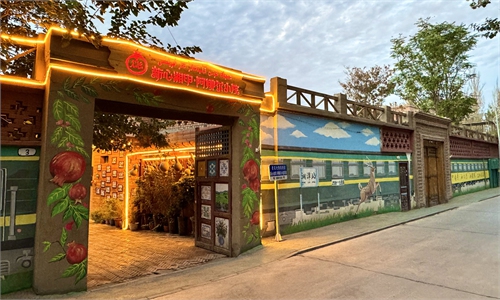
Qingshan village is recognized as a model "future village" in Zhejiang and was selected as a pilot "low (zero) carbon village." The village covers approximately 15.6 square kilometers, with forests accounting for more than 80 percent of its total area. Most villagers are engaged in bamboo cultivation, rice farming, tea planting and vegetable production. In the past, the village faced water pollution caused by the use of fertilizers and chemicals in agricultural production. Through the leadership of the local government, active community participation and support from various organizations, the village has transformed from an ordinary agricultural village into a model green community.
A key starting point of this success was the restoration of Longwu Reservoir, an important drinking water source for the area. In 2015-16, the Shanshui Water Fund was established to support water source conservation, prohibit the use of chemicals in the reservoir area, manage waste within and around the reservoir, and conserve forests to protect the watershed. These efforts encouraged local people to work together to protect their water resources. After several years of implementation, water quality improved significantly, and the reservoir became an important foundation for revitalizing and developing Qingshan village.
After addressing environmental challenges, the village began to develop a green economy based on its natural assets and local culture. It promoted eco-tourism, homestays, restaurants, community products, arts and cultural activities, sports facilities, and creative activity centers. The village also introduced systematic waste separation and management. As a result, it has become a clean, green, beautiful and pollution-free community.
In addition, the village has attracted designers, artists and younger generations to live, work and establish businesses in the community. These developments have helped increase the average income of villagers and turned the village into an important learning site for rural revitalization and sustainable community development in China.
Another notable feature is its participatory governance model. The village has also established a Future Village Council as a platform for villagers and stakeholders to jointly discuss and make decisions on the sustainable development, with the aim of improving livelihoods and maintaining the environment.
For Laos, the lessons from Qingshan show that nature conservation and economic development can go hand in hand. Water source protection, green tourism, green finance mechanisms and community participation are key factors that can be adapted for community development and conservation areas in my country.
Laos still has many urban and rural areas that require systematic and integrated development, including strengthening basic knowledge among local communities, improving infrastructure such as electricity, clean water, village roads, health centers and schools, protecting water sources, maintaining the environment, and introducing systematic waste separation and management.
China's experience shows that environmental development is not limited to urban areas. China has also paid close attention to rural communities, including remote villages, in order to narrow the development gap between urban and rural areas. Qingshan village is not the only model village in China. There are many other villages in China that have been developed in a similar way and have become models of sustainable development and environmental protection.
This field visit was not only an opportunity to learn from the experience of Qingshan as a model village in China. It is also a source of inspiration for exploring new approaches to promote green development, a circular economy and climate change adaptation in my own country.
The author is deputy director general of the Department of Planning and Cooperation, the Ministry of Agriculture and Environment, Laos. opinion@globaltimes.com.cn
RELATED ARTICLES