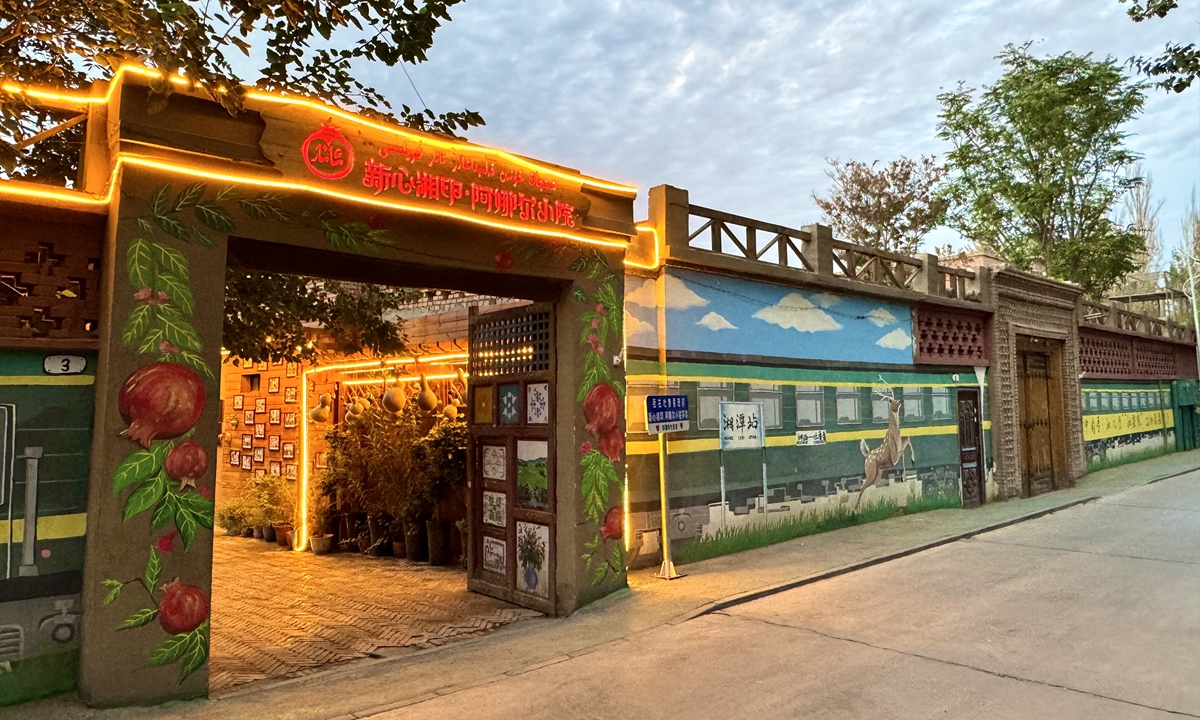
The photo taken on June 20 shows a local home adorned with vibrant graffiti in Ximen village, Xinjiang. Photo: Courtesy of the author
Editor's Note:China's rural revitalization is often discussed in policies and statistics. But what does it truly look like on the ground, especially in the eyes of foreign visitors? In this new series, "Village Walk," the Global Times invites foreign visitors who have explored China's villages firsthand to share their stories. Through their perspectives, we capture the quiet transformations, the rich and vibrant local cultures, the sustainable development of rural industries, and the vitality among rural communities. This is the sixth installment of the series.
By Yasir Habib Khan
Over the past two millennia, the western stretches of the Silk Road - now China's Xinjiang Uygur Autonomous Region - have thrived as a hub of vigorous trade and commerce. Today, a fresh avenue of economic promise is unfolding across the region's villages, offering local ethnic communities, including the Uygurs, a new and sustainable source of income.
This emerging and lucrative venture is home tourism. One notable example is Ximen village, located in the Turpan new town - a well-known area of Xinjiang. Residents of Ximen have tapped into this business, capitalizing on the stunning interior and exterior designs of their homes, which serve as living showcases of tradition, heritage and culture.
Experiencing the new holistic economy and livelihood in Ximen village aligns well with China's rural revitalization strategy, which aims to improve rural living standards, narrow the urban-rural gap, and create sustainable economic opportunities in villages.
According to my understanding and firsthand observation, local villagers are quite satisfied with this strategy, a national development program launched after China's success in eliminating extreme poverty, because it encourages entrepreneurship and local business development.
Recently, as a member of a foreign delegation program titled "Visiting the Core Zone of the Silk Road Economic Belt," I visited Ximen village. My fellow colleagues were captivated by the beautifully ornamented households. Both local and international tourists are drawn to these homes for their authentic, natural ambiance.
Guests are served home-cooked meals for breakfast, lunch and dinner, while family members, dressed in traditional attire, attend to their every need. One homeowner told me that monthly earnings during the peak season range between 10,000 yuan ($1,476) and 20,000 yuan.
We relished a rich spread of homemade treats served by a woman successfully running a home tourism enterprise. The visitors were also entertained by traditional singing and dancing performances. The Uygur hosts gave the delegates a tour of their home, allowing them to admire the historical interiors, ornate living rooms and distinctive textures of walls, doors and arches.
By commercially operating her home, she secures a decent income. Her husband added, "Our house is part of the home tourism movement, which has recently become popular in our village. It helps us earn extra money to effectively manage family expenses." She confidently shared that their average monthly income would rise to 25,000 yuan during the tourist season.
Home tourism is part of a budding entrepreneurial wave across many parts of China, where residents transform their homes into temporary eateries or guesthouses, offering culturally immersive, low-cost homemade meals.
The hostess highlighted the Uygurs' deep-rooted tradition of hospitality and their dedication to making every guest feel welcome. Home tourism, as a facet of the sharing economy, provides unique perks that conventional hotels cannot offer. Through this model, visitors - including domestic tourists from various provinces and international travelers - immerse themselves in Xinjiang's culture, savor traditional dishes and gain insights into local customs, religion and daily life. They also enjoy an authentic "live like a local" experience.
On a global scale, home tourism - as part of the sharing economy - represents a socio-economic system built on the collective use of human, physical and intellectual resources. China's rural revitalization, meanwhile, gives this global trend a unique purpose - not just economic growth, but the restoration of dignity and hope in the countryside. As I walked through Ximen village, I saw the collective pride of villagers who are no longer looking toward the cities, but are building their futures right where they stand.
The author is the president of the Pakistan-based think tank Institute of International Relations and Media Research. opinion@globaltimes.com.cn
RELATED ARTICLES