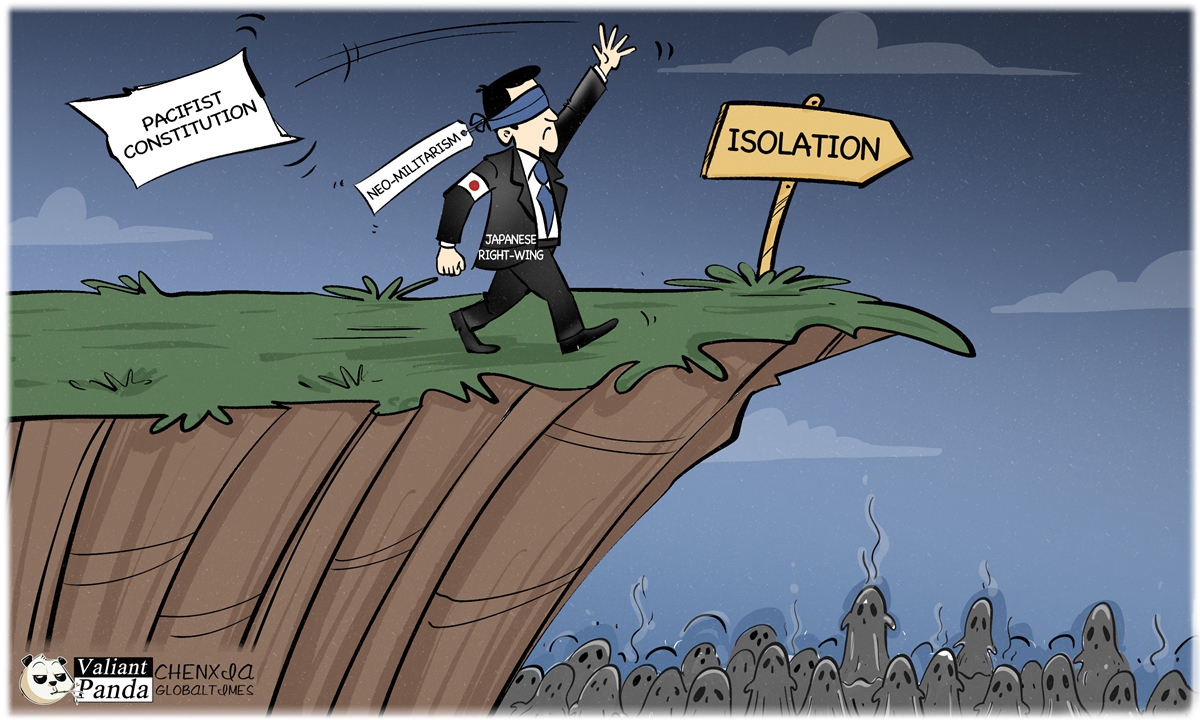
Illustration: Chen Xia/GT
In the eyes of others, Japan as a whole carries a strong streak of self-contradiction. This inherent paradox - a state of ambivalence and inner division - permeates its politics, economy, culture, history and security, and has become a distinct imprint on modern Japan.This systemic cognitive imbalance is most evident in Japan's China strategy. In recent years, Japan has characterized China as "an unprecedented and the greatest strategic challenge," employing an orchestrated approach of political confrontation, economic decoupling and bloc-based suppression. The root cause lies in Japan's fundamental misperceptions of China.
Four questions, therefore, warrant Japan's serious reflection.
Question 1: Does portraying China as a strategic challenge serve Japan's national interests?
Japan's confrontation with China is driven by multiple calculations. On the political front, right-wing forces use their tough stance toward China to divert public attention from domestic economic stagnation and social imbalance. On the economic and security front, Japan expands its military and develops its military-industrial complex under the pretext of "security threats." On the diplomatic front, it relies entirely on the Japan-US alliance, willingly serving as a linchpin of the US Indo-Pacific Strategy while wooing allies to build a containment ring around China.
This approach of treating neighbors as enemies is, in fact, strategic speculation. There is a disparity in the scale of national strengths between Japan and China. Provoking conflicts with China, particularly by playing with fire on China's core issues such as the Taiwan question, would incur consequences Japan could not afford. Such an approach runs counter to the basic logic of security and development.
Question 2: How can Japan achieve genuine reconciliation with China and other Asian neighbors?
Japan has a fundamental misperception of history. For its right-wing forces, the end of World War II was merely a "cessation of war" - their mistake, in their view, lay not in launching aggression, but in being defeated. This distorted perception has led to a striking lack of accountability within Japanese society for the atrocities Japan committed as an aggressor, while trapping it in a self-serving "victim" mentality. This manifests in multiple ways: History textbooks downplay Japan's war crimes, distorting facts by replacing "invasion of China" with "entry into China"; Japanese politicians make repeated pilgrimages to the notorious Yasukuni Shrine, which honors Class-A war criminals; and historical facts such as the Nanjing Massacre are openly denied.
Question 3: Isn't talking down China and promoting decoupling undermining Japan's own foundation for development?
China and Japan share close economic and trade ties. China has been Japan's largest trading partner for many consecutive years, with bilateral trade exceeding $300 billion. Japan relies on China heavily for its domestic supplies of heavy rare earths such as dysprosium and terbium. Yet Japan has aligned itself with the US in pushing for decoupling and cutting China off from the supply chains. At the same time, it stubbornly and naively keeps talking down China's development prospects.
Such judgment is completely divorced from reality. It is simply self-contradictory to enjoy the opportunities brought by China's development while fearing its vitality and fantasizing about its developmental stagnation.
Question 4: Why has Japan fallen into narrow-mindedness and paranoia in its perception of Chinese civilization?
Japan sent envoys to China during the Sui and Tang dynasties to learn from Chinese civilization. Cities such as Kyoto and Nara were built in imitation of the Tang-dynasty Chinese buildings. Japan's writing and ritual systems were also influenced by Chinese culture. However, after the Meiji Restoration, Japan sought to "leave Asia to join Europe," giving rise to a mind-set of "Western supremacy" in Japan.
These cognitive misconceptions at the civilizational level are essentially a lack of cultural confidence. Global governance requires the coexistence of diverse civilizations. If Japan cannot view Chinese civilization and the broader Eastern civilizations from an equal and inclusive perspective, it will not only misjudge China, but also lose itself in the historical process of global civilization integration and mutual learning between the East and West.
In conclusion, the four questions above reveal a deeply self-conflicted Japan: confrontational in its strategic outlook, distorted and alienated in its historical perception, short-sighted and self-defeating in its economic calculus, and narrow-minded in its understanding of civilizations.
The author is an observer on international affairs. opinion@globaltimes.com.cn
RELATED ARTICLES