Illustration: Chen Xia/GT
Editor's Note:China's rural revitalization is often discussed in policies and statistics. But what does it truly look like on the ground, especially in the eyes of foreign visitors? In this new series, "Village Walk," the Global Times invites foreign visitors who have explored China's villages firsthand to share their stories. Through their perspectives, we capture the quiet transformations, the rich and vibrant local cultures, the sustainable development of rural industries, and the vitality among rural communities. This is the fifth installment of the series.
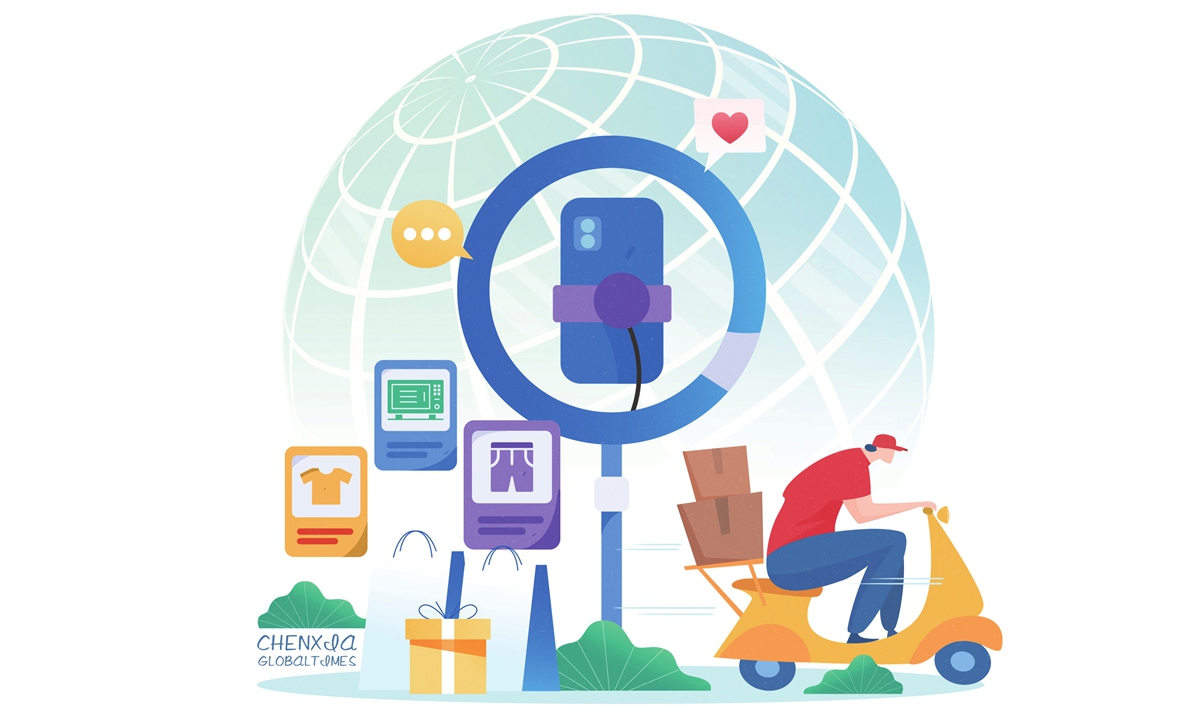
In rural China, livestreaming e-commerce has become a vibrant and transformative force. Farmers and young entrepreneurs now leverage various social media platforms to stream live directly from orchards, rice paddies, and farmyards. Equipped with smartphones as their new "agricultural tools," they showcase fresh produce, handmade crafts, and local specialties in real time, answering viewers' questions about planting, harvesting, and cooking.
The scenes are lively and authentic - hosts may squat beside vegetable patches or steam homemade buns, engaging audiences with humor and regional accents. This business model not only eliminates middlemen and boosts farmers' incomes, but also bridges the gap between urban residents and rural life. Local governments support these efforts through vocational training and infrastructure development, turning once-remote villages into bustling e-commerce hubs.
In 2020, the weekly magazine where I worked had sensed the impact of livestreaming, and decided to send a team of us to Luotuowan, a village in north China's Hebei Province, to take the plunge ourselves.
It was an especially critical time for China. The deadline to eradicate absolute poverty was nearing, and the authorities had redoubled their efforts in the rural areas.
Livestreaming was a potent weapon in this war. Fuping, of which the county Luotuowan is a part, is a major mushroom base. According to reports, about 38,000 people were part of the industry by 2024, growing mushrooms worth 1 billion yuan ($147 million) annually. We joined a livestreaming one night to help local mushroom farmers sell their products.
It was a novel trip for me in many ways. Instead of being behind the camera, I was going to be in front of it, live and speaking in Chinese. There were dozens of products - packaged mushrooms, dates, jujubes, rose tea, cooked chestnuts, mushroom sauces and many more. My Chinese was rudimentary and I felt panic-stricken, thinking I wouldn't be able to remember all the names and prices.
In reality, it was one of the most professional events I have ever seen. To start with, Luotuowan, once an impoverished village, now has good roads, which meant the sold products could be quickly dispatched to the buyers. It had a great telecom network and, wonder of wonders, a compact, modern studio with professional sound and lighting equipment.
Once during the livestream, we stepped out of the studio to go to a mushroom grower's farm. It was a long room, dark and with piles of what looked like logs to me. The mushrooms were growing on these logs. The farmer told us his story, which was livestreamed.
When the livestreaming was over, I was told nearly 510,000 people had tuned in. That was my first introduction to the power of livestreaming to improve people's lives in rural communities. And I am glad to say that during my nearly 10 years in China, I have seen other instances, from livestreams in Jingdezhen, the porcelain capital of China, selling ceramic objects, to former herders in Southwest China's Xizang Autonomous Region advertising their homestays.
Across China, from the terraced hills of the southwest to the vast plains of the northeast, livestreaming has become a quiet revolution. No longer just a tool for entertainment, it empowers villagers to tell their own stories, sell their honeyed hams and sun-dried chilies directly to urban kitchens, and preserve traditions that once faded. In this vast digital bazaar, every click carries the weight of hope, and every sale is a step toward narrowing the gap between mountain and metropolis.
The potential of livestreaming to promote common prosperity remains immense. It is helping transform China's villages. I am delighted that my night in Luotuowan made me a tiny wave in this endless, expanding stream of life.
The author is an India journalist who has worked in Asia and the Middle East, with a decade's stint in China. opinion@globaltimes.com.cn
RELATED ARTICLES