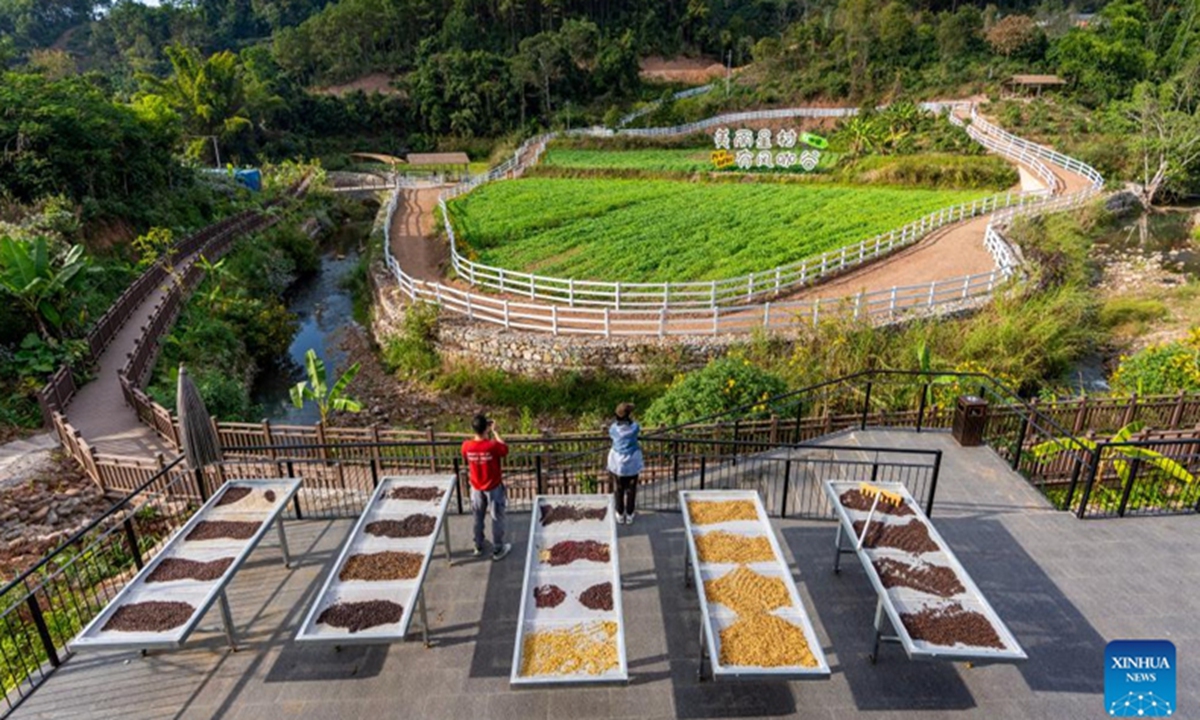
Tourists take photos at a coffee experience center in Pu'er, southwest China's Yunnan Province, Jan. 8, 2025. Photo: Xinhua
Editor's Note:China's rural revitalization is often discussed in policies and statistics. What does it truly look like on the ground, especially in the eyes of foreign visitors? In this new series, "Village Walk," the Global Times invites foreign visitors who have explored China's villages firsthand to share their stories. Through their perspectives, we capture the quiet transformations, the rich and vibrant local cultures, the sustainable development of rural industries, and the vitality among rural communities. This is the fourth installment of the series.
My great‑grandparents were coffee growers in the mountains of Antioquia, Colombia. Up there, the days are pleasant, the nights cool and the coffee thrives in that perfect, temperate pause between seasons. My great‑grandparents harvested beans by hand, just like thousands of other families who built their lives around that little red cherry.
I moved to China 25 years ago, and ever since then, I've been constantly on the lookout for a decent cup. Not the over‑roasted, bitter stuff, but real coffee with character - the kind that reminds me of my grandparents' farm, where the mist rolled in each afternoon and the hills stayed green all year long.
That search finally led me to the lush hills of Pu'er, Southwest China's Yunnan Province, in 2023. And honestly, I found more than just flavorful beans. I found a whole story of transformation - one that felt strangely familiar, like an echo of what my own ancestors had gone through when building Colombian coffee into a world-renowned product, but with a modern Chinese twist.
My first stop was a coffee estate in the mountains of Menglian County. The drive took hours, winding through misty valleys and tiny villages. A farmer there offered me a cup of their latest roast and explained how things used to be. Not long ago, they sold raw beans to the global market at whatever price buyers offered. They had no bargaining power, no brand and no pride. Then, local leaders pushed a decisive shift away from low‑value bulk beans toward high‑grade "specialty coffee." The new focus was on quality and on growing coffee at higher altitudes. That was the turning point.
Why does altitude matter so much? The "golden altitude zone" of 1,300 to 1,700 meters works wonders because for every 100 meters you climb, the temperature drops by about 0.6 C. In Yunnan, temperatures are warm enough for Arabica to thrive, but cool enough to slow down ripening. The result is a bean that is naturally lower in bitterness and richer in the compounds that, after roasting, give notes of fruit, floral aromas and balanced, wine‑like acidity.
But convincing local farmers to change wasn't easy. Still, the estate upgraded its infrastructure, building a production line that can process hundreds of tons of fresh coffee cherries daily. The results have been tangible, with their specialty coffee rate jumping to over 70 percent. That benefits not just the farm, but the thousands of local households it partners with.
I drove even deeper into the mountains to find another cooperative. This place is where the human side of the quality revolution truly shines. Founded by members of the Wa ethnic group in 2011, it has become a global symbol of Pu'er's rise. In 2021, their coffee beans were chosen as a gift presented to members of the United Nations Security Council. Picture that: beans grown by farmers in a remote corner of Yunnan, served at the UN. Today, the cooperative connects 280 households across 200 hectares of coffee fields, with incomes having increased by more than 4 million yuan annually.
Both projects have integrated coffee, tourism and rural life into a sustainable model. Since their launch, the villages have turned into vibrant communities. Young people who once were lured to move to distant factories have come back home. They're developing guesthouses, offering coffee tastings and organizing farm tours while training as baristas. All around Yunnan, you see young people in their 20s pulling espresso shots with the same hands that helped their parents pick cherries. That's the kind of change that really sticks.
On my last evening in Pu'er, I sat down with an older coffee grower. He explained the strategy in a way I could finally understand: "We're not just selling beans," he said. "We're selling the experience - the altitude, the sunrise, the education, the handcraft." That focus on the golden altitude zone has been the key to everything. And for me, the great‑grandchild of Colombian coffee farmers, that philosophy felt like coming home. Because, in the end, good coffee isn't just about what's in the cup. It's about the land, the people and the slow, patient work of getting things right.
The author is a reporter at Alianza Informativa Latinoamericana and is based in Dongguan, South China's Guangdong Province. opinion@globaltimes.com.cn
RELATED ARTICLES