‘China’s rural revitalization is not only about large-scale infrastructure but small yet practical livelihood innovations’: US influencer
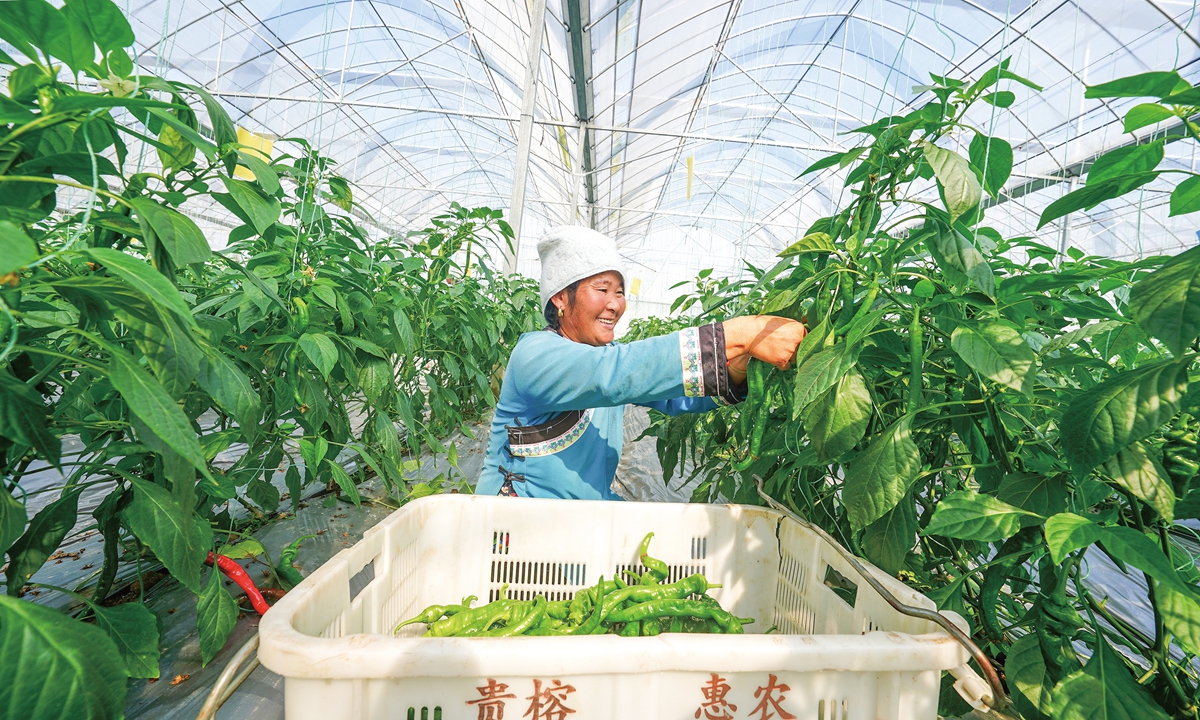
A villager harvests fresh chili peppers at a vegetable base in Qiandongnan prefecture, Southwest China's Guizhou Province on January 18, 2024. Photo: VCG
Editor's Note:China's rural revitalization is often discussed in policies and statistics. What does it truly look like on the ground, especially in the eyes of foreign visitors? In this new series, "Village Walk," the Global Times invites foreign visitors who have explored China's villages firsthand to share their stories. Through their perspectives, we capture the quiet transformations, the rich and vibrant local cultures, the sustainable development of rural industries, and the vitality among rural communities.
In the third installment of the series, Global Times (GT) reporter Liu Xuandi, speaks with Jackson Hinkle (Hinkle), a US influencer. Hinkle recently followed a group of vegetable farmers with bamboo baskets and boarded a very special bus at 5 am in China's Guiyang: Guiyang Route 252, also known as the "Farmer Bus," a customized line specifically designed to help rural farmers bring their fresh produce to the city at a very low cost. He later filmed the journey in a vlog, which quickly went viral on social media both in China and around the world. In conversation with GT, Hinkle shared his insights on the broader implications of this small yet meaningful livelihood initiative in China's approach to rural revitalization.
GT: When you took the "Farmer Bus" in Guiyang, what specific scene or detail touched you the most and made you feel truly moved? What were you thinking at that moment?
Hinkle: What moved me the most was the energy and spirit of the farmers - many of them elderly - whom I joined on the "Farmer Bus" at 5:00 am. Waking up that early is difficult for anyone, but for them it is part of a daily routine that begins around 4:00 am. They travel to Guiyang, spend hours selling their goods at the market, and then return home to continue working in the fields. It is an incredibly demanding lifestyle.
Yet, what struck me was not the hardship, but their positivity. Despite everything, they were in remarkably good spirits that morning. That image stayed with me, and later I came to understand why. Before the "Farmer Bus," many of these farmers had no reliable way to reach the city. Some walked long distances, while others paid for costly private transport or squeezed onto overcrowded buses alongside urban workers.
These options were inefficient, exhausting, and often meant they could sell less and earn less. The "Farmer Bus" changed that. It is a simple solution, but a powerful one. It saves time, reduces costs, and allows them to bring more goods to market, increasing their income. Beyond the economic impact, it restores something even deeper: dignity.
In that moment, I realized how meaningful even a small-scale initiative can be. It not only supports farmers but also strengthens entire communities, improves access to fresh food, and affirms the essential role farmers play in society. Without them, everything else falls apart, and that is something China deeply understands.
GT: Has this immersive "village walk" changed the way you see China's rural revitalization strategy? Were there any aspects that surprised you or challenged your previous understanding?
Hinkle: What surprised me most was how seamlessly China's rural revitalization strategy has integrated farmers into the modern digital economy. Having visited farmers' markets in the US and in many other countries, I've always made a point to carry cash, especially small bills, because transactions are still mostly done in the traditional way.
But in Guiyang, I saw something different. Every farmer at the market had an official license badge with a QR code that allowed customers to pay instantly using digital methods. It was simple, efficient, and universal, with no need for cash and exact change.
What stood out to me was how practical this is. It makes transactions faster and more convenient for both buyers and sellers, helps farmers maximize their sales since no customer is turned away due to a lack of cash, and adds a layer of security by eliminating the risk of losing money or carrying large amounts of cash throughout the day.
Even more impressive is that this system is accessible to everyone, including elderly farmers who may not be deeply familiar with technology. The process is intuitive and requires very little digital literacy, which shows how thoughtfully it has been implemented.
This experience genuinely shifted my perspective. It showed me that China's rural revitalization is not only about large-scale infrastructure or policy. It is also about small, practical innovations that directly improve people's daily lives. In many ways, it's these seemingly small details that make the biggest impact.
GT: In your view, what broader characteristics of China's rural revitalization does the Guizhou "Farmer Bus" reveal through this small yet telling example?
Hinkle: What the "Farmer Bus" in Guizhou reveals, above all, is a core principle at the heart of China's rural revitalization strategy: A commitment to ensuring that no one is left behind. What struck me was how thoughtfully even the smallest, most practical barriers had been identified and addressed.
Transportation, which might seem minor at first glance, was a critical bottleneck for rural farmers in reality. By solving it, the program unlocked greater productivity, higher incomes, and a better quality of life. This reflects a broader understanding that development is not just about large-scale projects, but about removing everyday obstacles that prevent people from fully participating in the economy. In that sense, the "Farmer Bus" is a small initiative with far-reaching impact.
GT: Are there lessons or practices from this approach that you believe could be valuable or adaptable for other countries?
Hinkle: There is a universal lesson here. The strength of any society can be measured by how effectively it supports its most vulnerable communities. When policy is guided by that principle, even modest interventions can produce meaningful results.
This approach is not unique to China - it is adaptable. Any country, at any level, whether national, regional, or local, can draw inspiration from this model by focusing on practical, targeted solutions that directly improve people's daily lives. It is not always about doing more, but about doing the right things with clarity and purpose.
RELATED ARTICLES