The CPC’s people-first governance ensures policies deliver tangible improvements in people’s lives
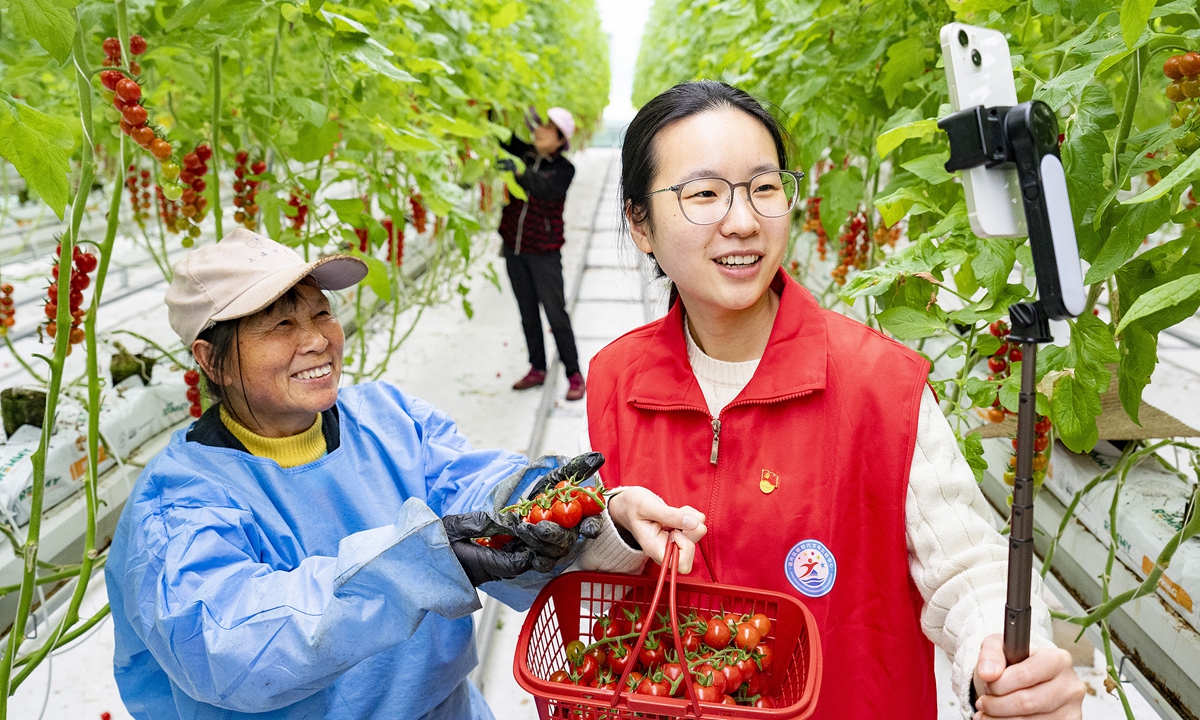
A party volunteer livestreams to sell cherry tomatoes inside a smart greenhouse in Nantong, East China's Jiangsu Province on March 18, 2026. Photo: VCG
Editor's Note:What does it mean to govern well and how should governance performance be gauged? The answer from the Communist Party of China (CPC) is that a correct understanding of governance performance should proceed from reality, respect objective laws, and, through sound decision-making and hard work, create achievements that withstand the test of practice and history, truly benefit the people, and earn the public recognition. To examine the distinctive logic and global relevance of the CPC's correct understanding of governance performance, the Global Times (GT) launches a new series, "Understanding the correct view on governance performance," inviting leading international observers to share their thoughts.
In the third installment of the series, Vinnie Molina (Molina), national president of the Communist Party of Australia, told GT reporter Liu Xuandi that the CPC's campaign to foster a correct understanding of what it means to perform well among officials is crucial as it helps reinforce a correct governance performance mind-set rooted in concrete achievements, initiative and responsiveness to people's needs.
GT: In late February, the CPC Central Committee initiated a Party-wide study campaign, prodding officials to fix their mind-set regarding governance performance. In your view, why is fostering a "correct understanding of what it means to perform well" among officials so important?
Molina: This study campaign is both timely and highly significant, as a down-to-earth approach and grassroots action lie at the heart of effective governance and Party self-governance. Fostering a correct understanding of what it means to perform well is crucial, as it shapes how officials set priorities, make decisions and assess outcomes. The campaign helps reinforce a correct governance performance mind-set rooted in concrete achievements, initiative and responsiveness to people's needs. It encourages officials to move beyond imitation and risk-avoidance, and focus on delivering tangible results.
GT: Chinese President Xi Jinping pointed out that "the ultimate gauge of governance performance is the improvement of the people's well-being." In your view, why has the CPC placed such importance on "the improvement of the people's well-being" as a measure of governance performance? How does reaffirming the people-first standard help correct officials' misguided views on governance?
Molina: I admire the political concepts on governance put forward by President Xi. People's satisfaction is a test in practice whether the policies are correct and if officials' efforts deliver real results. By promoting a people-centered standard for evaluating governance performance, we can stamp out the tendency among some officials to sacrifice public well-being in seeking to polish their performance records. Leaders must avoid treating governance as a mere box-ticking exercise aimed at justifying their positions and realize that success is measured by whether people genuinely benefit from campaigns and policy initiatives.
GT: You mentioned that the CPC is "a party linked to people." How do you view this people-first approach to governance performance in terms of reflecting and developing the Marxist conception of the people? In what ways does it strengthen the CPC's legitimacy as a party of the people and for the people?
Molina: As the president of a small Marxist-Leninist party in a developed economy, I have much to learn from the CPC. The Marxist conception of a party for the working people means pooling the wisdom of the people and acting resolutely in their interests. This is how we strive to operate as a party.
Therefore, a communist party must deliver concrete results for working people. It exists to serve and ultimately liberate the people. In this regard, the CPC's emphasis on people-first governance performance is crucial, as it ensures that policies translate into tangible improvements in people's lives.
GT: President Xi pointed out that governance should be guided by the needs of the people rather than political showmanship. He also noted that a key standard for evaluation is how many tangible benefits have been delivered to the public. In recent years, the CPC has reformed its performance evaluation system - introducing metrics beyond GDP and incorporating public satisfaction as a key benchmark. In your view, how do these measures help ensure the implementation of governance performance "truly benefiting the people"?
Molina: The implementation of the people-first approach has to be accompanied by institutional reforms and the education and training of officials for its understanding and evaluation. The key to ensuring the implementation of a correct understanding of governance performance lies not only in officials' morality and personal character, but also in building a system that guides, constrains and incentivizes them to internalize and consistently practice a people-first approach in their daily work.
GDP growth alone is not an adequate measure of governance performance. An overreliance on GDP artificially separates the "economy" from the people it is meant to serve. When economic indicators are detached from people's lived experiences, they can justify distorted outcomes that benefit only a narrow segment of society or excessive financialization.
The CPC's institutional reforms address this issue by moving beyond GDP and incorporating public satisfaction as a core benchmark. By introducing more comprehensive and grounded criteria, officials are required to confront concrete questions: Does growth improve people's quality of life? Are technological advances serving the public? Is development balanced and sustainable? In this way, the people have the final say about the policy in question.
GT: In your observation, how do CPC members practice the governance performance "truly benefiting the people" in their daily work? And which example of China's governance performance has impressed you most as "standing up in the eyes of the people"?
Molina: In my interactions with Chinese officials at meetings and events organized by the Chinese embassy or consulates in Australia, care is taken for a people-first approach. They avoid superfluous expenses and practice a new type of governance.
One example that has particularly impressed me is China's approach to developing "new quality productive forces." The new quality productive forces place emphasis on improving people's livelihoods and advancing green development, responding to people's increasingly diverse aspirations for a better life. It reflects that development must be embedded in society.
GT: How does this people-first approach to governance performance differ from practices often seen in Western political parties? What insights or implications might it offer for political parties around the world?
Molina: The key problems in Western political parties are that their policies and governance performance aim to please the status quo. The parties that take turns in office represent the interests of the ruling minority. Despite electoral promises, the interests of the majority are not represented in their style of governance.
We have much to learn in the West from the Chinese "whole-process people's democracy." It places public well-being at the center of policy design, implementation and evaluation. It emphasizes that legitimacy comes not from electoral cycles alone, but from delivering tangible improvements in people's lives. This is why we need to study modern China and understand its governance philosophy.
RELATED ARTICLES