A correct understanding of performance is a dynamic process of aligning governance with people’s needs
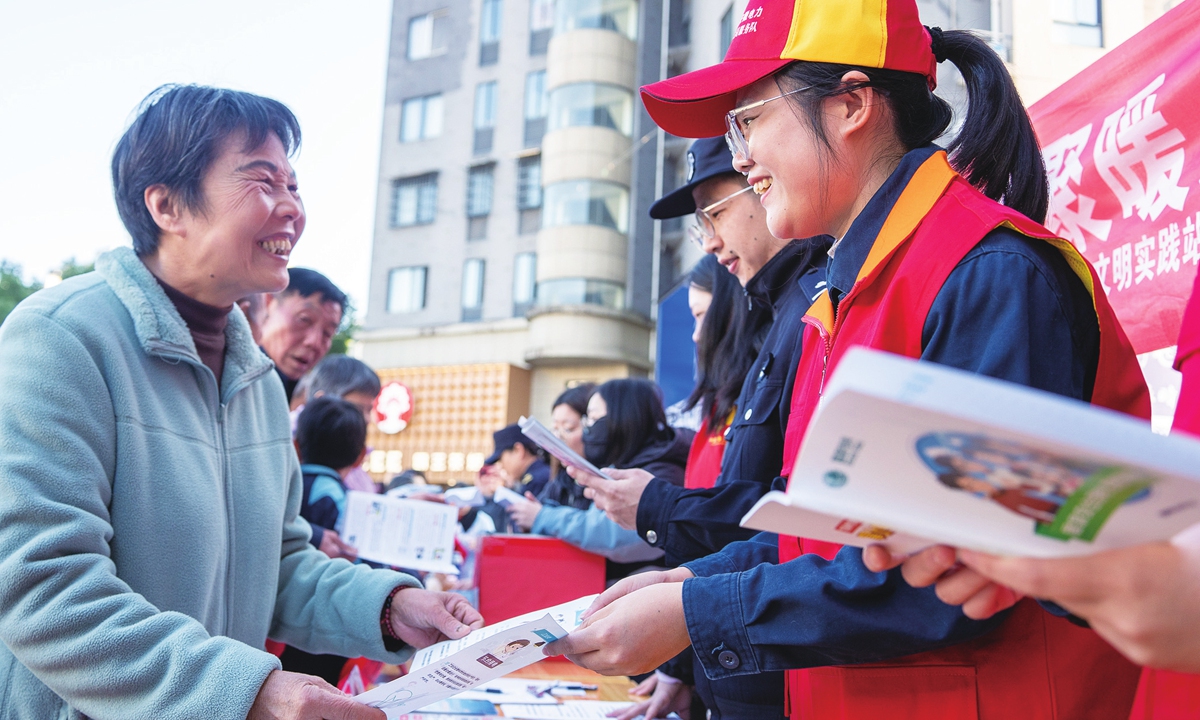
Party member volunteers from a power supply company in Xiuning, East China's Anhui Province discuss with local community residents the winter appliance safety and energy-saving tips on November 21, 2025. Photo: VCG
Editor's Note:What does it mean to govern well and how should governance performance be gauged? The answer from the Communist Party of China (CPC) is that a correct view on governance performance should proceed from reality, respect objective laws, and, through sound decision-making and hard work, create achievements that withstand the test of practice and history, truly benefit the people, and earn the public recognition. To examine the distinctive logic and global relevance of the CPC's correct understanding of governance performance, the Global Times (GT) launches a new series, "Understanding the correct view on governance performance," inviting leading international observers to share their thoughts on this question.
In the second installment of the series, Keith Lamb (Lamb), an independent international relations analyst who focuses on China's socialist development and global inequality, told GT reporter Xia Wenxin that "a correct understanding of governance performance reorients evaluation toward outcomes that genuinely benefit the people over time." Ultimately, a correct understanding of governance performance functions not only as an evaluative standard but as a self-correcting mechanism, he added.
GT: The CPC Central Committee, with Comrade Xi Jinping at the core, initiated a Party-wide study campaign for Party members to fix their mind-set regarding governance performance in late February, so as to deliver results that "stand up in practice, in the eyes of the people, and over the course of time." How should we understand the connotation of a correct understanding of governance performance proposed by the CPC? What is the significance of having such a correct understanding?
Lamb: A correct understanding of governance performance carries specific meaning in the CPC's political discourse. It is directed at a concrete problem: the tendency of officials to pursue visible, short-term achievements at the expense of genuine, long-term progress. A correct understanding of governance performance reorients evaluation toward outcomes that genuinely benefit the people over time.
When classifying what constitutes an achievement, context matters: Where is society collectively heading? China's governing system provides this anchor through socialism with Chinese characteristics, which places mankind as the producer of value and the benefactor of social outcomes - not an elite winner-takes-all ideology.
In this vision, peaceful rise and ecological civilization are core criteria that a correct understanding of governance performance must incorporate.
Some observers argue that China's development success stems from the dynamism of its people rather than its governing system. Yet the two are inseparable. The people have contributed to the formulation of [China's] Five-Year Plans and overwhelmingly support their governing system because their lived reality demonstrates that it benefits them.
A correct understanding of governance performance also functions as a self-correcting mechanism. China had many successes, but corruption threatened the governing system and popular support. The subsequent anti-corruption campaign followed directly from taking the democratic will of the people seriously - a consequence of holding governance to its foundational purpose. It keeps those in power accountable not to appearances of achievement, but to the substance of it.
GT: A correct understanding of governance performance emphasizes the need to "proceed from reality and respect objective laws." Xi has often likened policy-making to finding the right key for each lock - an idea that rejects one-size-fits-all solutions and emphasizes tailoring policies to different conditions. What does it mean in practice, and how does it guard against the impulse to pursue quick wins or "instant results" at the expense of long-term development?
Lamb: Proceeding from reality and respecting objective laws is about pragmatically working to improve people's lives. This encourages being on the ground. This is in dialectical contradiction to quick, flashy achievements, which may do nothing tangible to improve the lives of the people. What is the point of looking at a gleaming tower from a slum? Improving people's lives will lead and serve as the foundation for visible achievements in the long run.
Today, most can see China's obvious successes, such as its technological prowess. However, underpinning this are China's achievements at the local level that improve the average citizen's quality of life.
Lifting people out of poverty required looking at the objective conditions and the reality of each different locality, and even each different family. This was highlighted by China's poverty alleviation campaign.
GT: Whether discussing urban development or energy policy, Xi has cautioned against ideas detached from reality. Based on your observation, how does "proceeding from reality and respecting objective laws" enable the system to identify and correct past policy misalignments?
Lamb: Evaluating performance, in any field, is essential for rectifying past mistakes, formulating plans and judging whether those involved are suitably placed. For the CPC, a correct understanding of governance performance is a normative compass rooted in a people-centered philosophy. China's governing system defines performance not by "blind GDP pursuit" but by the tangible improvement of people's well-being and the long-term health of the environment. This interplay between a socialist future and the pragmatic present inherently implies a willingness to recognize and course-correct.
For instance, in previous decades, the leadership identified that the "growth-at-all-costs" model had become misaligned with the new reality of people's expectations. Once-celebrated breakneck GDP growth was re-evaluated as an unsustainable trajectory when it led to severe pollution. The decisive shift toward high-quality development and the Beautiful China Initiative serves as a prime example of such a course correction. It was a conscious recognition that the previous "governance performance" had gone off the rails by prioritizing "tangible" short-term gains over "intangible" long-term ecological and social stability.
Likewise, the eradication of extreme poverty and the crackdown on corruption were fundamental returns to original socialist commitments after recognizing that past errors had threatened the governing system's bond with the people. The CPC shows that a correct understanding of performance is a dynamic process of aligning governance with the evolving objective truth of the people's needs.
GT: What can other governance systems learn from the CPC's approach of "proceeding from reality and respecting objective laws"?
Lamb: China sets policy based on practice, which provides a feedback loop. Here, policy is set by looking at the objective reality of local conditions, experimenting, and then seeing what needs to be adjusted and what can be adapted for other regions. In this manner, policy evolves as a living tool rather than being constrained by statistical dogma.
This type of experimenting means setting goals, and that means defining who the goal is set for. If one sets policy for the people, a lifelong effort that never stops is required. However, this stands in contradiction to narrow-minded party electoral systems, which allow the undemocratic forces of capital to monopolize these systems.
It's easy for these governments to set a goal of poverty alleviation, then set a policy. Later, if it fails, they can use a myriad of excuses, saying it failed due to the people themselves or that the policy was unworkable as it clashed with the competing interests. After this, the effort, despite the failure, is paraded as a healthy democratic system, but clearly, this is not democratic.
RELATED ARTICLES