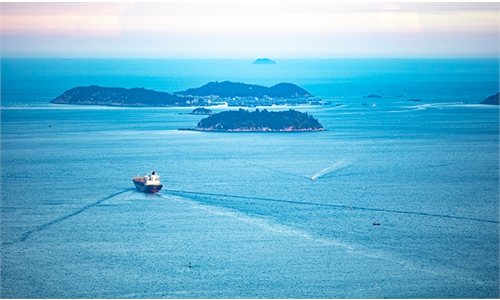
China Coast Guard vessels patrol the waters near China's Huangyan Dao in the South China Sea on July 8, 2026 (drone photo). Photo: Xinhua
Recently, Philippine officials and media outlets have once again issued a series of statements on the sovereignty of the Batanes Islands, asserting that the Philippines possesses "indisputable sovereignty" over the archipelago and presenting this claim as a natural continuation of history. Territorial sovereignty under international law, however, is never self-proclaimed. It must withstand successive tests of treaties, source of authority and the actual exercise of sovereignty.
Measured against these three standards, the Philippine claim raises questions at every stage that merit close examination: The international treaties that defined the territorial scope of the Philippines did not expressly include the Batanes Islands; there is no clear legal record that the Philippines ever acquired legitimate source of authority to the islands; and the de facto administration it now invokes originated in a contested unilateral boundary expansion. These points indicate that sovereignty over the Batanes Islands is far from settled. It remains a matter of substantive dispute under international law and calls for objective review and sober discussion grounded in legal facts.
International treaties did not explicitly include the Batanes Islands in the Philippines. Before the arrival of Spanish colonizers, the region comprising more than 7,000 islands lacked unified "territorial boundaries" in the modern sense of international law. The boundaries of the Philippines were from the outset products of treaties, not "inherent territory" existing by nature.
The 1898 Treaty of Paris, a treaty of peace between the US and Spain, defined the northern limit of the Philippines "along or near the 20° north parallel." Less well known is that the US demanded that Spain cede the entire Philippines colony to the US and proposed using 21°30' north latitude as the boundary, with the intention of including the Batanes Islands within the ceded territory. Spanish representatives rejected the proposal by invoking the 1895 Joint Declaration between Spain and Japan on the demarcation of their boundaries. They argued that Spain and Japan had already fixed the boundary between Spanish Philippines and Japanese-occupied Taiwan island, and that Spain had no authority to dispose of islands lying beyond that line. The US ultimately accepted the "20° north parallel."
Treaty between the United States and Spain for the Cession to United States of any and all islands of the Philippine Archipelago lying outside of the lines provided for the supplementary cession of certain outlying islands. The Batanes Islands were not included.
For a period thereafter, even the official maps of the colonial powers themselves did not depict the Batanes Islands as part of the Philippines. The 1935 Constitution of the Philippines confirmed that Philippine territory rested on the framework delimited by the preceding international treaties.
After independence in 1946, successive Philippine laws and international treaties repeatedly reaffirmed this limit. In July 2026, the China Institute for Marine Affairs (under China's Ministry of Natural Resources) published a report titled "Historical and Legal Critique of the Philippines' Territorial Claims in the South China Sea," which systematically reviewed this record; the conclusions apply equally to the Batanes Islands.
Whether viewed from the perspective of international treaties or the Philippines' own constitutional instruments, whether the northern limit of Philippine territory lawfully encompasses the Batanes Islands remains a controversy that cannot be overlooked.
The validity of the Philippines' unilateral boundary expansion is open to question. The later inclusion of the Batanes Islands under Philippine administrative jurisdiction resulted from the unilateral northward shift of the northern boundary from 20° north through domestic procedures during the period of US occupation of the Philippines. The legality of this action under international law remains questioned.
The international treaty limits defined the legal scope of Philippine territory and provided the basic coordinates for examining its sovereignty claims. After layer-by-layer examination of the treaty texts and historical records, a cautious conclusion can be drawn: Sovereignty over the Batanes Islands is questioned under international law. This is not a statement of position, but an unavoidable question arising from the logic of international law. It is particularly noteworthy that this claim is of a piece with the Philippines' methods of territorial expansion in other directions in the South China Sea. Its implications extend far beyond the bilateral dispute itself; they concern the seriousness of the international legal system, regional peace and stability, and the postwar order. If countries can use domestic laws to bypass their international obligations and create facts on the ground, the authority of treaties and the stability of borders will be weakened.
Both the Philippine source of authority and the legitimacy of its exercise of sovereignty are open to question. Whether by original or derivative acquisition, the legal basis of the Philippines' source of authority to the Batanes Islands has never received a clear answer. Its claim rests largely on residual facts from the colonial legacy that were never confirmed by treaty. This is precisely why sovereignty over the Batanes Islands remains unresolved under international law.
The Philippine side needs to treat the question of sovereignty over the Batanes Islands with prudence and return to the track of peacefully resolving territorial disputes in accordance with international law.
The author is vice dean of the Academy of Foreign-related Rule of Law in Jinan University in Guangdong Province. opinion@globaltimes.com.cn
RELATED ARTICLES