ARTS / CULTURE & LEISURE
Restored Qing Dynasty temple pens new chapter for Beijing's old-city preservation
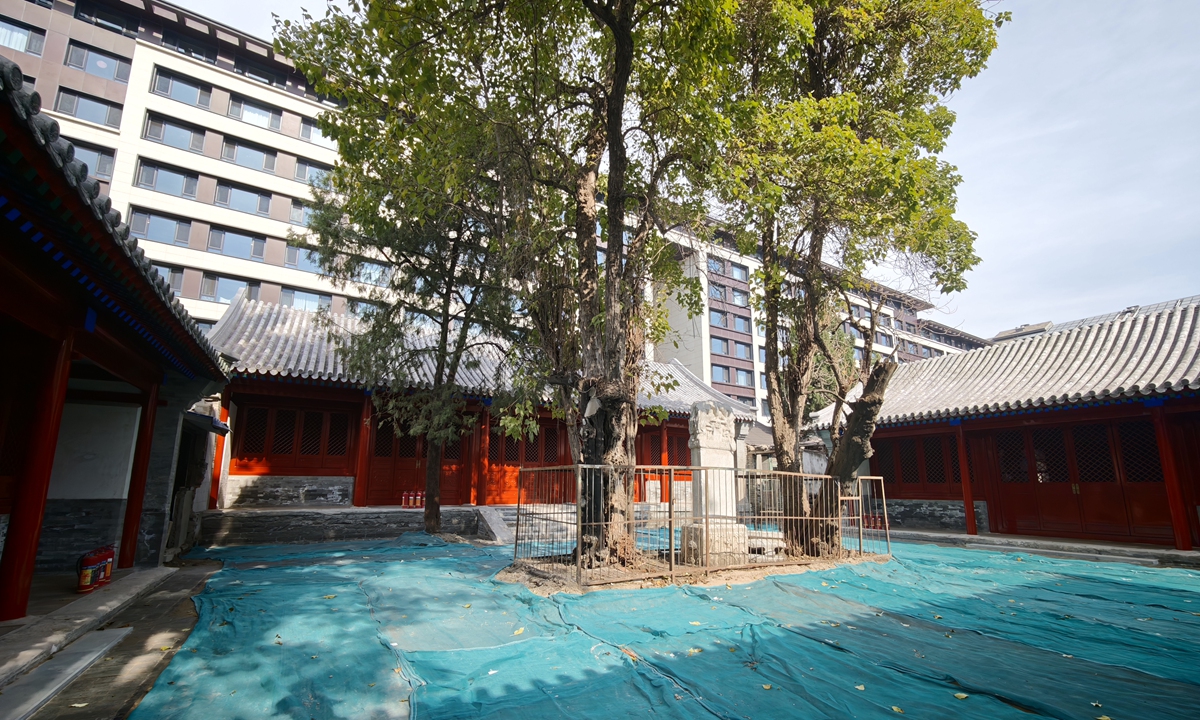
Anle Chanlin after restoration Photo: Beijing Development and Construction News
Located among the residential neighborhood about three kilometers south of the Temple of Heaven, Anle Chanlin, a Qing Dynasty (1644-1911) temple complex in Beijing's Dongcheng district, has completed a six-month structural restoration and is expected to open to the public later.
On the eastern courtyard wall, two surviving glazed Chinese characters, "An" (literally peace) and "Le" (literally happiness), attest to the site's identity as an ancient temple. Following a sensitive restoration, they are set off by green borders, yellow backgrounds and bold black lettering.
According to local records, the temple formerly served as the ancestral hall of a family tasked with managing grain deliveries to the imperial palace during the Qing Dynasty.
The temple's opening schedule is still under discussion. Once open to the public, it will provide another vibrant venue for the preservation of Beijing's history and the transmission of its cultural heritage.
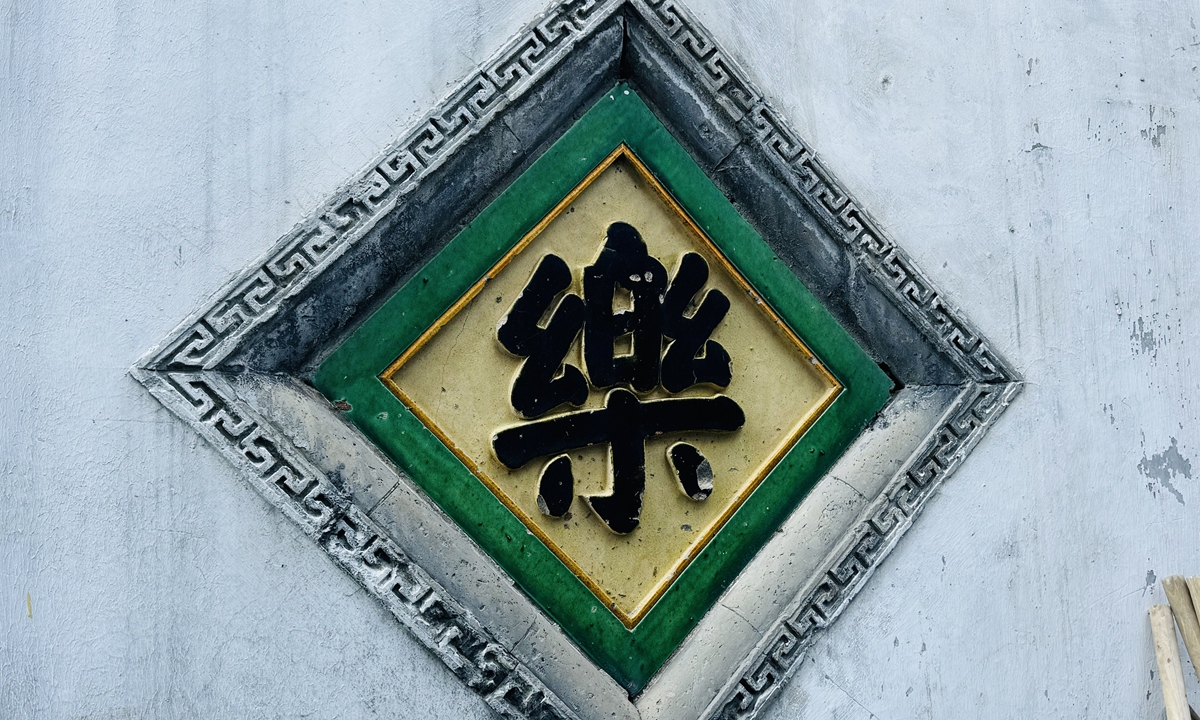
One of the surviving glazed Chinese characters "Le" on the wall Photo: Courtesy of Beijing Fangxiuyi Construction Engineering Co Ltd
Stepping into the two courtyards arranged along a central axis, visitors can see the timberwork and decorative painting of the main and side halls across all six completed buildings. Vermilion-red pillars lend the structures a dignified yet vibrant appearance, while the lattice doors and windows are neatly arranged and finely crafted. Rows of gray cylindrical roof tiles stretch across the rooftops. Behind the ancient halls, modern buildings rise in the background, bringing the heritage of Beijing's old city and the vitality of its modern urban landscape into a single frame.
Wang Yue, manager of the restoration project at Beijing Fangxiuyi Construction Engineering Co Ltd, told the Global Times on Wednesday that the exact founding date of the temple cannot be precisely verified.
According to the stone stele standing in the middle of the courtyard, a major renovation was carried out in 1705 - the 44th year of the Kangxi reign of the Qing Dynasty. The temple must have been built well before that date. Some researchers speculate that its origins may go back to the Ming Dynasty (1368-1644), Wang noted.
It is one of the temple complexes in Beijing that have best preserved their original layout and architectural features. Several distinctive structural elements are uncommon in the region, including the S-shaped overlapping eave structure characteristic of traditional architecture in southern Beijing architecture and the round, drum-shaped column bases in the central bay inside the rear hall. These features are rare surviving examples of traditional architectural craftsmanship in Beijing, according to Wang.
Before restoration, the temple complex was severely damaged: Widespread roof leakage had caused extensive decay of rafters and timber components. Many structural defects remained hidden until roof coverings were removed during conservation, said Wang.
The restoration team applied the principle of minimum intervention in the heritage conservation, steering clear of the vague slogan "restore the old to look old," she said.
Every interventions required tangible physical evidence and expert panel review. Original timber, stone slab roof sheathing and bricks that could be used were sorted, cleaned and reused. New replacement materials were introduced only where components were too badly damaged to preserve, said the manager.
Existing color painting traces on beams inside the halls were retained without repainting.
The restoration of Anle Chanlin is part of the Chinese capital's efforts of reviving the cultural heritage along the surrounding areas of the Beijing's Central Axis.
The Temple of the God of the Capital, known in Chinese as Du Chenghuang Miao, reopened to the public in July after a restoration project. First built during the Yuan Dynasty (1279-1368), it was once the highest-ranking temple of its kind in China.
In June, six cultural-heritage renovation sites in Xicheng district were launched. One of them, Zhenwu Temple, a temple dates back to the Tang Dynasty (618-907), uses large AI models to restore and display traditional artworks, offering an immersive experience centered on glazed pottery, a form of intangible cultural heritage.
RELATED ARTICLES