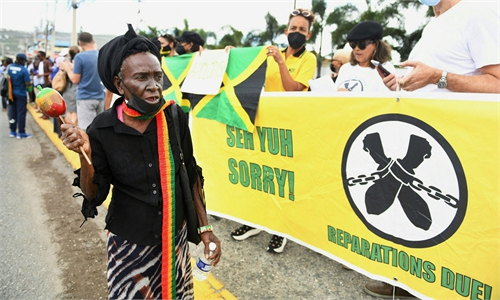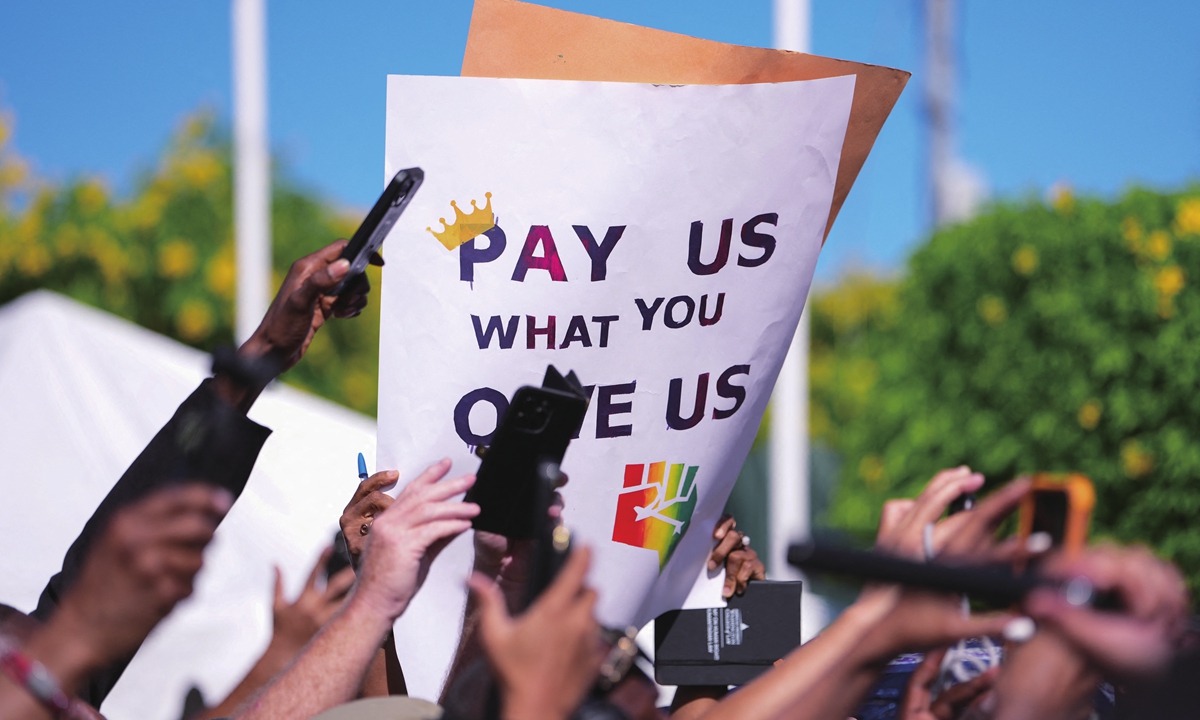
A person in the crowd holds up a sign reading "Pay us what you owe us" as Britain's King Charles III (out of frame) watches a Junkanoo parade in Parliament Square in Nassau, The Bahamas on October 28, 2026. Photo: AFP
Editor's Note:
Recently, Caribbean nations have been drawing up a multi-pronged action plan with legal options to push the UK into negotiating a decades-long slavery reparations deal. Over the years, the reparations movement has emerged as a critical global force addressing the historical injustices of slavery, colonialism and underdevelopment. In her I-Talk show, Global Times (GT) reporter Wang Wenwen talked to Professor Sir Hilary Beckles (Beckles), the chairman of the CARICOM Reparations Commission and a leading historian who spearheads the Caribbean's demand for reparatory justice from former European colonial powers.
GT: King Charles III just completed his nine-day trip to the Caribbean and South America. Nonetheless, he stopped short of issuing an apology for colonial-era slavery. British Prime Minister Andy Burnham has stated that he is "open" to considering a formal state apology, while firmly ruling out financial reparations. What's your stance on the UK's attitude?
Beckles: The UK is a post-colonial empire. For many hundreds of years, they had dominated the world. They have a legacy of racial domination, and they have a legacy of white supremacy. They believe that they are entitled to control the resources of the world and the people in it. They are going to intellectually struggle to see that justice for everyone is an expectation, so we call upon them to come to the table for a dialogue of decency. We don't see reparatory justice as revenge. We see it as the common enlightenment.
GT: This March, the UN voted to describe the transatlantic chattel slave trade as the "gravest crime against humanity" and called for reparations as "a concrete step towards remedying historical wrongs." You said that this means seeking reparatory justice has become a legal case. As a historian, how do you evaluate this paradigm shift from "moral appeals" to "legal rights"?
Beckles: The African people had been enslaved in the Caribbean for 500 years. And in that process, the English invented a new form of slavery. That new form of slavery, which was embraced by all the other Europeans, was called chattel slavery. It had never happened before in human history. It was called chattel, meaning property; therefore, African people were seen not as human beings but as profitable assets. You could buy them, sell them, mortgage them, pay taxes on them, pass them on to your children and use them as money. All of the values of property were now for the first time attributed to enslaved people.
In the middle of the 19th century, when Europe was forced to abolish that system of slavery, the African people said we need compensation. So, the call for compensation or reparatory justice has been ongoing for almost 200 years, and generation after generation, they have never given up on their demand.
We understand that the philosophy of Europeans is that black people do not deserve reparatory justice. What the UN approved was a resolution that to deny people their human identity was a crime against humanity. The descendants of that crime have a right to reparations. We were very happy that the UN said that there should be conversations about reparatory justice.
GT: In your view, is the international legal system truly prepared to compel former colonial powers to come to the negotiating table?
Beckles: If you are committed to justice, you will create the relevant principles in the relevant environment and relevant diplomacy, because justice is the objective, and you cannot deny justice on the basis that you are not ready. The International Court of Justice might be uncertain and unclear. But as the UN has said, this is the gravest crime ever committed in the modern world. Therefore, the judges and all of the courts should take that responsibility of bringing this matter to a closing.
GT: Why, after years of advocacy, does reparation remain so protracted and what do you see as the underlying reasons for Western colonial powers' persistent refusal to confront this history beyond acknowledgment?
Beckles: Their mindset has not changed. They did not wish to end slavery. They wanted it to go on and on. And even when the rest of the world was opposed to slavery, the Western powers insisted that they needed slavery for economic purposes, that slavery would help to build their economies. They still think that way. That is why they do not wish to participate in any form of reparatory justice for African people. And it is the international community that has been our supporters.
GT: You once said the reparations movement must focus on development and transformation. At a time when Caribbean nations are confronting both a climate crisis and debt pressures, why is addressing the colonial legacy key to resolving contemporary development bottlenecks, rather than being merely a matter of "historical reckoning"?
Beckles: Chattel slavery in the context of a colonial system was the most aggressive form of wealth extraction. Colonization in the Caribbean represented the most extreme and brutal form of economic and social exploitation. When that system came to an end, the Caribbean was left in the most underdeveloped condition - the majority of the people were illiterate, their infrastructure was not suited to a modern world, and violence and social insecurity were the norm. The colonial powers that created this catastrophe need to come back to the site of their crime and work with the governments that are trying to create development in order to develop economic activity and create social justice.
We believe that they should not be allowed to walk away and turn their backs on the crime they have committed. So we say it's a development paradigm. It is not only about social justice, it's about economic partnerships. The people of the Caribbean have a right to have that kind of support.
GT: From a global perspective, why should the Caribbean's demand be understood not as a singular historical grievance, but as part of a broader anti-colonial confrontation with the structures that still shape global inequality today?
Beckles: For us, reparatory justice is about helping to save humanity, to pull humanity back from the edge, and to restore civility and decency in global politics. We are looking at the whole world. We are looking at the future of humanity. And we are asking ourselves, as black people, what role we can play in helping the powers of the world to commit to a culture of fairness and justice and solve our problems through discussion and debate.
The message from the Caribbean is we were the site of the gravest crime. Therefore, our voice must be amplified to the world to say we must stop this. That is why we are motivated in the Caribbean to speak to the world and to build partnerships with all nations in the world that are committed to development and justice. The Caribbean is a theater where the voice is being spoken out to the world.
RELATED ARTICLES