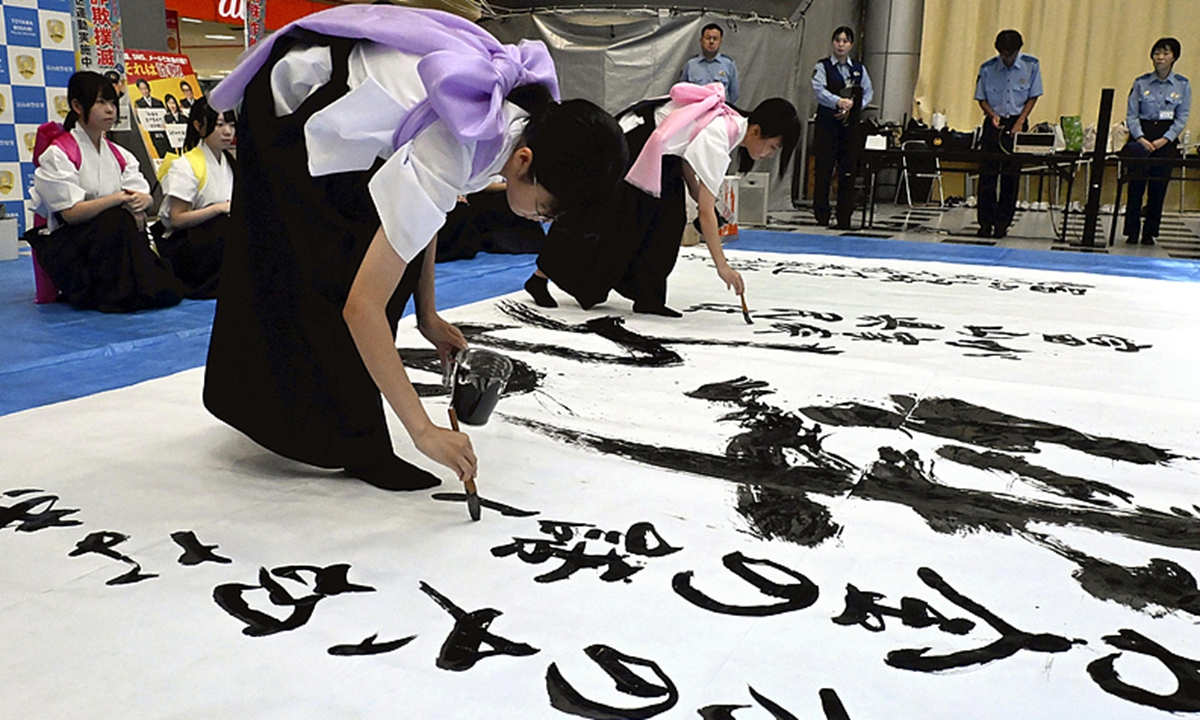
Students perform calligraphy in Toyama City, Japan, on August 24, 2026. Photo: VCG
On Thursday, Japan's Agency for Cultural Affairs announced that an evaluation body of UNESCO has recommended adding "shodo" to the Intangible Cultural Heritage list. Japanese Prime Minister Sanae Takaichi posted a congratulatory message on social media, describing shodo merely as a "precious Japanese cultural practice" and "traditions cultivated over our country's long history," while making no mention whatsoever of its historical roots in Chinese calligraphy. Many Japanese netizens pointed out that the brushes, Chinese characters and calligraphic techniques used in shodo all came from China, and that deliberately glossing over these origins was a rather narrow-minded approach.
Chinese calligraphy was inscribed on UNESCO's Representative List of the Intangible Cultural Heritage of Humanity in 2009, and Japan's bid to have shodo inscribed does not diminish the international standing of Chinese calligraphy in any way. What truly deserves attention, however, is not whether Japan's bid will succeed, but what some in Japan should learn from shodo's Chinese origins. Takaichi has deliberately emphasized the Japanese character of shodo, while others habitually stress that Japan independently developed its own so-called "wayō" style of calligraphy. Have they ever stopped to consider what made such cultural adaptation and reinvention possible in the first place? Because it had China as its neighbor.
It was the inherent inclusiveness of Chinese civilization that gave Japan the space to absorb, adapt and reinvent foreign cultural influences at its own pace. China's cultural influence on Japan extends far beyond the four treasures of the Chinese study: the brush, ink, paper and inkstone. From Confucian ethics, legal and administrative systems, capital-city planning, calendars and medicine to agricultural techniques, Buddhist temple architecture, literature and classical institutions, the foundations of ancient Japanese civilization bear the imprint of Chinese civilization at every turn. Without this open and inclusive foundation, foreign cultures would never have been able to take root in Japan and be reshaped through localization. In this sense, netizens are right to give Takaichi a history lesson - and it is long overdue and well done!
For centuries, ancient China maintained a position of overwhelming cultural leadership in East Asia, yet it never used its cultural advantage to impose ideological influence or ethnic assimilation on Japan. Instead, it consistently approached Japan through cultural exchanges on an equal footing. China never forced Japan to adopt Chinese characters or blindly copy its institutions. Rather, it respected Japan's freedom to adapt Chinese calligraphy to its own needs, allowing the country to eventually develop its distinctive kana calligraphic tradition. Such an approach was exceptionally rare in cross-civilizational relations in the ancient world. It also stands in stark contrast to modern Japan's aggression across Asia, when it used military force to impose cultural colonialism and compulsory Japanese-language education on other Asian countries.
Some argue that although Japan actively learned from Chinese culture throughout history, it absorbed only the "techniques" and not the "way." The "way" refers to the peaceful and inclusive ethos of Chinese civilization. Today, Japan once again finds itself at a crossroads. Should it return to the old path of aggression and expansion, or choose to coexist peacefully with its neighbors? This is what Japan should reflect on.