A single TBM should not become a source of friction between China and India: Global Times editorial
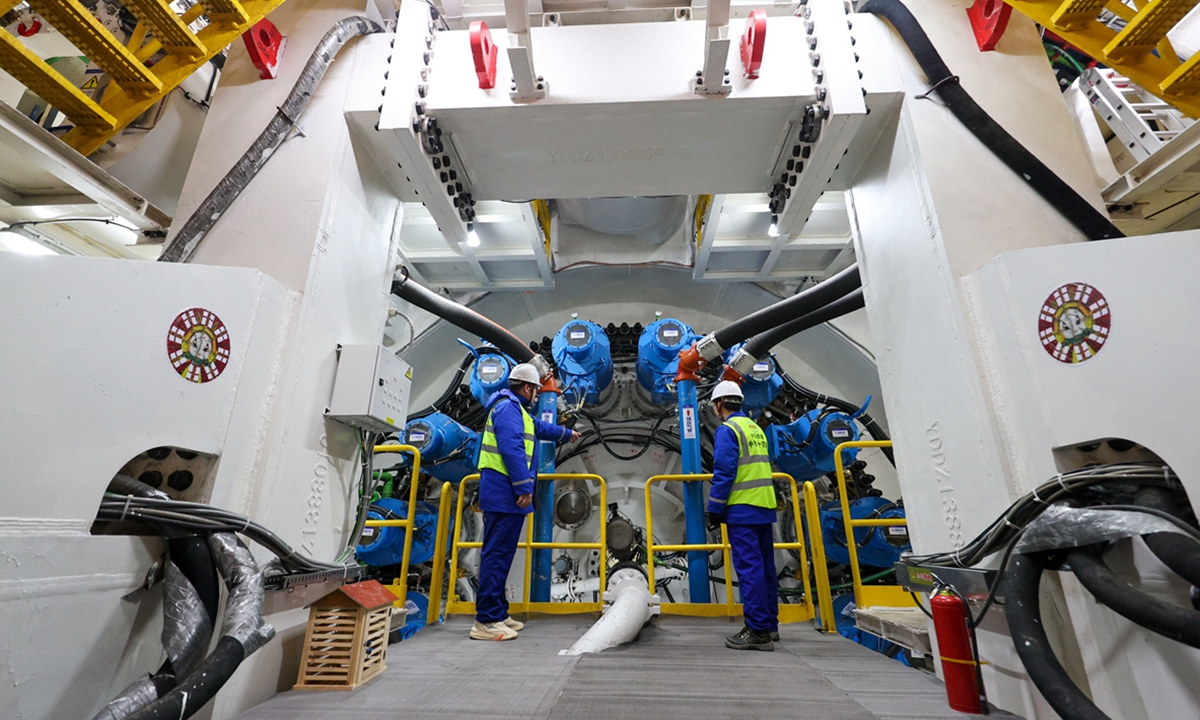
Workers check up the performance of a tunnel boring machine (TBM) that begins its dig through a tunnel section in Beijing's Tongzhou district on December 28, 2023. This TBM, with a diameter of 13.3 meters and a length of 138 meters, is the largest one currently serving in Beijing and plans to use five months to complete a passage of 1,285 meters.Photo: VCG
India's ambition to develop its domestic manufacturing industry and China's right to safeguard its national security are not inherently at odds. A single TBM should not become a source of friction between China and India. By setting aside excessive sensitivities and allowing technical issues to be addressed through appropriate technical channels, the two countries can create more room for the improvement of bilateral relations.China's export controls on tunnel boring machines (TBMs) have recently drawn considerable attention in India. India's Commerce Minister Piyush Goyal recently stated publicly that if China did not supply TBMs, India would develop them domestically, insisting that "India is not one to bow down." The remarks received coverage in Indian and some Western media, with many portraying the issue as a story of "India refusing to yield to China's 'chokehold'" and even interpreting it as a new flashpoint in China-India relations. Some narratives have become increasingly far-fetched, straying considerably from the facts.
The origins of the controversy are straightforward. On October 19, China announced new export controls on critical machinery, including TBMs, various types of shield and rock tunnel boring machines, effective November 18. According to the relevant authorities, at least three points are clear. First, the items included in these measures have a clear dual-use nature and can be applied for both military and civilian purposes, and China's lawful implementation of export control measures conforms to international practices.
Second, the announcement does not name any country, and the controls are not directed at any specific party. Third, the measures center on licensing rather than an outright export ban. Applications for compliant exports to legitimate civilian projects will be approved, provided the end users and end uses are clearly identified and meet the relevant requirements.
India may have some misunderstandings or even complaints about these measures, and that is understandable. The country is in the midst of an intensive infrastructure-building drive. Whether for metro networks, high-speed rail projects, highways or water conservancy tunnels, India has considerable demand for large-scale excavation equipment such as TBMs.
However, concerns over this issue should remain at the technical level. There is little need to politicize a routine export-control matter, let alone elevate it into a question of whether India will "never bow down" or defend its "national dignity."
As for speculations that China is deliberately seeking to "restrict India's use of TBMs in border areas," they say more about the insecurity of those making them than about China's intentions.
In fact, legitimate civilian projects have little reason for concern, and there are precedents for resolving similar issues. In 2024, India raised concerns over delays in customs clearance for TBMs manufactured in China by a German company. Minister Goyal also brought up the matter with visiting German officials. Following communication and coordination between China and India, the issues were resolved, and some of the equipment was subsequently delivered in a smooth manner.
During Chinese Foreign Minister Wang Yi's visit to India in 2025, China also assured the Indian side of addressing Indian key concerns relating to TBMs and other matters. This demonstrates that technical and regulatory issues of this kind can be resolved rationally through existing bilateral channels. A confrontational mindset will only narrow the space for pragmatic consultations, ultimately jeopardizing India's own infrastructure projects and development progress.
India's ambition to develop its domestic manufacturing industry and China's right to safeguard its national security are not inherently at odds. India's pursuit of "self-reliance" and its active efforts to build domestic TBM manufacturing capabilities are legitimate aspirations for its own industrial upgrading. At the same time, China, as an exporter of controlled items, has an equally legitimate right to safeguard its national security and fulfill its international obligations.
China has never viewed India's development as a threat to itself. As long as India provides Chinese companies with a fair and non-discriminatory business environment, the more advanced India's infrastructure and manufacturing sectors become, the greater the potential market demand and opportunities for cooperation between the two countries. In short, China is not that "petty."
It's particularly crucial to remind India to remain vigilant against attempts by some Western voices to sow discord between the two countries. We have noticed that certain US media outlets have shown particular "enthusiasm" for the TBM issue. Bloomberg, for example, claimed that China's relevant export controls on TBMs are "a trade war risk to India," while The New York Times portrayed China's industrial strengths as a source of economic leverage and asserted that Beijing was building up its arsenal of economic weapons.
Such reports deliberately disregard established international practices regarding export controls and omit the licensing application procedures and bilateral communication channels that China has kept open. In essence, these outlets would welcome mutual suspicion and confrontation between China and India, two major emerging powers, even at the cost of draining both countries' resources.
They are not genuinely concerned about whether India's infrastructure projects can proceed smoothly. Their real objective is to drive a wedge between China and India. India should maintain an independent, clear-headed understanding and judgment of these narratives.
Objectively speaking, reactions from various sectors in India also demonstrate how important pragmatic China-India cooperation is to India at this stage. The improvement in bilateral relations has not come easily, and both sides should devote more energy to expanding cooperation rather than allowing an export control issue involving a specific product to undermine the broader relationship. A single TBM should not become a source of friction between China and India. By setting aside excessive sensitivities and allowing technical issues to be addressed through appropriate technical channels, the two countries can create more room for the improvement of bilateral relations.
RELATED ARTICLES