India's widening trade deficit with China Illustration: Xia Qing/GT
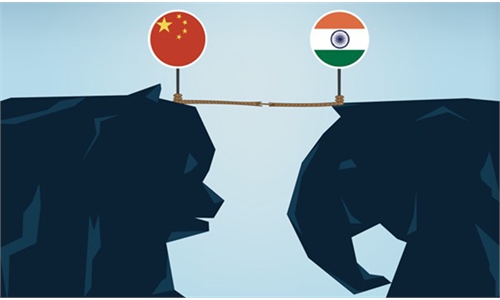
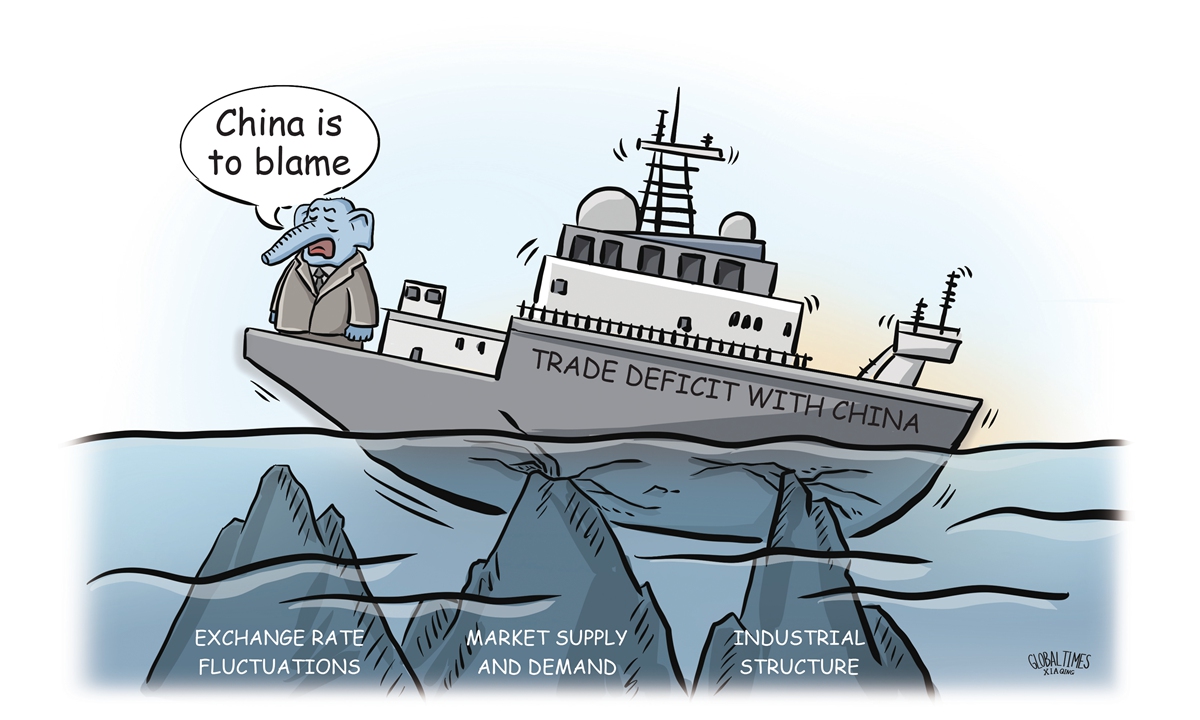
In recent years, the volume of bilateral trade between China and India has steadily expanded, and India's trade deficit with China has long remained at an elevated level. This imbalance has emerged as a central topic in Indian political discussions regarding bilateral economic relations. Recently, several senior Indian officials have pointed their finger at Beijing on international forums and at multilateral summits, attributing the trade imbalance to China.However, an objective examination across multiple dimensions - industrial structures, exchange rate mechanisms, and market supply and demand - reveals that India's trade deficit with China is essentially the inevitable outcome of its own structural economic shortcomings. Unilaterally shifting the blame outward will do nothing to resolve the trade imbalance.
India's fragile manufacturing base and insufficient export supply capacity represent the most fundamental structural root cause of this chronic trade deficit. World Bank statistics show that manufacturing value-added as a percentage of India's GDP has hovered between 13 percent and 15 percent for a decade, falling far short of the 25 percent target set by the Modi administration's "Make in India" initiative. India's industrialization process has been perpetually stymied by hurdles such as inadequate infrastructure, rigid labor markets and fragmented supply chains.
Looking at the bilateral trade composition, China-India trade exhibits classic traits of a vertical division of labor: Indian exports to China are heavily concentrated in resource-based and primary goods, with high-value-added manufactured goods accounting for a very low share. Meanwhile, Chinese exports to India are dominated by industrial intermediate and finished goods. This discrepancy in value chain positioning dictates that the array of products India can offer China remains limited, whereas India's own industrialization process continuously generates massive import demand for manufactured goods, naturally forming a structural pattern of "importing much and exporting little."
Moreover, exchange rate fluctuations within the dollar-dominated global trade denomination framework have further magnified the nominal bookkeeping size of India's trade deficit with China. The Indian rupee has continuously weakened against the US dollar in recent years. Rupee depreciation directly inflates the local currency purchasing cost of all dollar-denominated imported goods, thereby driving up the nominal import value of Chinese goods entering India.
At the same time, although the primary commodities India exports to China are likewise priced in dollars, commodity price cycles fluctuate significantly. The theoretical export price advantage brought by a depreciating rupee is frequently offset by global commodity market trends, making it difficult to effectively stimulate a rapid surge in India's exports to China. Yet, certain Indian politicians tend to deliberately ignore exchange rate factors when discussing trade issues, directly pinning the entire growth of the deficit on Chinese trade policies.
The exceptional cost-performance ratio and indispensable nature of Chinese supply chains perfectly match India's massive domestic demand for consumption and industrialization, sustaining high levels of Indian imports from China. Backed by a vast population base, India is advancing urbanization and industrialization simultaneously, creating robust domestic demand for industrial components, basic equipment and daily consumer goods. Yet, due to insufficient domestic manufacturing capacity and incomplete product categories, many intermediate products cannot be stably supplied locally. Leveraging large-scale production and complete supply chain ecosystems, China provides industrial products across all tiers, holding pronounced competitive advantages in pricing, delivery lead time and product reliability.
Even as the Indian government attempts to promote supply chain diversification by encouraging alternative sourcing from regions like Southeast Asia, many countries in those regions are themselves heavily reliant on Chinese intermediate goods, meaning their final products lack comparative advantages in cost and delivery schedules. The Indian smartphone industry serves as a telling case study.
Administrative restrictions cannot eliminate the Indian market's inelastic demand for Chinese products, and the trade deficit has failed to narrow as anticipated. Instead, trade protectionism has raised production costs for domestic Indian enterprises, driven up consumer prices and damaged India's long-term international business image.
Trade imbalances are the joint product of comparative advantages, industrial capabilities and market choices. If India wishes to fundamentally shrink its trade deficit with China, the focus should not lie in accusing another country of trade barriers, but rather in remedying its own manufacturing deficits, upgrading supply chain ecosystems and expanding its exports of high-value-added products. Politicizing economic issues and blindly pursuing trade protectionism will only cause India to miss opportunities for industrial upgrading, offering zero benefit to its long-term economic development.
The author is a professor at the Party School of the CPC Shandong Committee. opinion@globaltimes.com.cn
RELATED ARTICLES