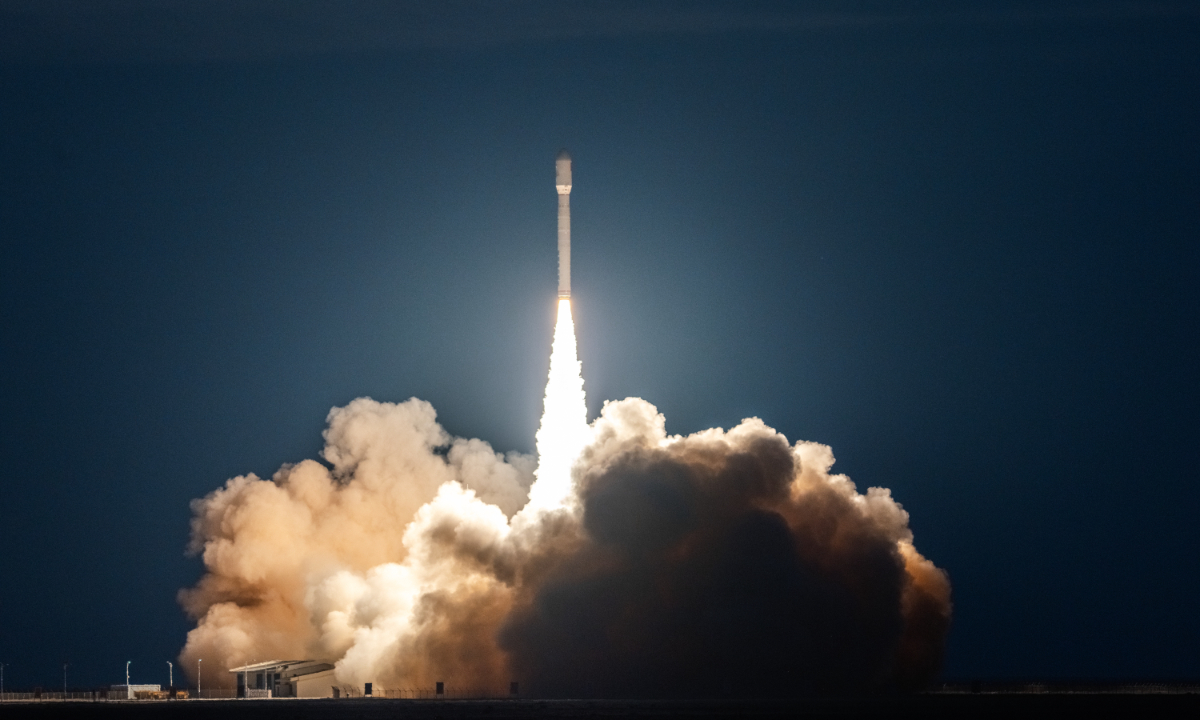
Galactic Energy’s CERES-2 rocket returned blasts off from the Jiuquan Satellite Launch Center at 7:37 am Beijing time on November 7, 2026. Photo: Ge Lixin
Chinese commercial space company Galactic Energy successfully launched its CERES-2 carrier rocket on Saturday, placing four satellites into orbit as China's commercial space sector expands its launch capabilities to serve a growing range of satellite applications, according to materials the company provided to the Global Times.
The mission marked the rocket's successful return to flight nearly 10 months after its maiden launch failed on January 17. An anomaly occurred during that flight, prompting the company to undertake a failure investigation, corrective work and preparations for another launch, the Global Times previously reported.
The rocket lifted off at 7:37 am Beijing time from the Jiuquan Satellite Launch Center in Northwest China, sending its payloads into a Sun-synchronous orbit at an altitude of 535 kilometers, according to the company.
Including the latest mission, the company said it has completed 24 successful orbital launches, placing 94 commercial satellites into orbit for 30 customers.
The four satellites will support ocean observation, commercial meteorology, university research and space situational awareness. The mission brought together customers with different requirements, ranging from environmental data collection and satellite technology testing to research and teaching support.
Among them, the Guanlan experimental satellite is designed to observe sea-surface height, while Yunyao-1 28 satellite carries equipment to gather atmospheric and surface environmental data. The Zhongbei University-1 satellite will support mineral resource monitoring, geological disaster warnings and education. Juntian-1 06A will test technologies including space-object monitoring and onboard AI computing.
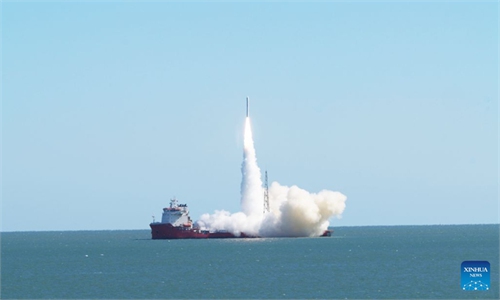
CERES-2 is an upgraded model in the company's CERES rocket family. With a liftoff weight of about 100 tons, it combines three solid-fuel stages with a liquid-fuel upper stage and can carry 1.3 tons to a 500-kilometer Sun-synchronous orbit. It is designed for both land and sea launches.
Galactic Energy said preparations for the return to flight included corrective measures, design changes, ground testing and system reviews. Work covered the rocket's overall design, upper-stage propulsion, electrical systems and launch support equipment.
The launch comes as China's commercial space industry expands both launch activity and satellite deployment. According to the China National Space Administration (CNSA), the sector completed 50 launches in 2025, accounting for 54 percent of the country's space launch missions. Of those, 25 used commercial launch vehicles. A total of 311 commercial satellites entered orbit, representing 84 percent of all Chinese satellites placed into orbit that year.
Satellite internet is one important driver of launch demand. After reviewing launch data, the Global Times found that nearly 20 Chinese launch missions in 2025 carried internet satellites, highlighting the growing role of constellation deployment in the country's space activities. Saturday's payloads also show demand extending to weather services, ocean monitoring and university research.
Policy support is also addressing the infrastructure needed for commercial operations. Under an action plan released in November 2025, the CNSA pledged broader commercial access to national tracking and control facilities, data-receiving stations and major testing equipment. The plan also supports commercial launch sites and shared manufacturing and testing platforms.
Global Times
RELATED ARTICLES