Heidelberg mayor urges pragmatic China-Germany cooperation amid EV trade tensions
‘Responsible diversification does not mean disengagement’


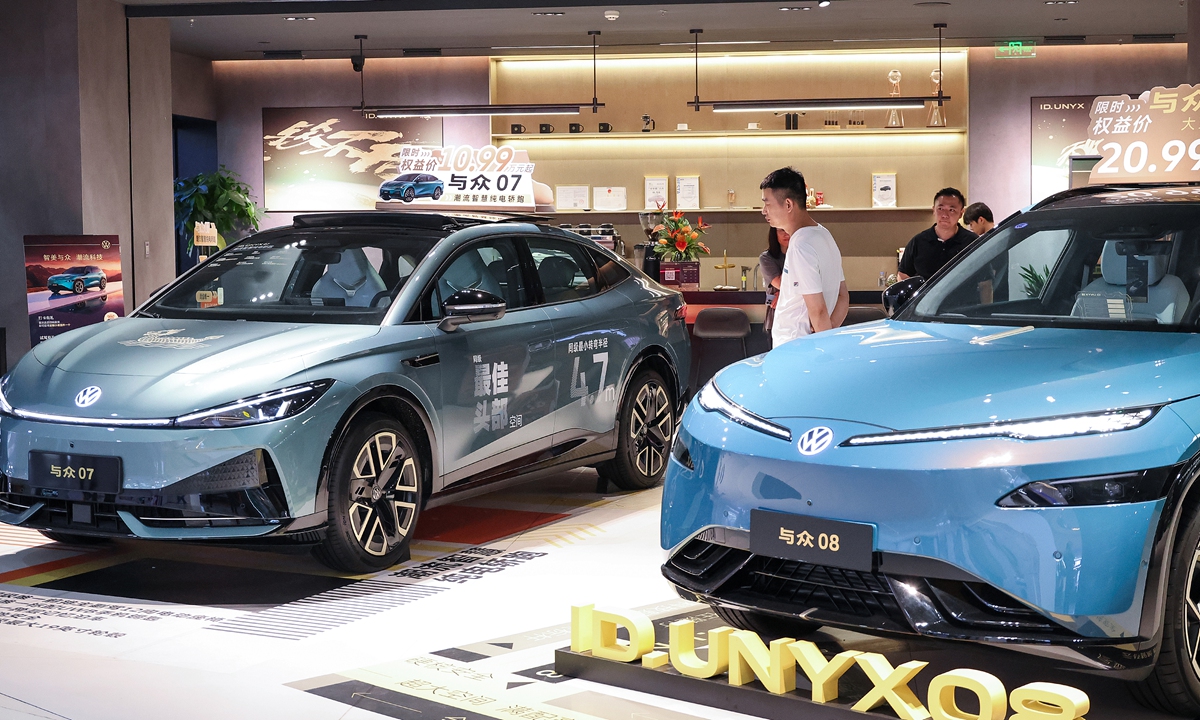
Visitors check out Volkswagen Anhui models during a new energy vehicle trade show in Shanghai on June 20, 2026. Photo: VCG
Economic cooperation and "de-risking" should not be seen as contradictory, and China and Germany should strengthen practical collaboration in areas ranging from electric mobility to sustainable urban development, Heidelberg Mayor Eckart Würzner told the Global Times in a recent exclusive interview, as the two economies navigate growing industrial competition and trade tensions."Responsible diversification does not mean disengagement," Würzner said. His remarks came as China and the EU continued negotiations over vehicle trade. The two sides reached an arrangement for upward adjustment based on the EU's 2025 imports of Chinese hybrid vehicles, with a fixed annual increase thereafter, ensuring room for Chinese automakers to maintain and steadily expand their exports, according to China's Ministry of Commerce on October 12.
Against this backdrop, Würzner offered a nuanced assessment of the challenges facing Germany's automotive industry and the opportunities for cooperation with China.
"Germany is an industrial nation," Würzner said, stressing that the country should not retain only research and development while allowing manufacturing to move elsewhere. "A strong economy requires both innovation and manufacturing capability," he said.
The mayor acknowledged that Germany's vehicle industry had been slow to recognize important trends in electric mobility, while China had established itself as a global leader and set important benchmarks for the industry.
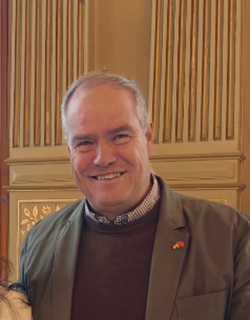
Eckart Würzner, Mayor of Heidelberg, Germany Photo: Cao Siqi/GT
A recent visit by German President Frank-Walter Steinmeier to Volkswagen's technology center in Hefei, East China's Anhui Province, offered a vivid example of this changing relationship. During his visit, Steinmeier toured laboratories for software and hardware integration and testing, where he learned about Volkswagen's software-defined vehicle development process based on its locally developed China Electronic Architecture, according to a statement sent to the Global Times from the Volkswagen Group China.Zhang Xiang, secretary-general of the International Intelligent Vehicle Engineering Association, said that German carmakers have increasingly given their Chinese operations a greater role in research and development as they respond to changes in the market. Developing new-energy vehicles in China allows them to draw on local engineers, suppliers and the broader industrial ecosystem, he said.
For Würzner, China's growing competitiveness does not eliminate Germany's legitimate concerns about economic resilience. He pointed to Germany's previous dependence on Russian natural gas and supply-chain disruptions during the COVID-19 pandemic as examples of the vulnerabilities created by excessive dependence on a single partner.
However, he emphasized that diversification should not become a justification for disengagement. "Modern economies are deeply interconnected, and successful cooperation remains essential," he said.
He also called for balanced media coverage that acknowledges both economic interdependence and the importance of resilient supply chains, rather than reducing complex trade relationships to simplified narratives.
Beyond the automotive sector, Würzner said that he saw considerable potential for China-Germany cooperation in urban development.
During the 17th Media Forum China-Germany, Global Times reporters visited Heidelberg's Bahnstadt district, internationally recognized for its energy-efficient "passive house" buildings. Walking through the neighborhood, the reporters could see how energy conservation had been incorporated into an entire urban district.
Würzner said that Bahnstadt had inspired development projects in China, including the "railway city project" in Gaobeidian, North China's Hebei Province.
He also expressed admiration for China's remarkable speed of urban development, noting that Chinese cities could often turn innovative concepts into large-scale projects much faster than their German counterparts.
One Chinese concept that particularly impressed him was the "sponge city," which helps cities manage rainwater through infiltration, storage and natural drainage systems, improving resilience to both floods and droughts.
Heidelberg has adopted similar approaches in Bahnstadt, incorporating rainwater infiltration and retention into neighborhood planning. "Innovation is not a one-way process," Würzner said. "Both Germany and China have developed pioneering approaches to sustainable urban development."
As China-Germany relations face a changing international environment, Würzner said that cities can play an increasingly important role in sustaining cooperation.
Heidelberg and Hangzhou are approaching the 10th anniversary of their sister-city partnership, which has facilitated exchanges in environmental protection, education and youth engagement.
Recalling his visits to China, the German mayor said that he had been particularly impressed by how quickly innovations entered everyday life. During one of his early visits, he noticed that mobile payments had already become widespread in China, while the practice remained uncommon in Germany.
For him, the experience illustrated China's ability to rapidly translate technological innovation into practical applications.
Würzner observed that German students were eager to understand China's rapid transformation, while Chinese students showed interest in Germany's education system, sustainability practices and technological development.
Würzner identified sustainable economic transformation and urban development as particularly promising areas for bilateral cooperation.
"Cities have a particularly important role to play in turning these ambitions into practical solutions," Würzner said, stressing that cooperation with Chinese partner cities is "about practical exchange, mutual learning, and identifying solutions that improve the lives of future generations."
As debates over industrial competition and economic security continue, Würzner's perspective highlights a practical dimension of China-Germany relations: The two countries may compete in global markets, but their cities still have much to learn from one another.
RELATED ARTICLES