ARTS / CULTURE & LEISURE
New archaeological report sheds light on ancient Tusi administrative center in Hubei and governance in SW China
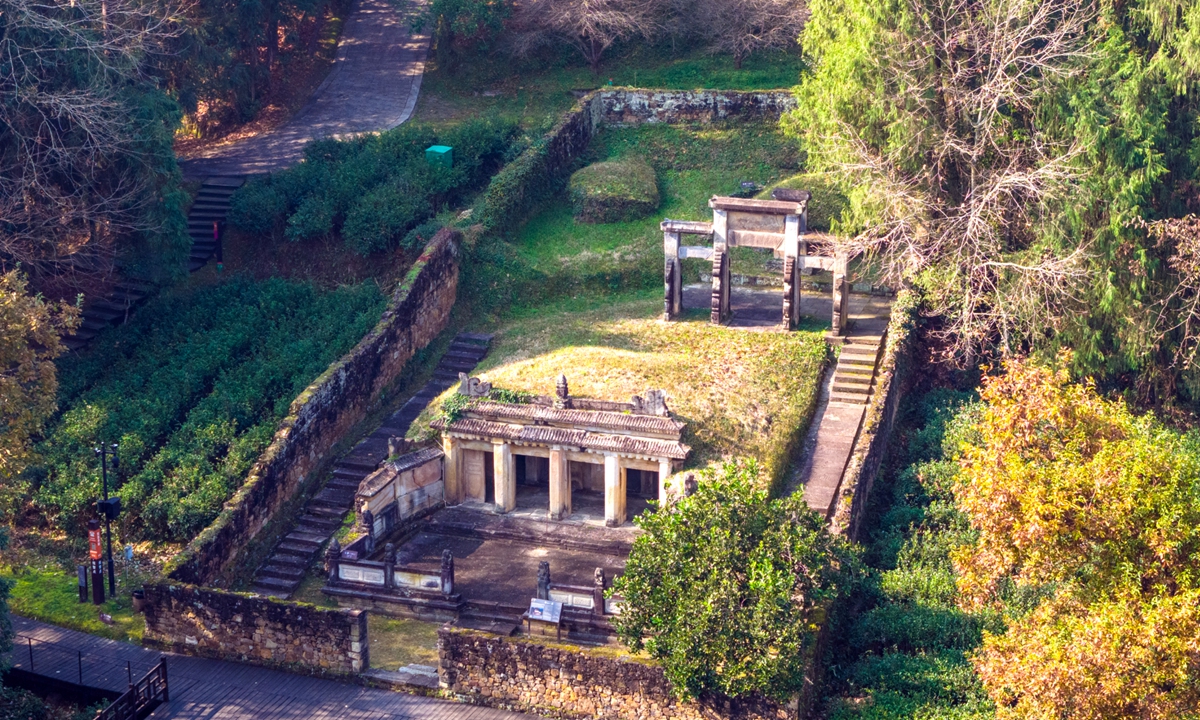
The Tangya Tusi site in Central China's Hubei Province Photo: VCG
The first archaeological report on the Tangya Tusi site in Central China's Hubei Province, was recently made public, providing a systematic account of the site's layout and historical remains dating from the Yuan (1279-1368), Ming (1368-1644) and Qing (1644-1911) dynasties. It is the first publicly published archaeological report dedicated to the site, which is part of a UNESCO World Heritage listing.Archaeological findings show that the site had a well-organized layout, with defensive structures and buildings serving different functions. Its design drew on traditional urban planning in the central regions of China while retaining local characteristics, offering clues to how ancient central governments in China administered ethnic minority areas in the southwest, according to the China News Service.
According to the Hubei Provincial Department of Culture and Tourism, the site is one of the important Tusi settlements in southwestern China dating from the Yuan to Qing dynasties. Under the Tusi system, the central government recognized local hereditary chiefs as officials in ethnic minority areas, allowing them to manage local affairs while remaining under central authority.
Liu Hui, chief editor of the report and a professor at Hubei University's School of Cultural Heritage, said archaeological surveys and excavations show that the site and its surrounding environment have remained relatively well preserved since its abandonment in the mid-18th century.
According to Liu, the period from the Wanli to the Tianqi reigns of the Ming Dynasty marked the height of the Tangya Tusi chiefdom. Most of the major structures still preserved at the site date from this period, including an ornamental archway, the Zhangwang Temple and Tusi tombs. These remains also offer a glimpse into how the ancient settlement was organized.
The report shows that the site had a multi-layered defensive system consisting of a moat, city walls and a wall enclosing the administrative area. The administrative area stood at the center of the site, with important buildings and functional zones arranged around a central axis. An archway marked the eastern starting point of the axis and served as a landmark for the site, the China News Service reported.
Liu said the site's overall layout drew on the planning principles of prefecture- and county-level cities in areas inhabited by the Han ethnic group, while retaining distinctive local cultural features. This reflects how ethnic communities in Tusi-governed areas of southwestern China increasingly adopted elements of Han culture from the mid-to-late Ming Dynasty onward.
Liu also noted that changes in the site's size and status reflected the evolving relationship between local Tusi authorities and the central government, as well as changes in local people's sense of belonging to the Chinese nation.
Zhang Yin, an archaeological expert, told the Global Times that the value of the remains goes beyond preserving the physical layout of the settlement. They also offer researchers a way to understand how local political power was organized and exercised.
"The positions of the city walls, moats and Tusi administrative area, as well as the way different buildings were arranged, show how the political center was organized," Zhang said. "These physical remains allow researchers to better understand how the Tusi authorities governed local areas, rather than having to rely solely on historical documents."
He added that the layout also illustrates the relationship between local Tusi authorities and the central government. Although Tusi chiefs had the power to manage local affairs, they were not independent of the central government. The way they built their settlements and organized local administration was also influenced by central institutions and culture.
"These remains show that local communities in southwestern China were not isolated from the rest of the country," Zhang said. "Through the Tusi system, local societies maintained their own traditions while also developing closer ties with the central government and other parts of the country. The site therefore offers a valuable example of how different ethnic groups and regional cultures became connected through China's historical development."
RELATED ARTICLES