Chinese researchers preliminarily classify meteorite fragments found in N.China’s Hebei as L6 ordinary chondrites

An image believed to show the "fireball" that streaked across the sky over North China on the evening of November 6, 2026. Photo: Online image via the Institute of Geochemistry, Chinese Academy of Sciences
Researchers at the Institute of Geochemistry under the Chinese Academy of Sciences (CAS) have preliminarily identified meteorite samples recovered in Shijiazhuang area, North China's Hebei Province, as L6 ordinary chondrites, following a bright fireball sighting on November 6, according to a release from the institute on Tuesday.
According to a release from the institute's official WeChat account on Tuesday, researchers analyzed the recovered samples using scanning electron microscopy to examine their internal structures and mineral composition.
The institute explained that the "L" in L6 refers to a group of ordinary chondrites with relatively low iron content, while "6" indicates a high degree of thermal metamorphism of the meteorite's parent body, which makes the original chondrule boundaries less distinct.
The institute said further studies of the meteorite and its trajectory could help scientists better understand the origins and evolution of small bodies in the solar system and contribute to asteroid impact risk assessment and planetary defense research.
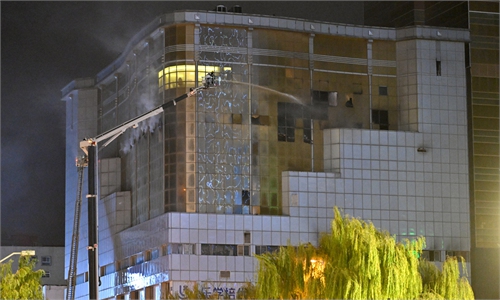
Meteorite fragments, including one reportedly weighing about 35 kilograms, were discovered in Luquan district of Shijiazhuang after a bright fireball streaked across the sky. Some fragments landed in a wheat field in Beigucheng village, leaving a crater, while another reportedly pierced the roof of a factory in nearby Mengtong village, according to Zonglan News, a Hebei-based news outlet.
Ma Rongwei, a meteorite professional, previously said that samples had been sent to the Purple Mountain Observatory of the Chinese Academy of Sciences for laboratory analysis, Zonglan News reported.
Li Shijie, a researcher at the Institute of Geochemistry, explained that analyzing the meteorite's fall trajectory could help scientists reconstruct its orbit as it entered Earth's atmosphere and obtain information about its path in space, providing valuable insights into the orbital evolution of asteroids and help assess the risk of near-Earth asteroid impacts, the Beijing News reported on Tuesday.
Li added that meteorites collected shortly after landing are particularly valuable for research because they are generally fresh and have been exposed to very little terrestrial material or external contamination.
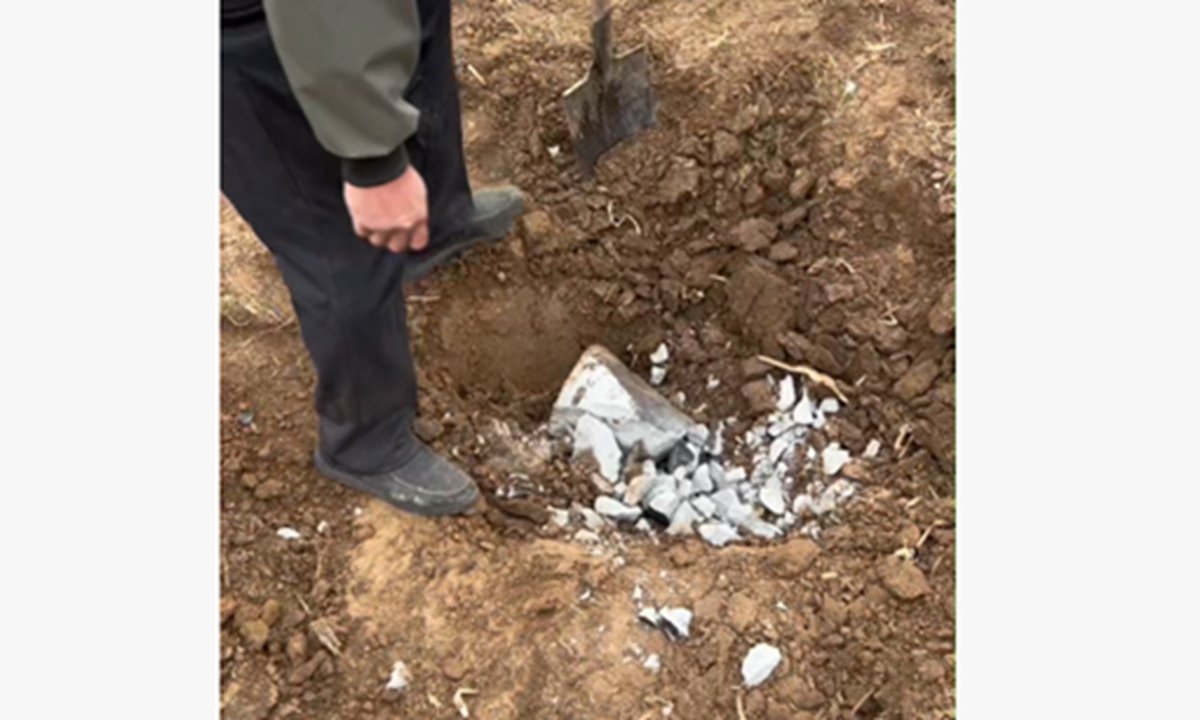
The site where a meteorite landed in a wheat field in Beigucheng village, Dahe township, Luquan district, Shijiazhuang, North China's Hebei Province. Photo: Zonglan News report
Despite their relatively common classification, meteorites can hold significant scientific value. Zhu Jin, former director of the Beijing Planetarium, said that the scientific value of a meteorite cannot be judged by its size alone, noting that even a fragment as small as a fingernail could be important for research, according to a report by the Beijing News on Tuesday.
Zhu explained that when a meteorite enters the Earth's atmosphere, its surface melts under intense heat, typically forming a fusion crust upon reaching the ground, making it distinguishable from ordinary rocks, according to the report.
The discovery has drawn meteorite collectors and enthusiasts to the area, with some searching for additional fragments. According to the Beijing News, more than 100 people went ot one of the fields on November 8 to look for meteorites, and some residents had already collected fragments.
Global Times
RELATED ARTICLES