FedEx expands China-US cargo services amid surging demand from AI supply chains
By Published: Nov 10, 2026 09:12 PM

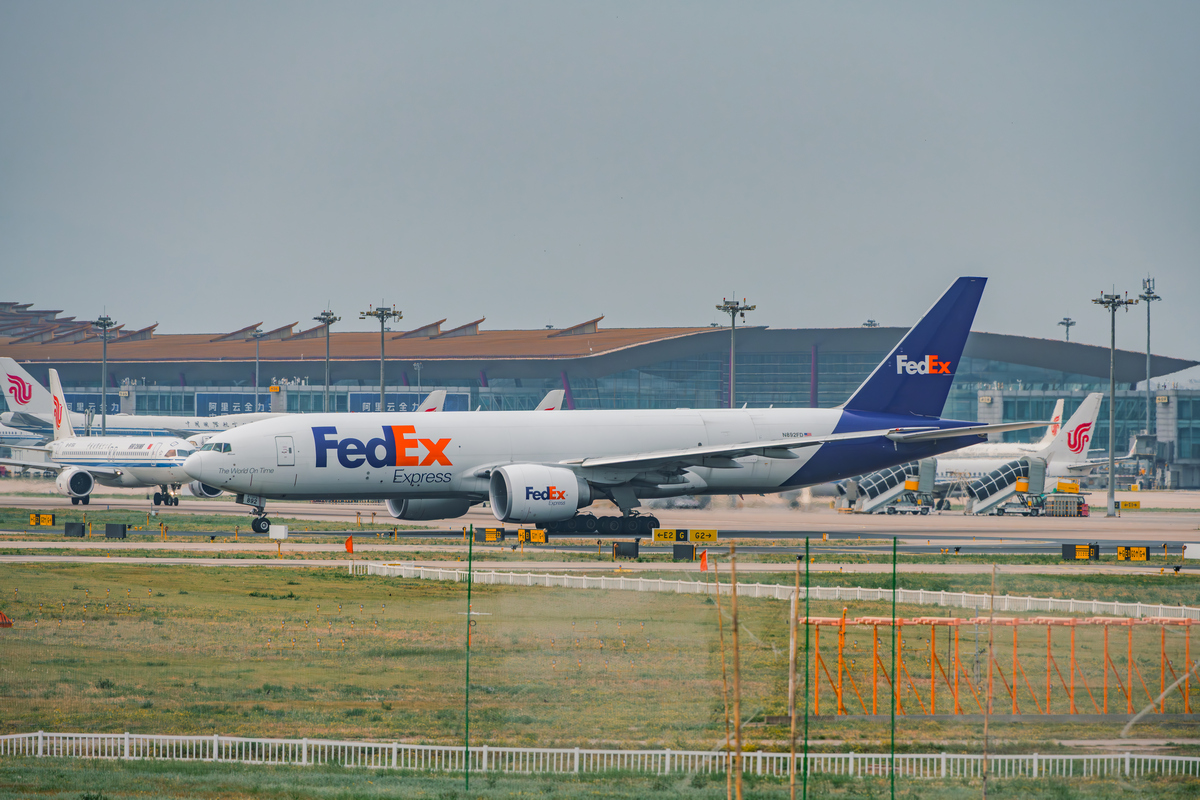
A FedEx cargo aircraft taxis on the apron in the Terminal 3 flight area of Beijing Capital International Airport on May 6, 2026. Photo: VCG
China-US freight capacity is getting an upgrade as FedEx announced that it will expand its China-US connectivity, the latest move by carriers ramping up transpacific services to cater to growing trade demand between the two countries.
FedEx said that it will have four out of five new weekly Boeing 777F flights connecting Shanghai and Guangzhou to US cities. Three of the weekly flights will connect Shanghai to the major US hubs in Anchorage and Memphis via Osaka, Japan, while the fourth flight provides a direct link from Guangzhou to Anchorage and Memphis.
The enhanced network also introduces a new five-times-weekly connection for China customers to Dallas-Fort Worth via Anchorage, providing an additional gateway to one of the US' leading technology and data center markets.
The connection strengthens access between Asia-Pacific manufacturing hubs and businesses across the Dallas-Fort Worth region, supporting industries that rely on the movement of high-value, time-sensitive shipments such as semiconductors, servers, and other critical components supporting the expansion of artificial intelligence (AI) infrastructure, FedEx told the Global Times on Tuesday.
In October, a joint report released by FedEx and Frost & Sullivan found that growing demand for AI, high-performance computing, electric vehicles, and advanced communications technologies was accelerating semiconductor production and driving investment in the digital infrastructure that powers the AI economy.
According to the report, the Chinese mainland, the world's largest single semiconductor market, alone accounts for more than half of the Asia-Pacific market and nearly 30 percent of the global market.
"The rapid growth of AI and other advanced technologies is reshaping semiconductor supply chains across the Asia-Pacific," said Poh-Yian Koh, president of FedEx China.
China remains central to this ecosystem as both a major market and manufacturing hub. As supply chains become more interconnected, businesses need greater speed, visibility and resilience, Koh said.
China-US trade remains one of the most closely interlinked commercial relationships in the world, and air cargo is the most sensitive gauge of it, Guo Jia, a veteran market insider, told the Global Times on Tuesday.
As US all-cargo carriers keep adding scheduled freighter capacity into Chinese hubs, it signals that two-way demand persists. American retailers and consumers rely on Chinese manufacturing and cross-border e-commerce, while US exporters of semiconductors and high-value components rely on Chinese buyers, Guo added.
As industries increasingly rely on advanced chips to power AI applications, data centers, connected devices, and next-generation vehicles, the ability to move semiconductors and related technologies efficiently across China and the US market has become critical, he added.
US all-cargo carriers have continued to open up new freight routes in China.
On October 14, Ezhou Huahu International Airport welcomed a Boeing 747 all-cargo freighter inbound from Los Angeles, operated by US-based Western Global Airlines, making the carrier the airport's 31st cargo airline.
All this comes amid growing trade ties between China and the US.
According to data from the General Administration of Customs of China, China's total trade with the US reached $522 billion in the first 10 months of 2026, a year-on-year increase of 11 percent.
In October alone, China-US trade totaled $60.12 billion, of which China's exports to the US stood at $46.41 billion and its imports from the US reached $13.71 billion.
Meanwhile, passenger travel between the two largest economies is also expanding. Delta Air Lines increased its flights between Shanghai Pudong International Airport and Los Angeles International Airport starting on October 7, raising the service from three to five weekly flights.
With the expansion, Delta will operate 19 weekly nonstop flights between the Chinese mainland and the US, including its current daily nonstop services linking Shanghai Pudong with Seattle and Detroit.
RELATED ARTICLES