China-Europe freight trains maintain 100% loaded-container rate for 50 months through October: NDRC
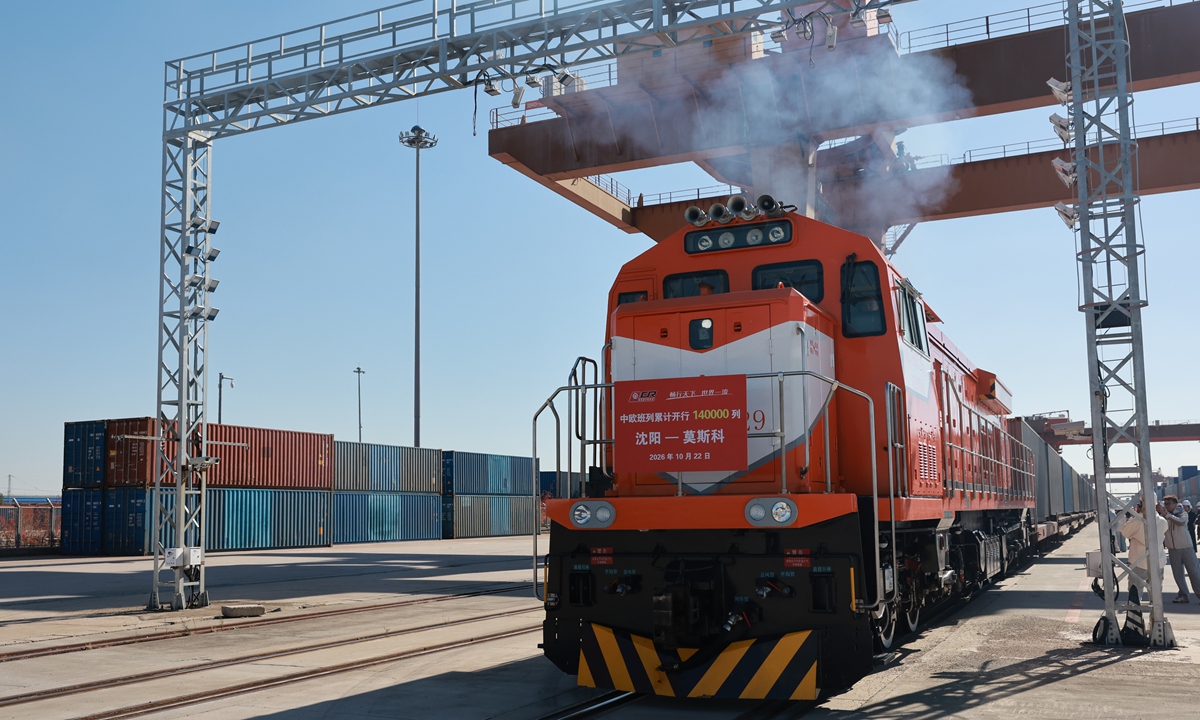
The X8059 China-Europe freight train bound for Moscow, Russia, departs from Puhe Station in Shenyang, Northeast China's Liaoning Province on October 22, 2026. Photo: VCG
China-Europe freight trains maintained a 100 percent loaded-container rate for 50 consecutive months through October, carrying loaded containers in both directions, an official from China's National Development and Reform Commission (NDRC) said on Wednesday. A Chinese expert said the near-equal number of outbound and return trains shows that China's import demand is as active as its export trade along the corridor. The ability to sustain cargo flows both ways gives Chinese exporters a reliable route to overseas customers and foreign suppliers a stable channel into the Chinese market, a strength for China's foreign trade amid global uncertainty.
In the first 10 months of 2026, the network operated 18,661 trains and carried 1.865 million twenty-foot equivalent units (TEUs), up 14.6 percent and 11.2 percent year-on-year, respectively, Liang Linchong, an NDRC official said on Wednesday during a press conference. Of those services, 9,301 ran from China to Europe and 9,360 made the return trip.
Bian Yongzu, executive deputy editor-in-chief of Modernization of Management magazine, told the Global Times that in the early years of the service, operators could find cargo more readily for trains bound for Europe than for those returning to China. With more freight on the return leg, operators can make better use of capacity in both directions and spread round-trip costs across more shipments, he said.
"As transport costs come down, more customers are likely to choose the China-Europe freight trains," Bian said. Higher freight volumes can in turn help bring costs down further, he added.
Li Yong, a senior research fellow at the China Association of International Trade, described the steady two-way flows as a sign of "trade trust." Regular return services reflect Chinese companies' sustained demand for imported goods, he told the Global Times. For foreign businesses, that trust rests on the stability of the Chinese market and the reliability of Chinese manufacturing, he said.
Against the backdrop of China-Europe trade frictions, Li said steady cargo flows in both directions reflect continued demand from businesses on both sides, though trade barriers remain a source of uncertainty.
Li pointed to the ninth China International Import Expo as another sign of overseas businesses' confidence in the Chinese market. The expo, which closed in Shanghai on Tuesday, recorded $85.45 billion in tentative deals on a one-year basis, up 2.3 percent from the previous edition and a record high, Xinhua News Agency reported.
The NDRC said 22 trains now run each week on end-to-end timetables linking nine Chinese cities with six European cities. The services have fixed train numbers, routes, operating days and transit times. For Chinese companies negotiating contracts with European customers, knowing when a shipment is due to arrive makes it easier to agree on a delivery date and work backward to decide when to buy materials and start production, Bian said.
"With a clearer delivery date, companies can plan production shifts and inventory more precisely," Bian said, adding that firms can shorten the time goods spend in storage and improve their chances of delivering on schedule.
Bian said predictable transit times also matter when sea routes face disruptions. He pointed to security risks around the Red Sea, which have led some shipping companies to divert vessels around the Cape of Good Hope, adding time and cost to voyages. For businesses with tight delivery windows, scheduled rail services offer another option, he said.
The network has operated more than 140,000 trains since its inception and reaches 237 cities in 26 European countries, according to the NDRC. Liang cited Spanish wine and Dutch cheese available to Chinese shoppers through platforms linked to the service, as well as Chinese-made smart appliances and household goods sold to European consumers.
China's imports from Belt and Road partner countries rose 17.9 percent in the first three quarters, 1.3 percentage points faster than exports to those markets, the commission said. Trade with partner countries has accounted for more than half of China's total goods trade since 2024. China has signed Belt and Road cooperation documents with more than 150 countries and more than 30 international organizations.
Growth in cross-border shipments was also evident at other gateways. Exports processed through the customs cross-border e-commerce platform at the Zhuhai road port of the Hong Kong-Zhuhai-Macao Bridge reached 112 billion yuan in the first 10 months, up 33.1 percent year-on-year and already above the full-year total for 2025, CCTV News reported, citing customs data.
For the 2026-30 period, Liang said the NDRC will work with countries along the rail routes to improve coordination and facilitate customs clearance. The commission also plans to develop new routes that combine rail with road, sea and air transport.
"More predictable deliveries can bring Chinese companies and their European customers closer together, which can help deepen economic cooperation between China and Europe," Bian said.
RELATED ARTICLES