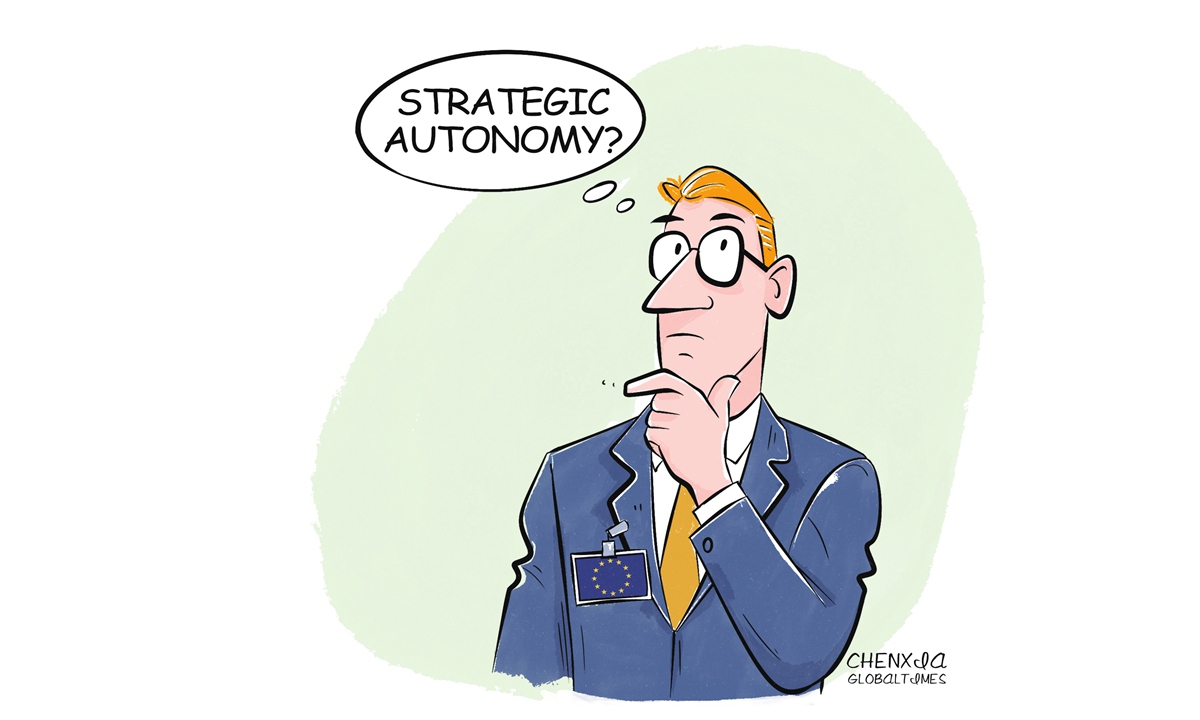
Europe strategic autonomy Illustration: Chen Xia/GT
A new round of trilateral talks involving Russia, the US and Ukraine began Tuesday in Abu Dhabi, the capital of the United Arab Emirates, which has once again placed Europe in an awkward position. European politicians have insisted that Europeans would participate in talks. However, the Russian side said that Europe has no formal role in the talks. According to reports, European representatives only held meetings on the sidelines and did not actually join the "trilateral talks."
The Ukraine conflict has dragged on for nearly five years, and Europe's stated strategic objectives remain elusive.
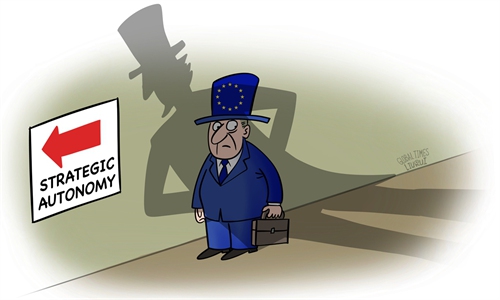
Europe's urgency to secure a seat at the table stems from its anxiety over the shift in US diplomatic strategy and approach. Since the outbreak of the Ukraine conflict, the EU has sought to strengthen strategic coordination with Washington through alliance management, keeping the US and NATO on a trajectory of prolonged confrontation and attrition with Russia. The Joe Biden administration likewise used Europe to reinforce its broader global strategic posture. However, during his second term, US President Donald Trump has pursued great-power diplomacy, including direct engagement between the US and Russian leaders, in an effort to secure strategic gains and extricate Washington from the costs of the conflict.
From Europe's perspective, Washington's near withdrawal from direct financial and military assistance to Ukraine, its use of the Starshield satellite network as leverage over Kiev, and its diesel deal with Russia all point toward what Europe sees as a "policy of appeasement," one that undermines its strategic interests. Against this backdrop, Europe's pursuit for participating in the negotiations is intended both to preserve channels for involvement, information and coordination, and to maintain its role as Ukraine's backer, thereby sustaining its strategy of pressure on Russia.
The EU remains caught between holding out for a future victory and cutting its losses before it is too late. Europe has now replaced the US as Ukraine's principal external supporter in the conflict. Since 2022, the EU and its member states have provided approximately 231.5 billion euros ($258.2 billion) in support of Ukraine, and arranged 90 billion euros ($100.3 billion) in loans for 2026-27. Yet the continued increase in financial commitments has not automatically translated into greater European influence over the peace process. Instead, it has intensified the EU's own fiscal pressures and constrained its economic development.
Despite the difficulties, most European countries continue to view support for Ukraine as a means of countering Russia and as a prerequisite for their future security. They are unwilling to let the enormous costs already incurred go to waste. In addition, the prospect of a "blue wave" in the US midterm elections, along with expectations that the Democrats may eventually retake the White House and resume support for Ukraine, has revived European hopes for Washington's return to a policy of aiding Ukraine and containing Russia.
It is foreseeable that, regardless of whether Europe participates substantively in the current talks, the Ukraine conflict and the underlying issues driving it will remain difficult to resolve, leaving the pursuit of peace fraught with uncertainty. Europe still has a number of limited levers to influence the course of events, including attempts to seize Russia's frozen assets and deepen military cooperation with Ukraine. But such moves would only add fuel to the fire and risk pushing the already volatile situation in an even more dangerous and uncontrollable direction.
For Europe, the real question is how to play a constructive role in safeguarding its own security, coordinating regional interests and shaping a peaceful regional order. Unless Europe can translate its growing security responsibilities into an independent capacity for strategic action, it will continue to watch other major powers determine the security order in its own neighborhood, while being left to bear the consequences.
The author is an associate research fellow at the Academy of International and Regional Studies of Beijing Language and Culture University. opinion@globaltimes.com.cn
RELATED ARTICLES